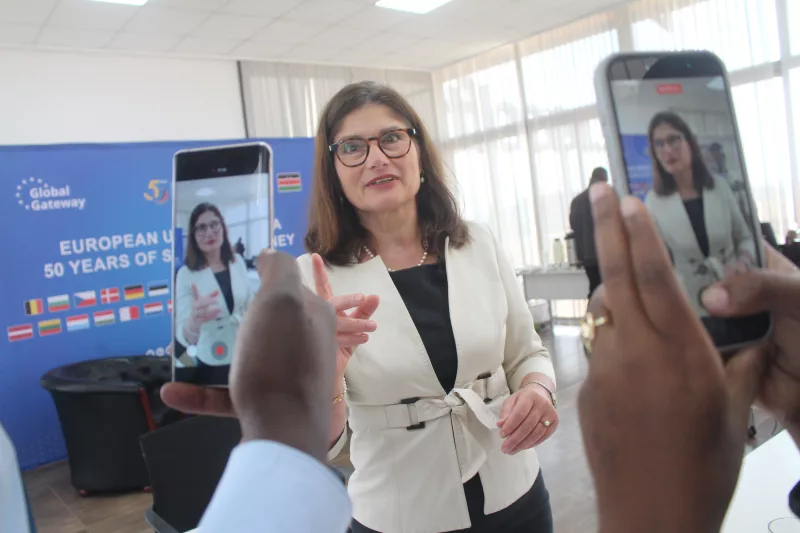
Corruption remains the single biggest obstacle preventing Kenya from fully realising its economic potential, outgoing European Union Ambassador to Kenya Henriette Geiger has said.
In a candid assessment of Kenya's governance after completing a five-year diplomatic tour, Geiger described corruption as the country's "Achilles heel", warning that it continues to undermine economic gains and public confidence.
"What is the big Achilles’ heel of Kenya is corruption," Geiger said in interview, even as she acknowledged progress in fiscal management and the country's growing international influence.
"There has been a little bit here, a little bit there, but everybody says corruption has reached unprecedented levels. A government and a country cannot prosper like that."
Using a household analogy, Geiger said corruption steadily drains national resources.
"If your family has a pot of food and everybody just goes into the pot and eats, and nobody puts anything in, the pot will be empty," she said.
"It also cannot be that only a few put in and everybody else takes out. That sort of balance has not been achieved."
The veteran diplomat said Kenya requires "a real reset" in the fight against corruption, insisting responsibility lies not only with political leaders but also with society as a whole.
"The solution is that the whole of Kenya says, 'Enough is enough. We cannot continue like that.' People must realise, 'I'm also part of the problem, and I have to work on the solution.'"
She also called for tougher penalties against public officials found guilty of corruption, arguing that weak enforcement has allowed graft to flourish.
"For me, the first thing that needs to happen is to make it very risky to engage in corruption," she said.
"Many people think they can get away with it. The risk of being caught is low, whereas the benefits are great. You have to reverse that."
She said officials caught engaging in corruption should face immediate removal from office, lose their titles and privileges, and be subjected to criminal proceedings.
"If that dynamic continues, we will not see a change," she warned. "You can have the best economy, but if it's bleeding like that, nobody can survive a thing like that."
Her remarks come as Kenya continues to grapple with public concern over graft and disbursement of millions in harambees and empowerment forums amid fiscal pressures, issues that also featured prominently during the Gen Z-led protests.
While critical of the country's corruption record, the envoy offered a measured assessment of President William Ruto's administration, crediting it with raising Kenya's international profile.
She also acknowledged the government’s efforts towards fiscal consolidation after inheriting a difficult economic situation.
Geiger, who arrived in Kenya during the final year of former President Uhuru Kenyatta's administration, said she had initially expected the new government to shift its focus towards domestic and regional affairs.
Instead, she said, Kenya had expanded its global engagement.
"I thought maybe there would be a big change, that the new government would focus more on national or regional issues. But, to my big surprise, the new government even put it to a completely new level in terms of putting Kenya on the international map and becoming relevant."
She cited Kenya's participation in the G7 outreach process, its international climate diplomacy and its growing role within the United Nations system as examples of that increased visibility.
The outgoing ambassador also defended the government's efforts to stabilise the economy, saying many observers underestimate the scale of the financial challenge it inherited.
"This government inherited basically empty coffers and a huge mountain of debt," she said.
According to Geiger, any administration would have struggled to reconcile the high public expectations created during election campaigns with the country's constrained fiscal position.
"You can speak to any macroeconomist and they will say that there has been a prudent course, even though we are not where we should be and there's still a bit of muddling through. But the tendency is good."
She said Kenya was moving towards better fiscal management and debt consolidation, but argued those gains would remain fragile unless corruption is tackled decisively.
Geiger, who has served as the EU's Ambassador to Kenya since 2021, is concluding her diplomatic posting after overseeing one of the bloc's most active periods of engagement with Kenya, spanning governance, trade, climate action, gender equality and the EU's Global Gateway investment programme.