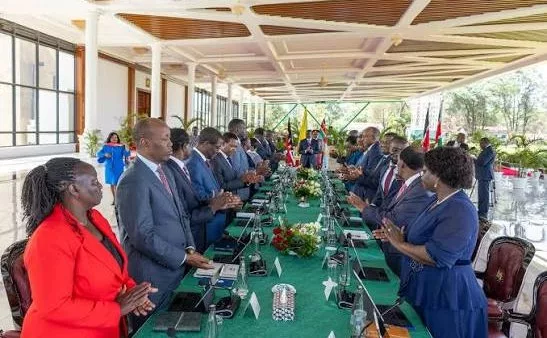
The recent High Court case (search for [2026] KEHC 9465) – usually mentioned as being about the Cabinet and the two-thirds gender rule - is interesting for other reasons. Actually the gender issue was straightforward.
The court split 2:1 over two issues. Here I analyse those issues and the judges’ reasoning. I hope to come back to the issues on which they agreed in the near future.
The case
It was all about the Cabinet appointed by the President (after approval by the National Assembly) in 2024 after he had sacked almost the whole Cabinet, then appointed a new one in which quite a lot from the old one reappeared.
One question that divided the court was whether - having been sacked by the President - individuals could again be appointed to the Cabinet. The other was whether appointing members of ODM as Cabinet Secretaries without there being any formal coalition between the parties was constitutional. In other words – was the “broad-based government” constitutional?
The government raised a number of, mostly very familiar, objections. Was it right to include the President as a party? Does the constitution allow the courts to interfere in decisions of this sort (or was it a violation of the separation of powers)? Had the petitioners adequately proved what articles of the constitution had been violated? Government tends to trot out the same arguments in many cases, though generally they have been adequately dealt with in previous cases.
Could the people sacked be again appointed?
Basically the majority (Justices Ogola and Githinji) said “No problem” while Justice Ngaah said “No”- in the circumstances of this case.
It is true that sometimes people who are sacked cannot hold public office again (Article 75(3)). This of course is an issue for ex-Deputy President Gachagua. He does not, he says, want the job back. But he wants to get an order that he ought not to have been sacked.
Justice Ngaah said CSs can’t be sacked without reason. My personal strong sense is that the judge was wrong on this. Generally, if, under the constitution, a person may be dismissed, there is an elaborate process and a set of grounds. None are stated for the powers of the President to dismiss CSs, the Attorney-General, Secretary to the Cabinet and PSs, whereas there are for dismissing the Inspector-Generl of Police.
This is an arguable issue, and if it should come before the courts in a future case it would deserve a more detailed analysis than Justice Ngaah’s short, unreasoned statement. Interestingly it has been discussed, even - inconclusively - taken to court, in South Africa. Prof Pierre de Vos has said “I … wonder whether it is ever a good idea to approach a court to deal with issues like this. … the appointment and firing of Cabinet ministers are profoundly political. Fighting about political disagreements in court usually just postpone the inevitable as the President will always be able to have a ‘do-over’ to get his or her way.”
There is always a reason, even if simply that the President no longer feels able to work with that person, or needs to appoint someone from another community to strengthen political support. Surely a court cannot be expected to interrogate the reasons.
Back to Justice Ngaah: he quotes from the President’s stated reasons for dismissing the CSs, which amount, he says, to saying that they were “below par”. The actual words included: “Upon reflection, listening keenly to what the people of Kenya have said and after a holistic appraisal of the performance of my Cabinet and its achievements and challenges, I have …decided to dismiss with immediate effect all the Cabinet Secretaries and the Attorney-General.”
What was the President doing? He did not say what any individual had done. They had no opportunity to defend themselves. My sense is that he was taking the opportunity to make a big gesture of supporting Gen Z. Then to get rid of CSs he would rather not work with, take back the ones he was happy with, and replace the others. Also, of course, subtly suggesting that any fault was that of the CSs rather than himself.
The idea that someone who has been dismissed as CS by the President is debarred from holding future office because of some vague statement by the President about the reason for the dismissal is, with respect, little short of ridiculous. Quite rightly the majority judges said, “the President would possess unilateral power to impose a serious constitutional disability upon a citizen without investigation, hearing, parliamentary scrutiny or judicial determination.”
Even if Justice Ngaah was right so far, what disqualifies a person from public office? The majority examined Article 75(3) carefully. It says they must have been dismissed for certain very specific types of wrongdoing – none of which comes within the category of inefficiency which seems to be what the President hinted was the reason (or excuse) for their dismissal.
Maybe the President was inconsistent, but the majority observed, “political inconsistency and constitutional invalidity are not synonymous”.
Is the broad-based government constitutional?
Here I have some sympathy with Justice Ngaah’s position. He saw this appointing of non-Kenya Kwanza members as undermining multi-party government, observing, “the quest for multi-party democracy was a major driving force for the constitutional reforms that culminated in the Constitution of Kenya, 2010.”
The majority insisted that there is no recognition of an “opposition” in the constitution. This ignores two elements of the constitution neither of which any of the judges mentioned. One is the assumption that there is a “minority” with a leader in the National Assembly (though of course the majority in that body might be not of the president’s party) (Article 108).
The second is that any MP who leaves the party for which they are elected loses their seat (Article 103(1)(e)). The main evil against which that was directed was precisely that of members on the opposite side to the President being enticed to change loyalties. There was also the element of not betraying the people who voted for the candidates from a particular party. And one reason for limiting the number of CSs was to limit the power of the President to offer that sort of benefit for a change of loyalty. These provisions originated in a parliamentary system draft and are more suited to that. But they are still in the constitution.
The majority perhaps underplayed this aspect a bit. They said, “The majority also said that “the existence of political parties that support and oppose the Government is a natural and desirable feature of democratic governance. However, it does not follow that every political reality becomes a constitutional institution.”
However, this does not mean that Justice Ngaah was right to say that appointing a CS from any party other than that of the President unless the parties were in formal coalition is constitutionally impossible. He said that “the only means through which the ruling party can work with the opposition parties is through the legal framework provided under the Political Parties Act”. But that Act does not say that. And it is not the constitution where the word “coalition” does not appear.
The majority judges said that the constitution does not limit whom the President may appoint.
A footnote: under the Act, a party member who “promotes the ideology, interests or policies of another political party” is deemed to have resigned from their party (unless the parties have merged or are in coalition). So one might say that the ODM appointees of Ruto are no longer members of ODM. However, that section implies that it is for the political party to initiate the “deeming”. But the ODM is not about to do that.
Jill is a retired
law teacher and
member of the
Katiba Institute
Board. The author writes
in her personal
capacity