As well as a vision of a new Kenya - a truly democratic Kenya with accountability as a key value - the constitution also has a vision of a new sort of relationship between men and women, andtheir relationships with children. That is a relationship of equality, respect and responsibility.What has it achieved?
Marriage
Before the constitution, marriage of children was common, particularly customary law marriages.Under Islamic law there is no rigid rule but generally people could marry once they reachedpuberty. The Kenyan law on Hindu marriage said that the male must be at least 18 and thefemale at least 16.No Act regulated customary law. But under Article 45 Parliament must pass laws recognisingmarriages under any tradition, or system of religious, personal or family law. Parliament did morethan that because it changed the various systems in different ways. It also recognised thepolygamous nature of customary and Islamic law.
The constitution made it clear that the preferred minimum age of marriage was 18 when it saysevery adult has the “right to marry”. But it did not of itself ban younger marriage.A judge was wrong to say that the constitution itself “outlaws” marriage below age 18. Severalpeople had been prosecuted in 2011 under the Children Act 2001 for “subjecting a child to earlymarriage”. The Council of Imams and Preachers challenged this, including on the basis of theright to religion. However, while everyone - and not just government - must respectconstitutional rights, they may be limited or interfered with by law and for a good reason. Onthat basis, the judge also held, any right to religion could be limited in the interests of children.
Now the 2014 Marriage Act says no one under 18 may marry - applying to all types of marriage.It makes any marriage of anyone under 18 “void” - no marriage. And if any sort of marriage isnot registered, it is “voidable” - it can be declared invalid. However, it not clear how such adecision would be made.
Realistically many child marriages still take place, by one estimate about 13 per cent of marriages,and many customary marriages must be unregistered. I worry a bit whether there might benegative effects of being told you were not married though you thought you were - maybe interms of the status of a child, or inheritance of property.
We come we stay “marriages” - prolonged cohabitation - are common in Kenya. But the law, in the court cases, is if anything becoming more confused. The Supreme Court has said, “It is timefor the National Assembly and the Senate, in collaboration with the Attorney General toformulate and enact statute law that deals with cohabitees in long-term relationships; their rights,and obligations.”
Children
Article 53 on the rights of children says that children have the right to parental protection ¾whether the parents are married to each other or not. Courts have used this to insist thatseparated parents should both take some responsibility for child maintenance if they can affordit.
The Article also says, “A child’s best interests are of paramount importance in every matterconcerning the child.” This language was incorporated into the new Children Act in 2022, andhas been used to make decisions including about child custody between divorced or separatedparents. Notably courts have sometimes departed from past assumptions, such as that youngchildren should necessarily be with their mother.
Property
Relevant constitution provisions include Article 68 that says law must “regulate the recognitionand protection of matrimonial property and in particular the matrimonial home during and onthe termination of marriage”.
There is general prohibition of discriminatory treatment on the basis of factors including sex,pregnancy or marital status (Article 27). A more specific provision is in Article 60(1)(f) on theland policy principle: “elimination of gender discrimination in law, customs and practices relatedto land and property in land”.
The Matrimonial Property Act (passed to implement the constitution) protects the matrimonialhome in several ways, including requiring a court order for one spouse to evict the other,requiring the consent of both to the mortgage of the home and the possibility of registering one’sinterest as a spouse in the land registry to alert possible purchasers.
Many cases, some before 2010, have held that women, even if married, are entitled to inheritfrom their parents, despite customary law rules. In 2023, Justice Anthony Mrima said, “With thepromulgation of the Constitution 2010, particularly Article 27 … the time has now come forthose discriminative cultural practices against women be buried in history.”
A controversial recent case held that children born to Muslims but whose parents were notmarried were not excluded from inheriting from their father. The Supreme Court said, “All laws,including religious or customary law, must be interpreted and applied through the lens of the Billof Rights.” The court was not prevented from deciding this by Article 24(4) that excludes equality challenges in the Kadhi courts. The case had begun in the High Court.
There have been many cases about what happens to property on divorce. Some have arguedclaims that Article 45 on “Family” which recognises parties to a marriage as “entitled to equalrights at the time of the marriage, during the marriage and at the dissolution of the marriage”means that property must be shared equally.
However, in 2023 the Supreme Court held that the right approach was “considering therespective contribution of each party to ensure no party is unfairly denied what they deserve aswell as ensuring that no party is unfairly given more than what he or she contributed.”Contribution, courts say, is not just financial. How far this applies to cohabitation is an aspect ofthe confusion mentioned earlier.
Divorce
A man married under Muslim laws may divorce his wife by formal pronouncement (Talaq) - apossibility protected from being declared unconstitutional by Article 24(4). However, animportant contribution especially for women, including those seeking divorce, has been theconstitution’s recognition of Kadhi courts, and their extension across the country.
One Abdulkadir Hashim wrote in 2024 that many kadhis are progressive in their approach inprotecting the rights of women. What he calls “neo-kadhis” are “influenced by contemporaryMuslim legal opinions and conventional legal trends and constitutional instruments such as theConstitution of Kenya”.
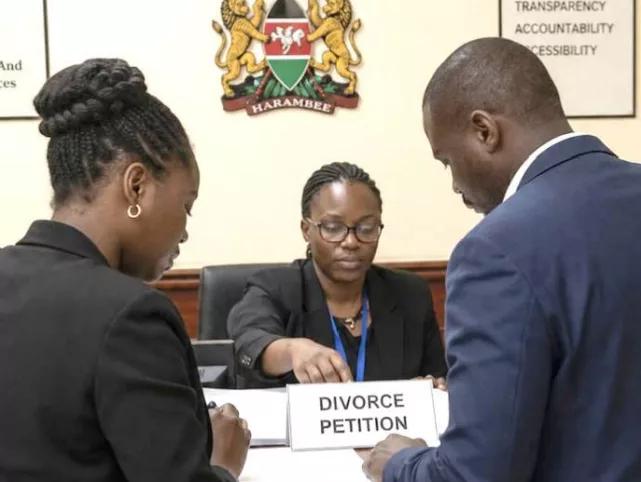
A Kenyan court recently rejected a petition seeking to get no fault divorce recognised. So, to bedivorced from a civil, Christian or Hindu marriage it is still necessary to prove something specific,rather than saying that both parties want to divorce (although a two-year agreed separation is sufficientfor some).
However, courts have made the ending of marriages a bit easier. The requirement that a petitionto annul a marriage be brought within one year after marriage was declared unconstitutional - interfering with the rights to equality, freedom of conscience and access to courts.And the Court of Appeal held that it was wrong to require everyone with grounds for divorce towait until they had been married for three years before they could start divorce proceedings.
They wanted Parliament to change the law to allow for exceptions where necessary. This nothaving happened by mid-2025, the three-year waiting period no longer is law.Finally: the right to be free from violence from any source (Article 29) has not led to declaringunconstitutional the Sexual Offences Act Section 43(5) that protects husbands from liability forraping their wives. Ironically that Act assumes that intercourse involving a wife is necessarilywelcome, while with someone under 18 it is forced. (I note, however, that a recent High Courtcase held that the Director of Public Prosecutions should not assume the latter and should not prosecute inthe case of genuinely consensual acts between adolescents.)
Jill is a retired law teacher and member of the Katiba Institute Board. The author writes in her personal capacity