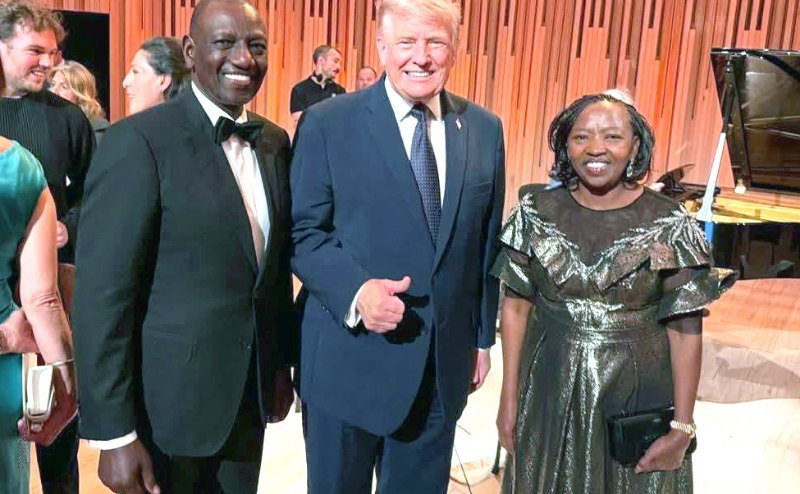
 President William Ruto, US President Donald Trump and First Lady Rachel Ruto at La Source Vive, for a musical performance for the Heads of Delegation and their spouses attending the G7+ Summit at the Évian Resort
Since taking over the reins of power in late 2022, President William Ruto has set himself the focus of discharging his diplomatic responsibilities with unprecedented enthusiasm.
As the chief public relations officer of the country, Ruto has come out as the most active and strategic in the country’s history. He has provided personal leadership to the government’s international relations efforts with such resolve as never witnessed before.
He has deftly explained that the nation’s foreign policy is neither east nor west but dynamic. President Ruto's official response is that Kenya is neither looking to the West nor the East, but is strictly "facing forward".
His administration maintains an independent, non-aligned foreign policy aimed at securing maximum economic opportunities, purposeful cooperation and investments, regardless of the global bloc offering them.
In pursuing pragmatic economics over geopolitics, the government's approach is driven by domestic development goals such as climate financing and market access rather than Cold War-style geopolitical alignments.
The Ministry of Foreign and Diaspora Affairs directs this strategy to adapt to evolving global dynamics, prioritising pragmatic, mutually beneficial international partnerships over rigid alliances.
The policy offers strategic flexibility and allows the country to engage with competing powers, such as both the United States and China, to leverage trade agreements and position Nairobi as a diplomatic bridge.
The President has visited over 40 countries since taking office, making dozens of international trips to anchor Kenya as a global diplomatic and economic hub.
These travels have proved to be core to his mandate, since they are strategic engagements designed to secure jobs, foreign direct investment and trade opportunities.
He secured a landmark state visit to the United States of America, resulting in major technology collaborations with the Silicon Valley, a Sh900 billion health partnership to combat HIV/AIDS, and the designation of Kenya as a major non-NATO ally.
Significantly, over 20 trade and infrastructure agreements targeting investments in the agricultural and manufacturing sectors were signed when he visited China.
In Europe, he secured investments in Kenya's blue economy, signed green energy agreements and established bilateral labour migration frameworks. In the same region, he represented the African continent to advocate for global financial reforms and easier credit access for African nations.
The country has negotiated labour pacts aiming for over 300,000 job opportunities for Kenyans with the Saudi Arabia and other Gulf states.
While at the local regional front, the President has pushed for the lowering of cross-border tariff barriers, boosted intra-African trade, Uganda, Tanzania, Ethiopia and Angola. At the same time, he has strengthened Kenya’s mediation role in regional peace and security initiatives.
Increasingly, Nairobi has assumed a position of high value strategic interest in the region. While Kenya has played a key role in international relations within the region before, her position has been greatly enhanced by the active presence of President Ruto on the international stage.
The UN recently declared, that the offices in Gigiri will be upgraded to incorporate more agencies including the General Assembly. Indeed, the ground-breaking ceremony was officiated by the Secretary General Antonio Gueteress and witnessed by other world leaders including the French president Emmanuel Macron.
The President's recent travels signal a shift in Kenya's foreign policy, with diplomacy increasingly being used as a tool for economic growth, market expansion and job creation.
Kenya has therefore, strategically enhanced its geopolitical standing through a multi-alliance foreign policy that eschews bloc alignment, the centralisation of digital and climate diplomacy, and decisive leadership in critical regional and global security missions.
Nairobi continues to cement its status as a premier global diplomatic hub (the UN's headquarters in Africa) by aggressively championing reforms in global financial systems and leading Africa's advocacy for the African Continental Free Trade Area (AfCFTA).
Africa is becoming an increasingly important force in shaping the future global order. Kenya in particular is emerging as a key hub for diplomacy and cooperation in Africa and the Global South.
The emergence of middle powers, China's growing influence and the relative decline of Western dominance have accelerated the shift toward a multipolar world, where power is distributed among several major actors rather than concentrated in a few capitals. The transatlantic world order as we once knew it is fading.
The dominance of the dollar is being challenged, and the era of unquestioned power is slowly coming to an end. As power shifts and a new world order takes shape, Kenya faces a choice; to react to events shaped elsewhere or to help shape the emerging order itself.
Through the vision of Ruto, Kenya is leading Africa into playing central roles and no longer peripheral actors in global affairs. Kenya’s enhanced diplomatic activities benefit Africa by elevating the continent's bargaining power on the global stage, driving regional economic integration, spearheading climate resilience initiatives, and mediating peace efforts.
By hosting major international summits and advocating for global financial reform, Kenya acts as a critical gateway for African development. The government has successfully led the continent's unified voice on climate governance, as highlighted by its hosting of the Africa Climate Summit and the Global Center on Adaptation Africa regional headquarters.
This ensures Africa secures necessary green investment, technology and carbon credit funding.
President Ruto is proving to be one of Kenya’s most forward-looking and globally connected leaders. Through massive infrastructure deals, Kenya is positioning itself as East Africa’s transport and trade powerhouse.
In May 2026, he brought together a galaxy of continental leaders to Nairobi. Beyond the deals, the summit was a major diplomatic scoop for Kenya.
Bringing nearly all African presidents and leaders to Nairobi alongside France has elevated Kenya’s status as a continental diplomatic hub and gateway between Africa and Europe.
At a time when global powers are competing for influence in Africa, Nairobi is increasingly becoming the room where major conversations on trade, climate, security and investment are happening and that signals growing confidence in Ruto’s regional and international leadership.
The invitation from French President Emmanuel Macron to attend and participate in the G7 Summit is more than protocol. It is political signalling.
It reflects a widening belief among Western capitals that Kenya is a stable, pragmatic and strategically useful partner in an increasingly fractured world order.
The symbolism is unmistakable. Kenya is no longer speaking from the margins.
It is speaking from the centre. It marks a sharp elevation in Kenya’s diplomatic standing. One African leader. One African voice. A crowded table of global power.
Political and Policy Analyst