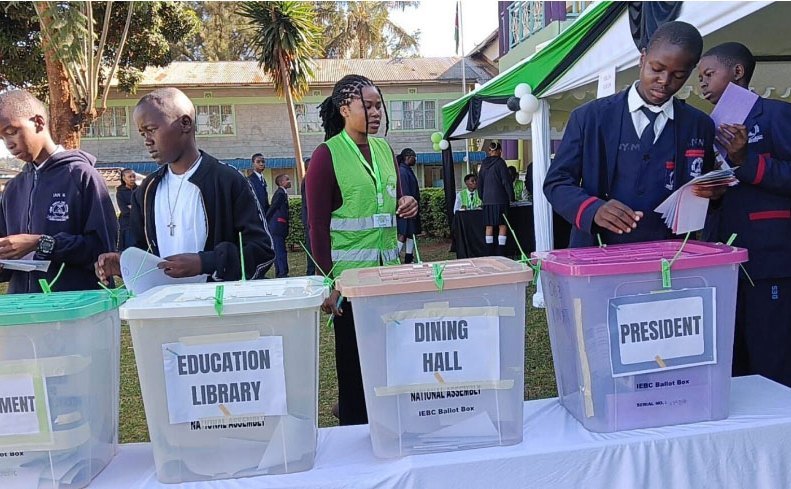
 Tenri School students participate in the elections /Courtesy
I am not sure at what point the students’ elections at the Tenri School in Embu became a national sensation, but as soon as the campaigns went viral online, Kenyan social media users were glued to the events like they would a popular soap opera.
And the school’s marketing and social media pages didn’t disappoint, providing daily doses of young political intrigues that made Kenyans see themselves in the children.
I doubt if the school’s director and management actually set
out to have the students’ campaigns and elections become such a national
fixture. But once the students upped the stakes with brilliant campaigns and
vote-hunting methods that nearly mirrored the country’s general elections, we
were always going to be invested one way or another.
You have to admire the level of marketing involved in all
this. Because in the weeks and months that the students’ campaigns carried on,
everyone discovered the previously unknown school in Embu, with well-groomed
learners and seemingly easy-going environment for young Kenyans, who seemed to
enjoy expressing themselves and announcing their future ambitions openly.
Indeed, the staff members behind the campaign never shied away from letting the children declare their role models on the national political sphere, regardless of the perceived divide.
Additionally, the election was conducted by the Independent Electoral and Boundaries Commission, which in this case and in a rare show of credibility, conducted a process where there were few complaints and even fewer threats for demonstrations and court action.
The only part that the country couldn’t understand was where the public
was allowed to engage in online voting for the candidates, a process that had
no bearing in the final outcome.
It was the similarities with a general election scenario
that must have captivated Kenyans more. There were four candidates. There was
the incumbent seeking re-election and prone to giving handouts, with a “make a
queue” order for handing out goodies. Then there was the populist one rumoured
to be a goon master, whose campaign elicited an element of fear within the
electorate, and was complete with street lingo to go with it.
The third was a stylish girl with a touch of arrogance, confident in her abilities and well informed on national events. The fourth, the ultimate winner, was a fiercely intelligent and bubbly girl, who, despite seeming like the underdog from mere media views, ran a powerful grassroots network, which quietly won hearts without being loud.
As if to crown it all, she stated during an interview that
she admired and intended to adopt the confidence and resilience of Suba North
MP, Millie Odhiambo, who is widely popular among the women and young girls in
the country.
After Sally Mwende won, the first interesting thing was the number of senior politicians, especially female ones, who sent congratulatory messages to the Grade 8 pupil.
Success does have relatives, as they say, but the consensus was that a
respectful and non-abrasive campaign is the preference of most Kenyans, even
though our general elections don’t quite show that verdict in the results.
Additionally, the voters at Tenri School proved another point. That neither the money nor the goons ultimately give you victory in elections conducted via secret ballot.
In a season where goons have become a
permanent fixture in Kenyan politics, the message was key to the upcoming adult
campaign season. Of course, there never really were goons in the school
version, but it seems the scrip writer cleverly intended to package each
candidate uniquely for the show.
Beyond just the emerging goon culture, there is the
dangerous money philosophy that has taken control of our politics. Wherever you
go these days, and unlike the period between the restoration of multiparty
democracy and at least until the 2007 electoral cycle, when youths seemed to
align politically based on real preference, these days, politicians mobilise
and indoctrinate the electorate using money.
The script folks at Tenri allocated this role to the incumbent students’ president, whose campaign speeches ended with an order to his audience to form a queue to receive goodies.
It was hilarious, even though the
adult version of the practice, currently the fad in national politics, is
helping spur the rise of criminal networks within the legislative arm of
government, with many unsavoury characters buying their way into leadership.
The learners in Embu apparently decided to shun the
moneybags too, confining him to the tail end of the polls, a lesson from
children to adults in the country that we can all “eat” from the bottomless pit
of cash provided by politicians, while making our own informed decision on the
type of leadership we want and need in attempting to sustain democracy and good
governance.
I know this story wouldn’t be complete without touching on the “social media is not a polling station” refrain that follows the announcement of results, whenever a candidate who had appeared very popular on online chatter doesn’t quite perform as well in the election.
This was the case
when former Gatanga MP Peter Kenneth who ran for president in 2013. Hugely
popular within Kenya’s social media scene and apparently carrying the
detribalised tag that the nation yearned for so much, the final tally placed
Kenneth among the also-runs, with not much to show for the online frenzy
accompanying his campaign.
Well, the online sensation from Tenri School did much better than Kenneth in terms of voter support, clocking a respectable second, but commentators still couldn’t miss this dig at him about online popularity and reality at the ballot.
Appearing in campaigns complete with a hype man and
perceived kingmaker who seemed more popular than even the candidates, the
runners-up built up such popularity within the adult Kenyan population, which
ended up believing that Allan Njue would win the election with a landslide. It
was hilarious reading the comments after the results were declared, with
Kenyan-style threats to convene demos and file a petition at the Supreme Court.
There are many ways in which the country saw itself, or at least its electoral desires, in the entire drama from Embu. The first was the desire to have the IEBC conduct credible and transparent elections.
When not
being pushed or being influenced by interested parties, the electoral agency
can and indeed does conduct elections in a manner that restores confidence in
the nation’s democracy. And the 2027 general elections call for even more
vigilance and competence on their part.
The second ambition that Tenri School managed to showcase is the ability to look past the money and the threats and actually pick the best candidate on offer.
Sally Mwende’s victory almost united the country in
acknowledging that regardless of earlier forecasts and hype built around certain
contestants, the right candidate emerged victorious. The circumstances
surrounding this kind of victory are important for any strategists trying to
win the 2027 elections against the established order.
Finally, the campaigns were a lesson in humility, harmony, friendship and good neighbourliness. All four candidates professed friendship with each other and carried out campaigns that were respectful and friendly.
One could say that this is easy among children, where cut-throat competition for power and state resources exists in a manner not possible in that young age, but still, we must admit that it is possible to achieve.
I am persuaded
that we can borrow many aspects of our own campaigns from the pupils at Tenri
School Embu for our own 2027 elections. I am also sure many other schools will
try to replicate the amazing vibe that the Embu school has created across the
nation, but it won’t be the same!
Political commentator