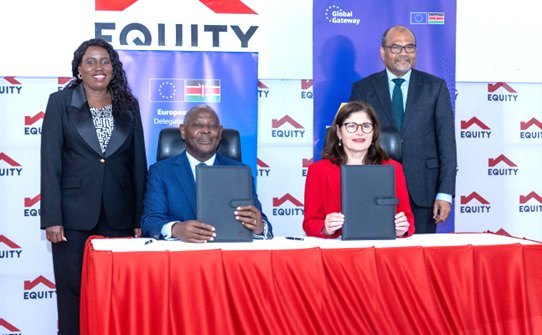
 Equity Group Foundation Executive chairman and group managing director and CEO, DrJames Mwangi, and the European Union Ambassador to Kenya, H.E. Henriette Geiger. Standing Left to Right: Principal Secretary for the State Department for Higher Education and Research, DrBeatrice Inyangala and Principal Secretary for the State Department for Science, Research and Innovation, Prof Shaukat Abdulrazak /Handout
Kenya's recent diplomatic successes extend beyond trade and politics to the realm of people-to-people partnerships. These collaborations tell the story of a powerful and enduring truth, that definitely no investment delivers greater returns than investing in people and their potential.
Last Thursday, was one of those scores where Kenya witnessed more than the signing of a partnership agreement.
The just signed collaboration between the European Union Delegation to Kenya and Equity Group Foundation on human capital development is a powerful statement about the future of Kenya's greatest asset: its people, especially the ever growing ready youth.
By ready, meaning, Kenyan youth that have completed mandatory basic education are ready to scale to academic heights.
This signed partnership aims to create pathways for 100 top-performing scholars annually to pursue university studies in European universities, the initiative just confirmed a very simple but transformative truth, that nations can only prosper when they mostly invest in human capital.
So what is human capital development? Human capital development is the concept behind the process of improving people's knowledge, skills, competencies, health, and abilities to enhance their productivity, employability and contribution to society.
A true noble concept in getting nations to higher statuses in development. Education, further higher education, is one of the central pillars of human capital development because it equips individuals with the knowledge and critical thinking skills needed to innovate and compete in a global economy.
For the European Union, supporting education partnerships will help strengthen international cooperation, talent mobility, innovation and people-to-people ties between Africa and Europe for the present and the future.
Equity Group Foundation can also maximise this opportunity by expanding the already existing global exposure they offer for scholars by now continuously building and expanding into international European networks through collaborations, and nurturing, especially return scholars, capable of driving sustainable development in Africa.
For decades, Kenya has invested heavily in expanding access to higher education through the establishment of new public and private universities, while also strengthening Technical and Vocational Education and Training (TVET) institutions across the country.
These investments have yielded significant gains in enrolment, skills development and the creation of a more educated workforce, positioning human capital as a key driver of the country's social and economic transformation.
Kenya's higher education sector has also expanded significantly over the past two decades, with tertiary enrolment, according to UNESCO rising from about four per cent in 2009 to over 10 per cent, of the relevant age group, in 2024.
However access alone is not really enough. The Kenyan government has the task of ensuring that talented young people can convert academic potential into opportunities that prepare them to thrive in an increasingly interconnected world.
This is where initiatives such as the Equity Leaders Program and Erasmus+ can become particularly significant. Preparing those that are ready to thrive and taking them to the next level.
To strengthen such opportunities the government needs to also consider introducing a county-based higher education promotion kind of initiative to bring such partnership opportunities closer to communities, increase awareness, promote inclusion and ensure talented students access higher education regardless of location.
The EU-Equity partnership recognises that education today extends beyond classroom learning. This partnership encompasses exposure to diverse cultures, participation in global research networks, acquisition of advanced skills and the development of leadership capabilities, and the capabilities that such exposure can bring to the Kenyan youth.
By enabling Kenyan scholars to study in Europe, the programme will not only benefit individual students but also contribute to strengthening Kenya's knowledge economy.
Importantly, the initiative demonstrates that opportunity is most effective when it meets preparedness. Kenya is fortunate to have a growing pool of talented and ambitious young people.
Through programmes such as Wings to Fly, Elimu Scholarships and the Equity Leaders Program, thousands of students have already been equipped with the academic foundations, mentorship and practical experience needed to compete globally.
The new partnership builds on this preparation by opening doors that many deserving students may otherwise never access. Moreover, beyond this new EU collaboration, Equity Group Foundation has previously partnered with Germany’s KfW Development Bank to support hundreds of Wings to Fly scholarships, demonstrating its track record in advancing education and human capital development.
However, scholarships and international exchange programmes alone cannot solve all human capital development needs. It is the duty of our country and its leaders to continue investing in its local universities, research institutions, innovation ecosystems and employment opportunities that allow returning graduates to apply their knowledge effectively. Global exposure should thus only complement, rather than replace, efforts to strengthen domestic institutions.
The event last week brought together distinguished leaders, including the EU Ambassador to Kenya H.E Henriette Geiger, Principal Secretary for Higher Education and Research Beatrice Inyangala, Principal Secretary for Science, Research and Innovation Prof Shaukat Abdulrazak, Equity Group managing director and CEO James Mwangi, European ambassadors and senior Equity executives, among other invited guests.
Vera writes on African youth, democracy, higher education and development