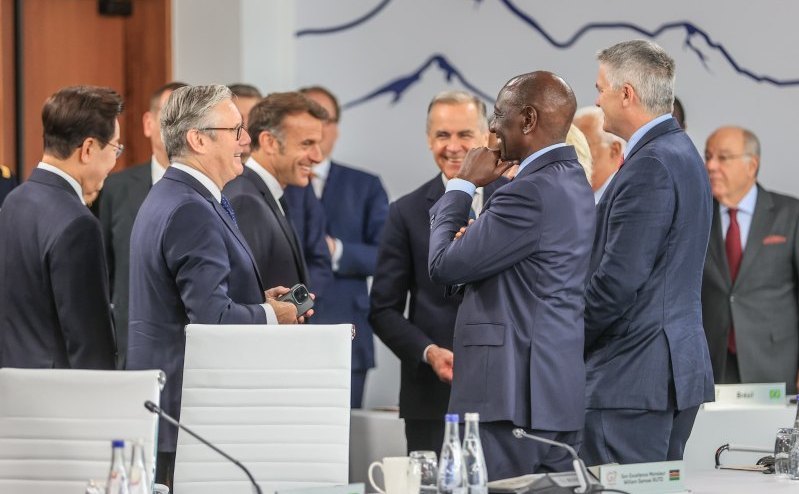
 President William Ruto and other leaders/FILE
President William Ruto's participation in a second consecutive G7 Summit, coupled with a string of high-level bilateral engagements, has entrenched Kenya as one of Africa's most influential diplomatic voices on the international stage.
At the three-day summit in Évian, France, Ruto joined leaders of the world's leading economies and held talks with key global heavyweights.
These included Indian Prime Minister Narendra Modi, German Chancellor Friedrich Merz, Ukrainian President Volodymyr Zelensky, European Commission President Ursula von der Leyen and World Bank Group president Ajay Banga.
The invitation and the engagements highlight Kenya's growing relevance in discussions on trade, development financing, climate action, digital transformation, food security and reforms to the international governance system.
More significantly, Ruto was accorded a central role during the G7+ working session on "Fostering New Partnerships and Rebuilding International Solidarity," where he delivered the lead intervention on behalf of Africa.
His message reflected a broader shift in how African nations seek to engage the world.
Speaking on behalf of Africa, Ruto called for a new paradigm in global relations—"one grounded not in hierarchy, but in sovereign equality; not in aid alone, but in mutual benefit and shared prosperity”.
"Africa seeks neither dependency nor patronage. We seek partnership. Not as beneficiaries, but as equals. Not as spectators, but as co-authors of a shared future."
He also sustained his criticism of the international financial framework, saying African nations borrow at rates far above their peers.
“Where the fundamentals are equal, the price we pay is not. Too often, risk is measured by assumptions the facts no longer support. The result is plain. Opportunity goes unfunded. Growth is deferred,” he said.
It is against this backdrop that the President urged the G7 to stand behind African institutions through guarantees and other risk-sharing instruments.
“We have identified existing institutions, including the African Trade and Investment Development Insurance (ATIDI), that can deploy this support effectively,” Ruto said.
The remarks underscore Kenya's growing role in advocating for reforms to the global order and amplifying African perspectives in international decision-making forums, particularly following the Africa-Forward Summit in Nairobi.
At the inaugural summit in an Anglophone state, African leaders called on Nairobi, alongside France, to convey the continent’s concerns raised at the Africa-France Summit to the G7.
“We call on France, together with Kenya, which is associated with the G7, to convey this important concern of the African continent to the Summit in Evian in June 2026,” African Heads of State and Government said in the Call to Action statement.
Diplomatic observers say the invitation to the G7 Summit — and a third for Kenya — signals increasing recognition of the country as a strategic partner and a credible interlocutor between Africa and major global powers.
International law expert and foreign policy analyst Evans Ogada notes that the President is Kenya's lead diplomat and the country must remain actively engaged on the international stage.
However, he notes, concerns are growing over the frequency of the trips.
“These travels are being undertaken against the backdrop of serious domestic challenges, including high taxation, the rising cost of living, budgetary pressures and shortages in essential services.
Further, he noted, Kenya must in an increasingly multipolar world, balance its relations with both Western powers and emerging global players such as China, Russia, Turkey and India.
Unlike previous eras when African participation in such forums was largely centred on aid and development assistance, Kenya's engagements in Évian reflected a broader agenda focused on investment, trade, technology, security and global governance reforms.
Among the key bilateral meetings was Ruto's discussion with Modi, where the two leaders reaffirmed their commitment to strengthening ties between Nairobi and New Delhi.
The leaders pledged to deepen cooperation and continue working together in multilateral forums to advance the interests of the Global South, including inclusive growth, sustainable development and a more equitable international order.
India has increasingly viewed Kenya as a strategic gateway to East Africa, while Nairobi has sought to leverage relations with New Delhi in areas such as trade, technology, pharmaceuticals and education.
Ruto also held talks with Merz, focusing on expanding cooperation in trade and investment, renewable energy, agriculture, digital transformation and support for micro, small and medium enterprises.
The leaders also reviewed progress under the Kenya-Germany labour mobility agreement, which has opened employment opportunities for Kenyan professionals in Europe.
Germany remains one of Kenya's most important European economic partners and a key supporter of the country's green industrialisation and energy transition agenda.
The President's meeting with Ukrainian leader Zelensky highlighted Kenya's growing role in discussions around global peace and food security.
Ruto reiterated Kenya's support for efforts to achieve a peaceful resolution to the Russia-Ukraine conflict through dialogue, diplomacy and adherence to the principles of the UN Charter.
The two leaders also reviewed progress in bilateral relations and agreed to accelerate plans for establishing a grain hub at the Port of Mombasa.
The proposed facility is expected to strengthen regional food security and improve the supply of grain and agricultural commodities across East Africa.
However, other diplomatic observers warn that Kenya risks being painted as a Western puppet and selling out in Africa.
Dr Kenneth Ombongi, Associate Dean, Faculty of Arts, at the University of Nairobi notes that it is important for the Ruto administration to distinguish between diplomatic visibility and strategic effectiveness.
“The number of journeys matters less. The number of outcomes
translated into jobs infrastructure, tech and economic transformation is
extremely useful”.
“The criticism around the situation that the President is in, is about whether the financial cost of his trips are proportionate to the dire situation here locally,” Ombongi noted.
Lawyer Ogada also cautioned that Kenya could be attracting negative image on the continent.
"Why is Kenya, for example, at the G7? Because South Africa was sacrificed. Why was South Africa sacrificed? Because South Africa dared to take some people to the ICJ. And so we are, in effect, dancing on the blood of a fellow African country," he said.
INSTANT ANALYSIS
President William Ruto's participation in a second consecutive G7 Summit in France reinforced Kenya's growing status as a key African voice in global affairs. Speaking on behalf of Africa, Ruto called for equitable partnerships, reforms to the international financial system and greater support for African institutions. His bilateral meetings with leaders from India, Germany, Ukraine, the EU and the World Bank underscored Kenya's expanding diplomatic influence.