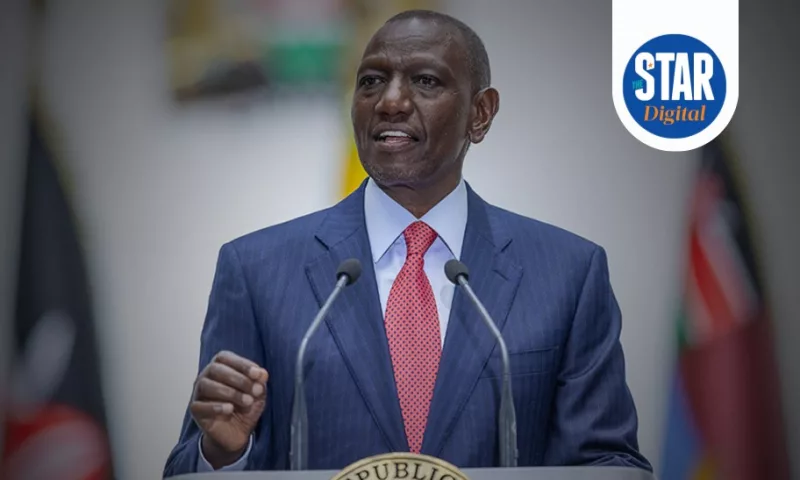
 National Treasury Cabinet Secretary John Mbadi /HANDOUT
National Treasury CS John Mbadi disclosed to senators that only 20 of the country's 47 counties have embraced the Electronic Government Procurement (e-GP) system.
This is despite extensive training of procurement officers, contractors and suppliers.
The revelation prompted senators to question whether counties are carrying out procurement for critical development projects and service delivery.
This came amid fears that stalled adoption of the digital platform could be slowing down implementation of county programmes.
Mbadi spoke when he appeared before the Senate plenary on Wednesday.
The counties that have adopted the platform include Kisumu, Siaya, Murang'a, Uasin Gishu, Vihiga, Baringo, Busia, Nandi, Bomet and Samburu.
Others are Migori, Homa Bay, Trans Nzoia, Lamu, Elgeyo Marakwet, Tharaka Nithi, Kakamega, West Pokot, Machakos and Kajiado.
"The rest, which are not here, did not have any contract in the system," Mbadi told the House, triggering concern among lawmakers over the status of procurement and development projects in the remaining counties.
Deputy Speaker Kathuri Murungi led senators in questioning how counties that have not migrated to the system are managing to undertake development projects and acquire essential goods and services.
"If the utilisation of this system is not even 30 per cent by our counties, then how do you expect development to go on? They are not procuring," Murungi said.
His concerns were echoed by Migori Senator Eddy Oketch, who sought clarification on how county governments continue operating, particularly when critical services require constant procurement.
"Governors who appear before the County Public Investments Committee say they are not able to procure because the system is not working. How then are they surviving, especially when essential services are required?" Oketch posed.
Mbadi, however, dismissed claims the system was malfunctioning and instead accused some county governments of deliberately resisting its implementation.
"There is no reason why counties should not use this system because the stability of the system has been guaranteed. We have trained contractors and suppliers," the CS said.
He said the Treasury had provided room for counties to use alternative procurement methods only in emergencies or where essential services such as healthcare and education could be disrupted.
The Treasury officially launched the e-GP system on April 7, 2025, and directed all public procuring entities to conduct procurement processes through the platform from July 1, 2025.
Mbadi told senators the system is anchored in Article 227 of the constitution, which requires public procurement to be fair, equitable, transparent, competitive and cost-effective.
He said the platform automates procurement processes from tender advertisement and bid submission to evaluation and contract awards, significantly reducing human interaction that has traditionally been associated with corruption, favouritism and solicitation of bribes.
"The system minimises human interaction, which traditionally has been a major source of corruption, favoritism and solicitation of facilitation fees," Mbadi said.
He said the platform is built on the Open Contracting Data Standard, allowing procurement information to be published for public scrutiny and enabling oversight institutions, suppliers and citizens to track tenders from submission to award.
According to data presented to the Senate, 1,540 public procuring entities had been registered and onboarded onto the platform by March 5, 2026.
Out of these, 640 entities had already published their consolidated annual procurement plans through the system.
Further, 684 procuring entities had published contracts worth about Sh3.78 billion through the portal.
However, Mbadi acknowledged that it was still too early to determine actual financial savings realised through the platform since implementation remains at an early stage.
"There is no verified figure for total savings realised from the e-GP rollout yet, as the system is in the initial phase of take-off," he said.
Nevertheless, he maintained that the platform is expected to generate significant savings once fully implemented across government.
"I call upon this honourable House to support this critical public finance management reform which upon maturity is expected to give value for money and secure savings of up to Sh85 billion," Mbadi said.
To support implementation, the Treasury has deployed 269 trainers of trainers to assist procurement officers across both levels of government.
More than 2,000 procurement officers have already undergone hands-on training, while another 15,000 are participating in virtual training sessions.
The government has also established a help desk at KISM Towers in Nairobi and partnered with the Kenya School of Government to train public finance management officers and other stakeholders countrywide.
Weekly webinars for suppliers and contractors are also being conducted, while support centres have been established in Huduma Centres across the country to facilitate registration and onboarding.
Mbadi further disclosed that the platform is being integrated with other government systems, including IFMIS, KRA iTax, the Business Registration Service and population registries to enhance verification and strengthen accountability.
He said the digital procurement platform forms part of the government's broader Digital Superhighway Agenda aimed at moving 80 per cent of public services online.
The Senate's concerns now place pressure on county governments yet to adopt the system, with lawmakers warning that failure to embrace the platform could undermine transparency, accountability and the pace of development projects at the devolved level.
INSTANT ANALYSIS
The Senate debate exposes a major gap in the implementation of Kenya's e-procurement reforms, with 27 counties yet to adopt a system designed to enhance transparency and curb corruption. Senators fear the low uptake could be slowing development projects and service delivery. Treasury CS John Mbadi's accusation that governors are deliberately resisting the platform points to deeper governance and accountability challenges. Full adoption could significantly reduce procurement irregularities and save taxpayers up to Sh85 billion.