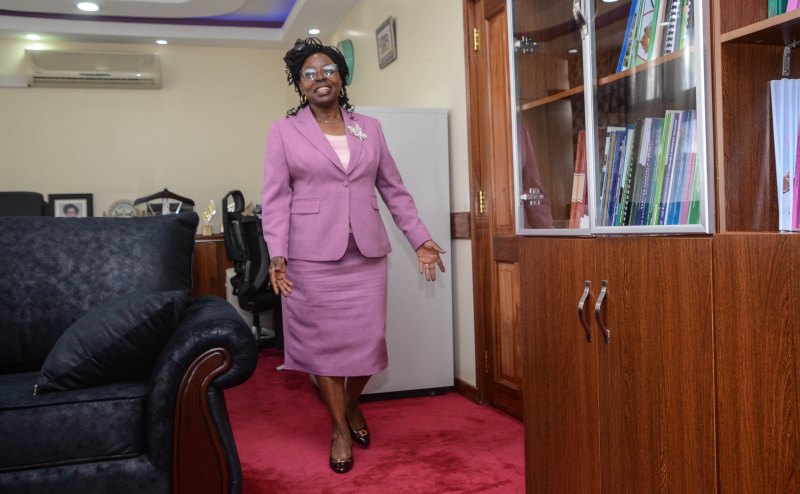
 Controller of Budget Margaret Nyakang'o during a past interview.
The government's Eurobond buyback programme is not solving the country’s debt problem and instead is only pushing the pain to another day, Controller of Budget Margaret Nyakang'o has warned.
In a new report, Nyakang'o says that while the strategy has given temporary relief from looming debt payments, it risks becoming an expensive debt-swapping exercise.
She says the government is essentially replacing old loans with new ones rather than reducing what the country owes.
The report, which reviews the first nine months of the 2025-26 financial year, says this approach comes with long-term risks including higher costs for servicing debt and continued exposure to foreign exchange shocks.
By the end of March, Kenya's public debt had climbed to Sh12.82 trillion, up from Sh11.8 trillion in June 2025. The increase was mainly driven by domestic borrowing, even as the government took steps to manage its liabilities.
"Kenya's foreign bond buybacks are a tactical measure, not a permanent solution. They provide short-term fiscal space and reassure investors, but they do not reduce the country's overall debt stock in the long run," Nyakango says.
The warning comes at a time when the National Treasury, led by Cabinet Secretary John Mbadi, has signalled it may return to international capital markets for fresh borrowing in the coming financial year.
Between March 2025 and February 2026, the government repurchased three Eurobonds at a total cost of Sh222.7 billion.
The transactions included buybacks worth Sh78.3 billion in March 2025, Sh86.3 billion in October 2025, and Sh58.1 billion in February 2026.
The Treasury has argued that this move helped reduce refinancing risks by retiring part of the country's 2028 Eurobond obligations.
It also extended repayment schedules to 2032 and 2037, giving the government more time to pay.
However, Nyakang'o notes that the buybacks came at a price. The government incurred approximately Sh6.1 billion in premium payments and accrued interest while executing the transactions.
Even more worrying, she questions where the money came from. The government issued fresh Eurobonds worth Sh195.5 billion in seven-year and 12-year tranches at an average yield of 8.7 per cent.
"This essentially implies that Kenya swapped the old debt for the new rather than reducing the overall debt stock," the report states.
As of March 2026, domestic debt stood at Sh7.14 trillion while external debt reached Sh5.68 trillion.
Treasury bonds alone increased by Sh688.2 billion during the nine-month period, rising from Sh5.11 trillion in June 2025 to Sh5.8 trillion in March 2026.
Treasury bills also increased by Sh155.5 billion to Sh1.19 trillion.
The report shows that the government spent Sh1.35 trillion on debt repayments in the first nine months of the financial year.
Of this amount, Sh763.2 billion went to domestic debt servicing while Sh588.9 billion was spent on external obligations.
External debt payments included Sh419.7 billion in principal repayments and Sh166.6 billion in interest costs.
This massive spending on debt leaves less money for development projects.
The concerns come hot on the heels of recent revelations by MPs that part of the government's external borrowing is now being used to finance day-to-day operations rather than development projects.
MPs warned that debt servicing is consuming an ever-larger share of government revenue and squeezing funds available for investment and service delivery.
In its review of the 2026/27 budget estimates, the National Assembly's Public Debt and Privatisation Committee said commercial loans contracted under liability management operations are not being used exclusively to retire existing debt.
Instead, lawmakers noted that some of the proceeds are channelled through the Consolidated Fund and used to finance the broader budget deficit and approved government expenditures.
"A portion of the proceeds is used to finance the overall budget deficit and support approved government expenditures through the Consolidated Fund," the committee said.
The MPs further expressed concern that commercial loans obtained on potentially costly terms are not ring-fenced for specific projects.
"Although these are commercial loans, they are not ring-fenced for specific projects but are pooled within the Consolidated Fund for general budget financing, even where they may be obtained on potentially unfavourable terms," the committee noted.
The assertions lend weight to Nyakang'o's observation that recent Eurobond buybacks have largely involved replacing maturing debt with new obligations, raising questions about the long-term sustainability of Kenya's debt strategy.
The report flags growing exposure to currency fluctuations, especially the Kenya Shilling against the US Dollar.
About 52 per cent of external debt is denominated in US dollars, leaving the country vulnerable if the shilling weakens.
"With 52 per cent of Kenya's debt denominated in US dollars, any depreciation of the shilling between 2026 and 2028 may erode the actual benefits realised from the extended seven- and 12-year debt maturities," Nyakang'o warns.
She cautions that relying on international capital markets ties the country's fiscal health to global financial conditions beyond its control.
If global interest rates rise or liquidity tightens, the borrowing costs could increase significantly.
The International Monetary Fund projects that Kenya's debt-to-GDP ratio will rise further to 71.6 per cent in 2026 and 72.4 per cent in 2027. This is approaching the record 73.4 per cent reached in 2023.
Nyakang'o argues that the solution lies not in repeated refinancing operations but in deeper fiscal reforms.
She recommends stronger revenue collection through an expanded tax base and improved compliance, tighter controls on government spending, and reduction of fiscal deficits that force the government to borrow.
She also calls for more selective bond buybacks, diversification of financing sources, development of domestic capital markets, accumulation of foreign exchange reserves, and greater transparency in debt management.
"Eurobond buybacks are a double-edged sword," Nyakang'o says. "They can stabilise the debt trajectory by smoothing maturities and lowering refinancing risks, if used wisely. However, they entail the risk of costly stopgap measures if relied upon without addressing underlying fiscal imbalances."
Experts agree that while buybacks may buy the country some time, they do not solve Kenya's debt problem entirely. Treasury's borrowing plans is likely to come under scrutiny following the current year's Sh1.1 trillion deficit.
MPs described the deficit as the highest ever projected at the start of any financial year. “This indicates a continued expansionary fiscal policy stance and points to sustained growth in the public debt stock,” the debt committee said.
INSTANT ANALYSIS
For the budget boss, the challenge has merely been pushed further into the future. Without serious reforms in how the government collects revenue and spends money, Kenya risks falling deeper into a debt trap that will hurt ordinary citizens the most. The government’s way out is to find lasting solutions rather than quick fixes that only postpone the inevitable day of reckoning.