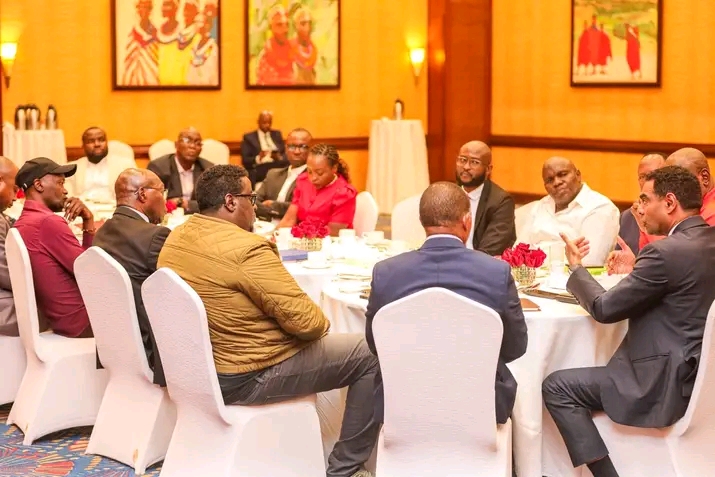
 FKF president Hussein Mohamed addresses club representatives at a Nairobi hotel/HANDOUT
 Kenyan football is standing at a very important moment, one that could completely change how the game is run for many years to come.
Plans are now in motion to move the FKF Premier League into the control of an independent body, starting from the 2026/27 season. If this plan succeeds, it will mark one of the biggest and most important changes in the history of football in Kenya.
This idea has not come out of nowhere. It has been discussed and shaped through several meetings between Football Kenya Federation (FKF) leaders and the 20 clubs that compete in the Premier League. During these discussions, the clubs made their position very clear.
They feel the league needs to be managed in a more professional way, with better systems, clearer decisions, and stronger accountability for everyone involved.
To make this transition possible, a special group known as the Transition League Management Committee (TLMC) will be formed to take temporary control of the league. This committee will bring together different stakeholders, including club representatives, FKF officials, broadcasters such as Azam TV, and commercial partners like SportPesa.
The idea is to ensure that all key voices are involved so that no single group dominates the process, and so that the transition is smooth and stable.
The role of this committee will not just be to keep the league running, but also to lay down the foundation for a fully independent structure that can operate on its own in the future. This includes setting up systems that are transparent, fair, and designed to support the long-term growth of the game.
One of the main reasons behind this push for independence is the issue of money and transparency. For a long time, clubs have raised concerns about how revenue from broadcasting rights, sponsorship deals, and other league income is shared.
Many clubs believe the current system does not give them enough clarity or fairness, and this has created frustration and mistrust over time.
Another major reason is the need for growth and development. Modern football is no longer just about what happens on the pitch during the 90 minutes of a match.
Today, football is also a business that depends heavily on media coverage, sponsorships, branding, and fan engagement.
An independent league structure would allow the competition to operate more like a business, making it easier to attract investors, negotiate better deals, and improve the overall value of the league.
Stability is also a very important factor in this discussion. In the past, changes in leadership and administration have often led to changes in direction, which have slowed down progress and affected long-term planning.
With an independent structure, the league would be able to plan further into the future without being heavily affected by short-term political or administrative changes. Even with all these changes, it is important to understand that the league will not operate outside the rules of football.
It will remain under the broader governance of FKF and will fully comply with FIFA and CAF regulations. This ensures that Kenyan football remains part of the global football system and continues to follow international standards.
However, even with this positive direction, there are still real questions that need to be answered. Running a football league is a very serious responsibility that requires strong leadership, financial discipline, transparency, and trust among all stakeholders. Without these key elements, independence alone will not automatically solve the existing problems.
Fans also play a very important role in this conversation. They are no longer just spectators; they are active consumers of the game who expect quality football, well-organised fixtures, reliable broadcasting, and fair competition. An independent league, if well managed, could help meet these expectations more effectively and improve the overall experience of following Kenyan football.
Broadcast partners such as Azam TV will also be central to this new structure. Strong broadcasting deals can increase revenue for clubs, improve match coverage, and help the league reach a wider audience both locally and internationally. This, in turn, raises the profile of Kenyan football and makes it more attractive to sponsors and investors.
In the end, this proposed transition is about much more than just changing who runs the league. It is about building a stronger foundation for the future of Kenyan football, where the game is managed professionally, planned properly, and allowed to grow without constant disruption.
If successfully implemented, this reform could finally help Kenyan football move away from uncertainty and instability and instead begin a new chapter defined by structure, growth, and long-term progress.