
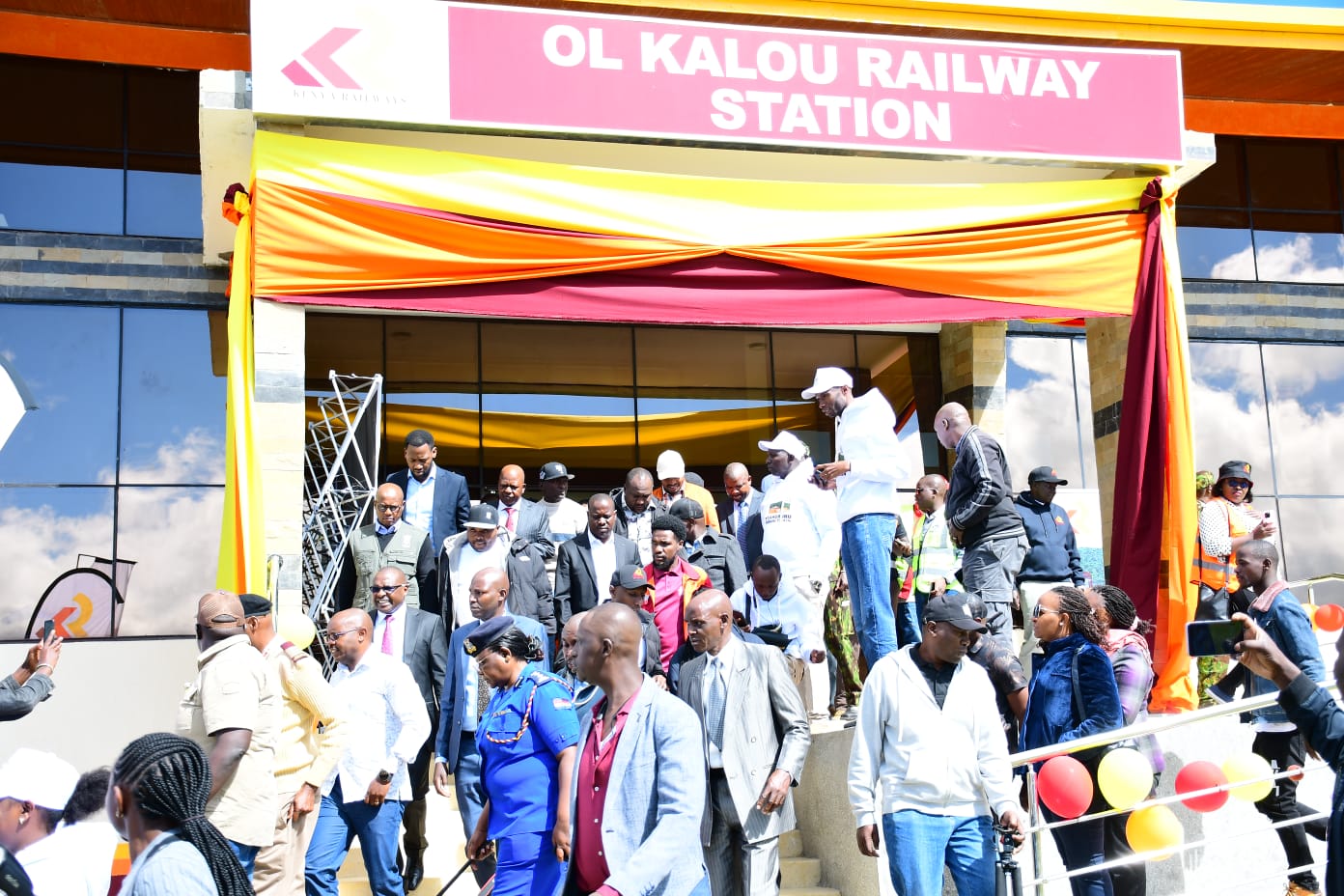
 Dignitaries, railway officials, and local leaders descend the steps of the newly renovated Ol Kalou Railway Station during the historic relaunch of the region's passenger rail services on June 2, 2026/HANDOUT.
AUTHOR and aspiring politician Cathy Insuga described her historic journey as "a safari full of beautiful scenic views and interactive moments with residents, who were happy to see us as they welcomed the train."
Blogger Kasuty Ndiritu documented the entire trip and posted portions of the itinerary for his 280,000 followers on Facebook.
Laikipia Woman Rep Jane Kagiri could not hide her joy. "The Nyahururu-Ol Kalou-Gilgil-Nairobi Safari train is back after 46 years," she said.
Thousands of residents in their 40s have known the railway line for years but had never seen a train running on it.
"Our food will now have a direct market in Nairobi and the whole country. There will be no more excuses for delayed fertiliser delivery," Kagiri said.
The Kenya Railways Corporation on Tuesday last week resumed transport services on the route, popularly known as the Thomson Falls Line, which has been dormant since 1998.
The passenger train leaves Nairobi every Tuesday and Friday at 10 am and makes return journeys from Nyahururu on Wednesdays and Sundays.
Cargo services operate daily. The first cargo freight included 1,000 tonnes of fertiliser.
The railway line covers Nairobi, Kiambu, Nakuru, Nyandarua and Laikipia. It has two new stations at Gilgil and Ol Kalou.
The train will carry about 1,000 passengers per trip. Travellers enjoy low fares of Sh600 (economy, Sh1,300 first class) and those going for shorter distances pay as low as Sh50.
Kenya Railways managing director Philip Mainga described the resumption of services as a game changer for the region.
"Our trains are modern, fast and going all the way to the Central region. They carry their wares and children. They want enough space to put their wares.
"That is what we are there for. That is what we have been doing for the commuters using the Nairobi-Thika-Nanyuki line," he said.
The service will be a major boost for farmers in the agricultural-rich region, many who suffer huge post-harvest losses due to poor roads and high transport costs to markets.
"Some 30 to 60 per cent of the potato crop rots in this area due to bad roads," Mainga said.
The revival of the Nairobi-Nyahururu line, built in 1926, marks a significant milestone in restoring Kenya's transport infrastructure and unlocking economic opportunities across the Central region and beyond.
"Our food will now have a direct market in Nairobi and the whole country. There will be no more excuses for delayed fertiliser delivery."
The railway is expected to enhance the efficient movement of goods and passengers, reduce transportation costs and improve connectivity in the five counties it traverses.
The restored service will provide farmers with a reliable and affordable means of transporting agricultural produce, including potatoes, maize, wheat, dairy produce and horticultural crops, to major markets across the country.
This will help reduce post-harvest losses, improve market access, and increase returns for farmers.
The railway is also expected to stimulate trade and investment by attracting industries, warehouses and logistics services along the corridor.
Businesses will benefit from lower freight costs, while towns such as Gilgil, Ol Kalou and Nyahururu are likely to experience increased commercial activity and urban growth.
In addition, the line will support tourism by improving access to key attractions in the Aberdare ecosystem, Lake Ol Bolossat and the wider Laikipia tourism circuit. "Kenyans really need to go out to enjoy the resources that God has given this country," Mainga said.
The project has created employment opportunities during railway rehabilitation, operations and the growth of related sectors such as transport, hospitality and commerce.
The revival of the railway further contributes to reducing congestion and wear on road networks by shifting part of the freight burden from roads to rail.
This will lower maintenance costs, improve road safety and support environmentally sustainable transport solutions. Trains are safer than highways that witness frequent fatal accidents.
"It's a game changer. What is the role of government in such an investment? Governments are meant to put money in people's pockets. We confirmed from Ol Kalou to Nyahururu banana commuters pay Sh200. Now, they will pay Sh10," Mainga said.
With the revival of the Nairobi-Nyahururu line, Kenya Railways has completed rehabilitation of all the routes of the metre gauge line that had been dormant for many years.
The Nairobi-Thika-Nanyuki line was made operational in 2020, followed by the Nakuru-Kisumu in 2021. The Kisumu-Butere line was also revived.
The revival of the Voi-Taveta-Holili railway line is poised to be one of the most transformative infrastructure projects in the Coast and southern Tanzania economic corridor. Mainga said the project is 80 per cent complete and will be commissioned by April next year.
"Tanzania provides crucial goods for our industries. One of them is clinker from Tanga, Cement and other fresh produce are transported every morning across the border," Mainga said.
"Then we have coal. Moving coal from Tanzania to Kenya is challenging. We move the mineral by water from Mtwapa to Kilifi, and from Kilifi it is transported to the industries in Nairobi.
"You can imagine that route? Once this line opens, the coal going all around will just come straight to Voi and then to Nairobi, cutting the distance by almost 80 per cent."
Taita-Taveta county and agricultural reports indicate that Taveta's irrigated rice sector has expanded significantly, with the county producing about 4,600 of rice per year and targeting 12,000 tonnes annually through irrigation expansion, improved seed varieties and value-addition measures.
Key rice-growing areas in Taveta include Kitovo, Kimorigo, Timbila and Bomeni rice fields. These areas account for the bulk of rice production in the county and are central to ongoing efforts to increase output.
Once the Voi-Taveta-Holili railway line is commissioned, farmers will gain cheaper access to domestic and regional markets for rice and other produce.
The railway will reconnect the historic Mombasa-Voi-Taveta-Moshi-Arusha trade corridor, making it easier and cheaper to move goods from Kenya to Tanzania, Rwanda, Burundi and the wider East African region.
The planned dry port in Voi, together with the railway, will transform Voi into a major logistics and cargo distribution centre linking the Port of Mombasa with the Taveta-Holili border. This will attract warehousing, transport, clearing and forwarding and other support services.
Taita-Taveta county possesses significant deposits of gemstones, industrial minerals and other mining resources.
The railway will provide a cost-effective means of transporting bulk minerals to the Port of Mombasa and export markets.
Moving cargo by rail will reduce pressure on the Mombasa-Nairobi highway and roads leading to Taveta, lowering vehicle operating costs, road maintenance expenditure and travel delays.
Improved accessibility to the Taveta wildlife ecosystems, Lake Jipe and Mount Kilimanjaro will boost domestic and international tourism, especially cross-border tourism packages between Kenya and Tanzania.







