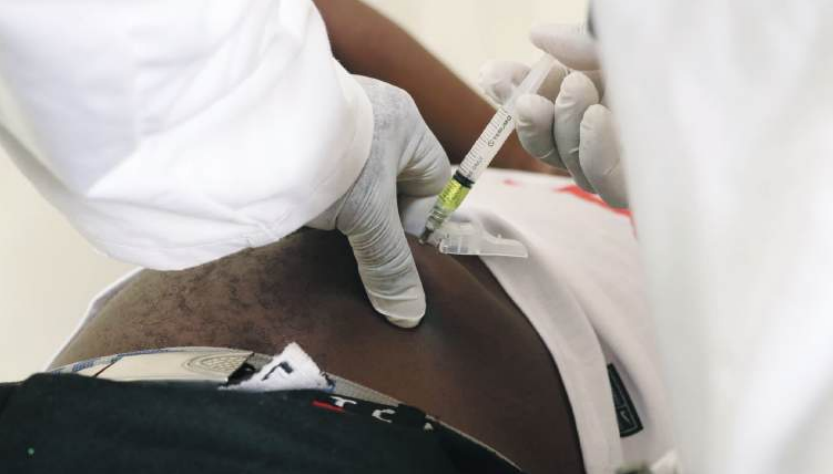
 A man receives Lenacapavir, an anti-HIV injection, during the launch of the long-acting Prep at Riruta health centre in Nairobi on February 26 /LEAH MUKANGAI
The Global Fund, which provides countries with grants for three-year periods, has allocated Kenya US$324.4 million (about Sh41.9 billion) for the 2027-30 utilisation period.
That is down sharply from US$408 million (Sh52.8 billion) allocated during the current 2024-27 grant cycle.
The fund allocates the money it fundraises from governments, private donors and institutions around the world every three years.
However, it raised only US$12.64 billion (Sh1.63 trillion) during its eighth replenishment in December last year against a target of US$18 billion (Sh2.32 trillion).
The shortfall has forced it to reduce allocations to the nearly 120 recipient countries and territories.
Kenya received the letter announcing its allocation on March 13 this year.
Last week, the Ministry of Health, the civil society and the private sector met to draft the funding request needed to access the funds.
The funding request will be submitted to the Global Fund before July 27 this year so that Kenya can receive the first tranche of the funding.
In the March 13 letter, Mark Eldon-Edington, head of the grant management division at the Global Fund, informed Public Health PS Mary Muthoni that Kenya must move towards self-reliance.
“Kenya is encouraged to use the allocation to reinforce the sustainability of lifesaving services and health outcomes. Budgeting of the allocation must be harmonised with other donor funds and aligned to domestic budgets, with progressive domestic uptake of major investment areas currently financed by the Global Fund,” he said.
Kenya’s allocation includes US$206.9 million (Sh26.8 billion) for HIV programmes, US$49.6 million (Sh6.4 billion) for TB and US$67.9 million (Sh8.8 billion) for malaria. The grant utilisation period runs from July 2027 to June 2030, a period known as grant cycle 8 (GC8).
The reduction is expected to increase pressure on the Kenyan government to spend more of its own money on HIV, TB and malaria programmes.
The donor also signalled that the funding will depend on how much Kenya spends from its own budget.
“Fifteen per cent of Kenya’s GC8 allocation will be accessible if Kenya meets the co-financing requirements,” the letter says.
The fund estimated Kenya must commit at least US$658.2 million (Sh85 billion) in domestic co-financing during the 2027-30 cycle (GC8).
It warned that failure to meet these and earlier commitments could trigger funding penalties.
“Failure to realise previous co-financing commitments from GC7 (2024-27) may result in the Global Fund reducing funds from existing grants and/or the GC8 allocation,” the letter states.
The donor also pushed Kenya to integrate the three diseases into ordinary health services.
“Countries are encouraged to consider opportunities for further integration of HIV, TB and malaria responses into primary healthcare services to enhance effectiveness and efficiency,” the letter states.
Kenya was specifically told to intensify efforts against new HIV infections and deaths.
“We recommend that Kenya consider intensifying efforts to reduce the persistently high mother-to-child transmission rate, which remains significantly above the five per cent WHO benchmark,” the letter says.
“Reduce Aids related mortality, which has been stagnant over the past five years, and reduce the disproportionately high new HIV infections among key and vulnerable populations.”
The donor urged Kenya to involve more private hospitals and clinics in finding TB patients who remain undiagnosed.
For malaria, the Global Fund asked Kenya to invest in antimalarial drug resistance surveillance and response strategies.
The Global Fund acknowledged the financial pressure facing donor countries and said some may not fully honour their pledges.
“Should pledge risks require further adjustments to sources of funds, given the current external funding landscape, a portion of the allocation amount may not materialise,” the letter warned.
“The KCM, Principal Recipient(s) and the Global Fund will work together to operationalise any required changes.”
Nelson Otuoma, head of the National Empowerment Network of People Living with HIV and Aids (Nephak), is part of the Kenya Core Writing Team, which is drafting the proposal needed to access the funds.
He told the Star that all countries funded by the Global Fund are facing the same pressure to increase domestic financing.
“For instance, the 15 per cent domestic financing is mandatory for all countries. Kenya is also on a transition out of the Global Fund, which means it must commit more domestic financing to HIV, malaria and TB,” he said.
He said much of the Sh41 billion will go to ARVs, which means Kenya must use its own money for advocacy and HIV prevention.