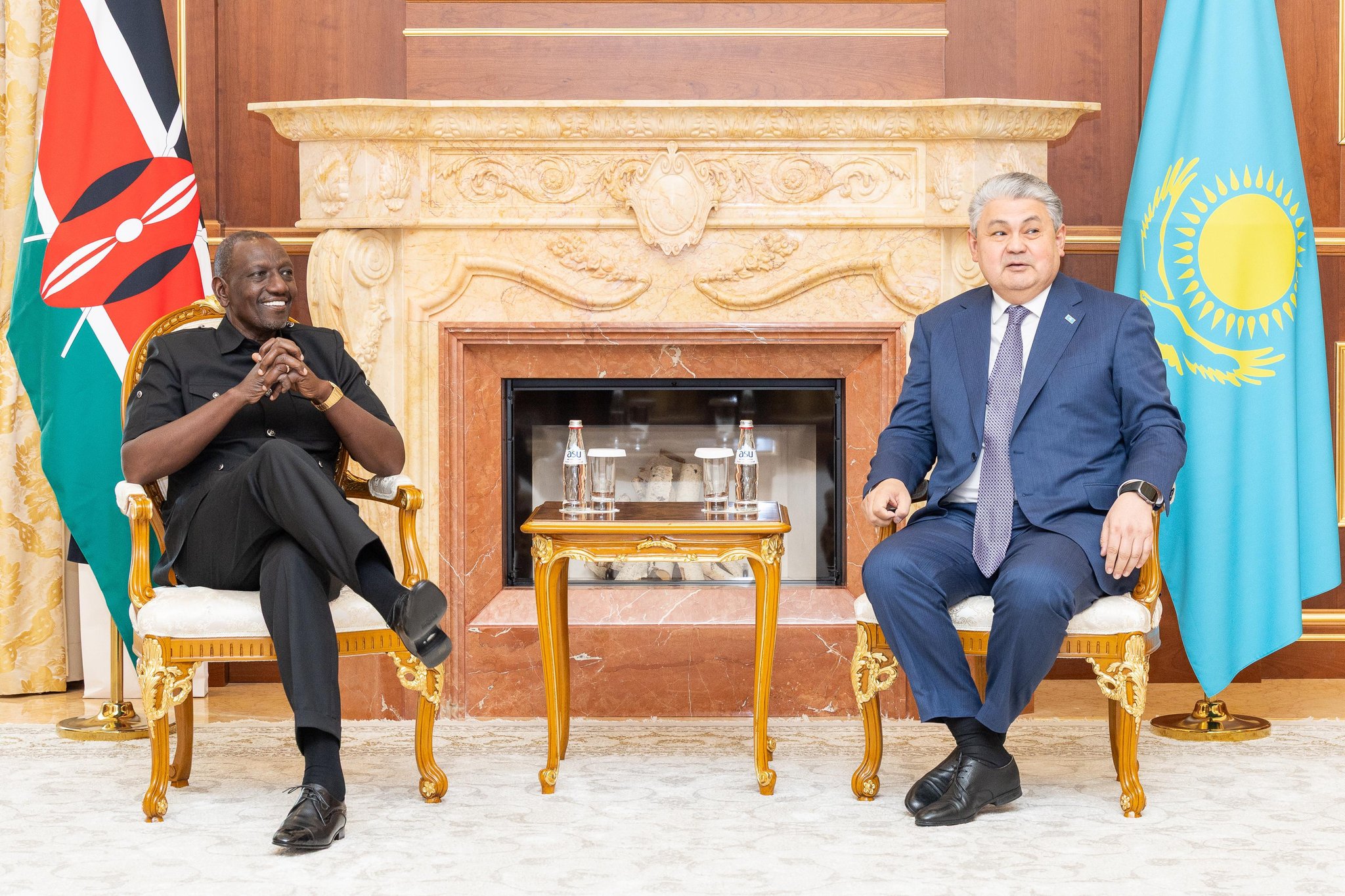
President William Ruto is increasingly pushing Kenya’s diplomatic reach beyond its traditional Western allies, with recent visits to Azerbaijan and Kazakhstan.
The shift has become more visible through his engagements with Azerbaijan and particularly the inaugural state visit to Kazakhstan by a Kenyan leader, alongside diplomatic outreach to Lithuania, Croatia and Czech Republic.
"Kenya and Kazakhstan have been planting seeds of friendship for over a decade through series of deliberate engagements. It is time to take these cordial relations to the next level.
"Our trade ties are already blossoming in tea, flowers, fertilizer, and logistics, with a growing direct connection between Nairobi and Astana, as well as other countries in Central Asia," President Ruto said.
Ruto’s intensified engagements with emerging partners across Central Asia, the Caucasus and Eastern Europe are widely seen as a broader push to diversify economic and geopolitical alliances. This is in line with the President’s Kenya Kwanza Manifesto.
“We will not only deepen our bonds with our long-standing international and bilateral partners, including the US, the EU, the UK, China, and India, but we will also extend our friendship to anyone with whom we believe a mutually beneficial relationship can be formed,” the manifesto said on foreign policy.
It is against this background that Ruto’s diplomatic outreach beyond the traditional allies is seen.
The engagements signal a foreign policy increasingly driven by economic pragmatism, strategic diversification and targeted partnerships beyond Kenya’s long-standing diplomatic orbit dominated by powers such as the UK, the US, France, Germany, Japan and China.
During meetings in Astana, Ruto described Kazakhstan as a model for economic transformation and industrial modernisation, saying Kenya was keen to deepen cooperation in trade, logistics, energy and digital infrastructure.
“We are committed to deepening trade and expanding economic opportunities between Kenya and Kazakhstan for the shared prosperity of our two nations,” Ruto said.
He added that Nairobi was particularly interested in learning from Kazakhstan’s development trajectory, especially in infrastructure, transport connectivity and industrial growth.
The discussions culminated in the signing of multiple agreements covering trade, transport and infrastructure, finance, tourism, climate action, mining and education.
Ruto said the partnerships were aimed at expanding market access, facilitating skills transfer and opening new investment opportunities.
“Our ultimate goal is to ensure that this growing partnership translates into tangible deliverables for the people of our two nations,” he said.
In Azerbaijan, Kenya similarly pushed for stronger cooperation in renewable energy, logistics and agriculture, with Ruto signalling Nairobi’s intention to tap into emerging economic corridors linking Europe and Asia.
The engagements suggest Kenya is increasingly looking eastward and toward non-traditional middle powers as it seeks new sources of investment, technology and geopolitical partnerships amid shifting global alignments.
The broader diplomatic outreach also aligns with the Kenya Kwanza administration’s emphasis on economic diplomacy, where foreign relations are increasingly measured by trade potential, technology transfer and investment opportunities.
Nairobi’s approach reflects recognition that smaller and mid-sized states can provide niche advantages that larger traditional allies may not always prioritise.
President Kassym-Jomart Tokayev of Kazakhstan said the visit marked a new momentum in relations, moving beyond just agricultural trade to create new possibilities in ICT, energy, and sustainable growth.
Tokayev and Ruto agreed that Kenya serves as a vital gateway for Kazakhstan to East and Central Africa, while Kazakhstan acts as a key strategic bridge for Kenya into the wider Eurasian and Central Asian markets.
Lithuania, on the other hand, offers expertise in fintech regulation and digital governance, while Azerbaijan presents opportunities in energy and logistics.
At the same time, Kenya’s expanding diplomatic activism is also exposing Nairobi to more delicate geopolitical terrain.
This became evident during Ruto’s meeting with President Aleksandar Vučić of Serbia following Kenya’s move to recognise Kosovo.
The decision by Ruto triggered tensions with Serbia, which considers Kosovo part of its sovereign territory.
In March 2025, Serbia Ambassador Danijela Čubrilo Martić registered their displeasure over the move, which she termed "unacceptable and unfriendly act". They consequently withdrew university scholarships for Kenyans.
So, while Ruto said Kenya and Serbia continue to build stronger diplomatic and economic ties, his meeting with President Vučić was coming amidst these tensions.
The Serbia engagement was thus seen as an attempt to manage diplomatic fallout and maintain bilateral relations despite disagreements over Kosovo’s status.
The Kosovo issue demonstrates the complex balancing act facing Ruto, even as he broadens global engagements into regions shaped by unresolved geopolitical disputes and competing spheres of influence.
Still, Kenya appears determined to sustain the diversification strategy.
The recent Kenya-Lithuania political consultations in Nairobi — the first structured talks between the two countries since diplomatic relations were established in 1992 — further reinforced that trajectory.
The consultations focused on renewable energy, ICT, education, trade and investment, sectors both countries said remain largely underexploited despite decades of formal ties.
The intensified engagements point to a more assertive and flexible Kenyan foreign policy that that seeks to position Nairobi as a globally connected middle power capable of building partnerships across multiple geopolitical centres.