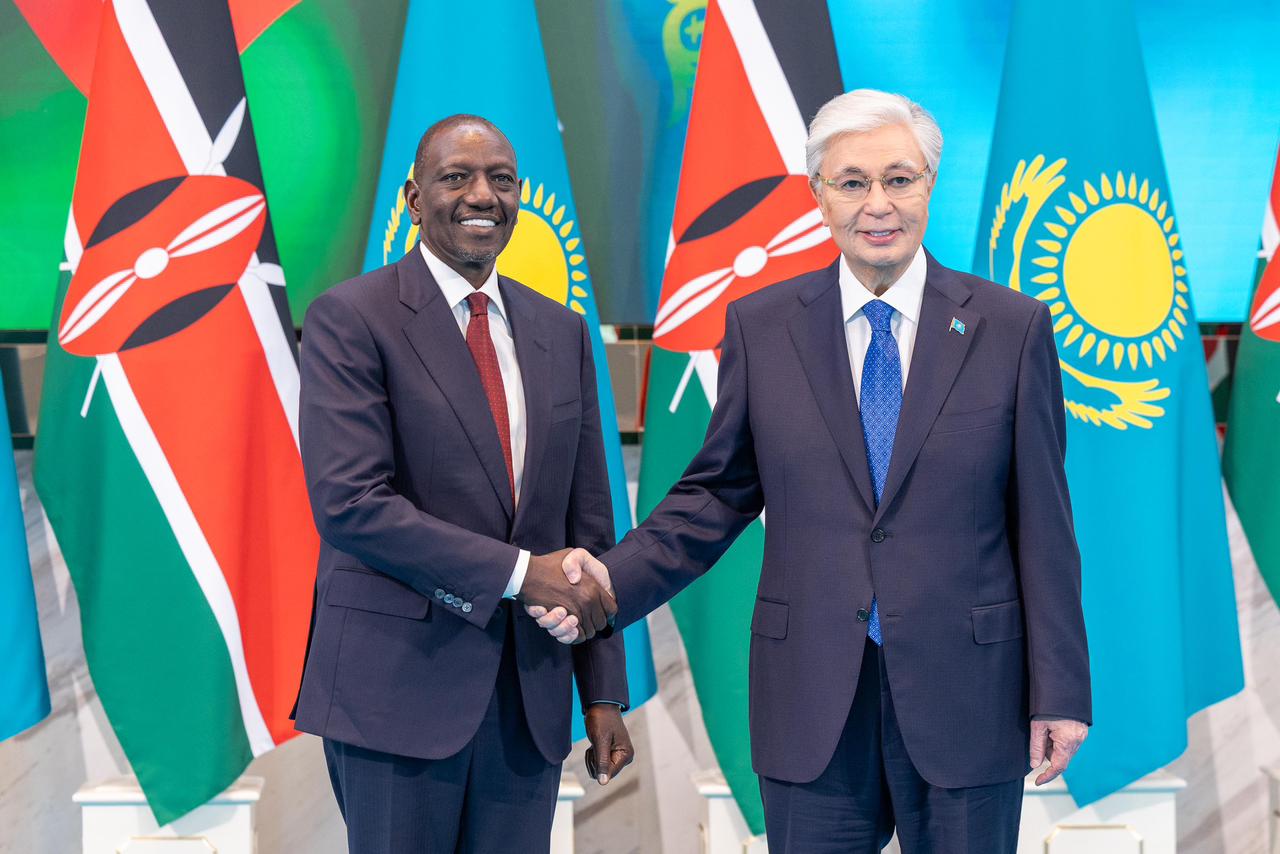
 President William Ruto and his Kazakhstan counterpart Kassym-Jomart Tokayev hold talks on May 20, 2026 / PCS
President William Ruto and Kazakhstan President Kassym-Jomart Tokayev have overseen the signing of multiple Memoranda of Understanding (MoUs) aimed at strengthening bilateral cooperation between Kenya and Kazakhstan across trade, transport, technology, mining, climate action, and diplomacy.
The agreements were concluded following high-level talks between the two leaders, during which both sides committed to deepening economic and strategic relations.
President Ruto described the discussions as constructive and forward-looking, noting that both countries reviewed the state of bilateral relations and agreed on practical measures to unlock new opportunities in trade, investment, innovation, and regional connectivity.
“President Tokayev and I have held candid, constructive, and highly productive discussions aimed at deepening cooperation across a broad range of strategic sectors. Together, we reviewed the state of our bilateral relations and agreed on practical measures to unlock new opportunities for trade, investment, innovation, and regional connectivity,” Ruto said.
Kenya positioned itself as a key gateway into Africa, while highlighting Kazakhstan’s role as a strategic entry point into Central Asia and the Eurasian region.
The President also invited Kazakhstan to establish Nairobi as a continental operational hub, leveraging the Port of Mombasa and the Lamu Port-South Sudan-Ethiopia Transport (LAPSSET) corridor as logistics gateways.
“To give concrete expression to the outcomes of our discussions and the shared ambitions of our partnership, President Tokayev and I have witnessed the signing of several Memoranda of Understanding and cooperation agreements,” he said.
Among the key agreements signed was an MoU on intermodal and multimodal transport systems aimed at improving connectivity between Kazakhstan’s transport corridors and East Africa’s Northern Corridor and LAPSSET corridor.
“To strengthen connectivity and regional integration, we have signed a Memorandum of Understanding aimed at enhancing cooperation in intermodal and multimodal transport systems,” Ruto said.
The two countries also signed an ICT and e-government cooperation agreement focused on digital infrastructure, cybersecurity, innovation ecosystems, and digital public service delivery.
Kenya emphasised its growing role as a technology hub in Africa, supported by a youthful workforce and an expanding digital economy.
A further agreement in the mining sector will promote investment, value addition, industrialisation, and job creation in Kenya through joint projects.
“To advance sustainable industrial development, we have signed a Cooperation Agreement in the mining sector,” Ruto said.
In addition, the leaders signed an MoU on remote sensing and space technologies to support agriculture, climate monitoring, disaster response, and environmental management.
“We have further agreed to strengthen collaboration in remote sensing and space technologies. This partnership will enhance food security, strengthen climate resilience, and better protect vulnerable communities,” he said.
Additional agreements were also concluded in investment promotion, financial services, tourism, commerce, and diplomatic training.
“These agreements are instruments of action that reflect our shared determination to deepen collaboration, expand opportunity, and deliver tangible benefits to our peoples,” Ruto said.
On global issues, the leaders discussed climate change and international financial reforms. Ruto briefed Tokayev on outcomes of the Africa Climate Summit held in Nairobi in 2023, including the Nairobi Declaration calling for fairer global climate finance systems.
He also commended Kazakhstan for hosting the Regional Ecological Summit in April 2026, which addressed issues such as glacier melt, desertification, and rising temperatures.
The two leaders reaffirmed the need for climate justice, improved access to climate financing, and reforms to global financial institutions to ensure fairness for developing countries.
They further called for reforms to the United Nations Security Council and broader multilateral systems to make global governance more representative and equitable, particularly for Africa.
On peace and security, Kenya and Kazakhstan reaffirmed their commitment to dialogue and diplomacy as tools for resolving global conflicts, while commending Kazakhstan’s efforts in promoting nuclear and biological safety through initiatives such as the proposed International Agency on Biological Safety.