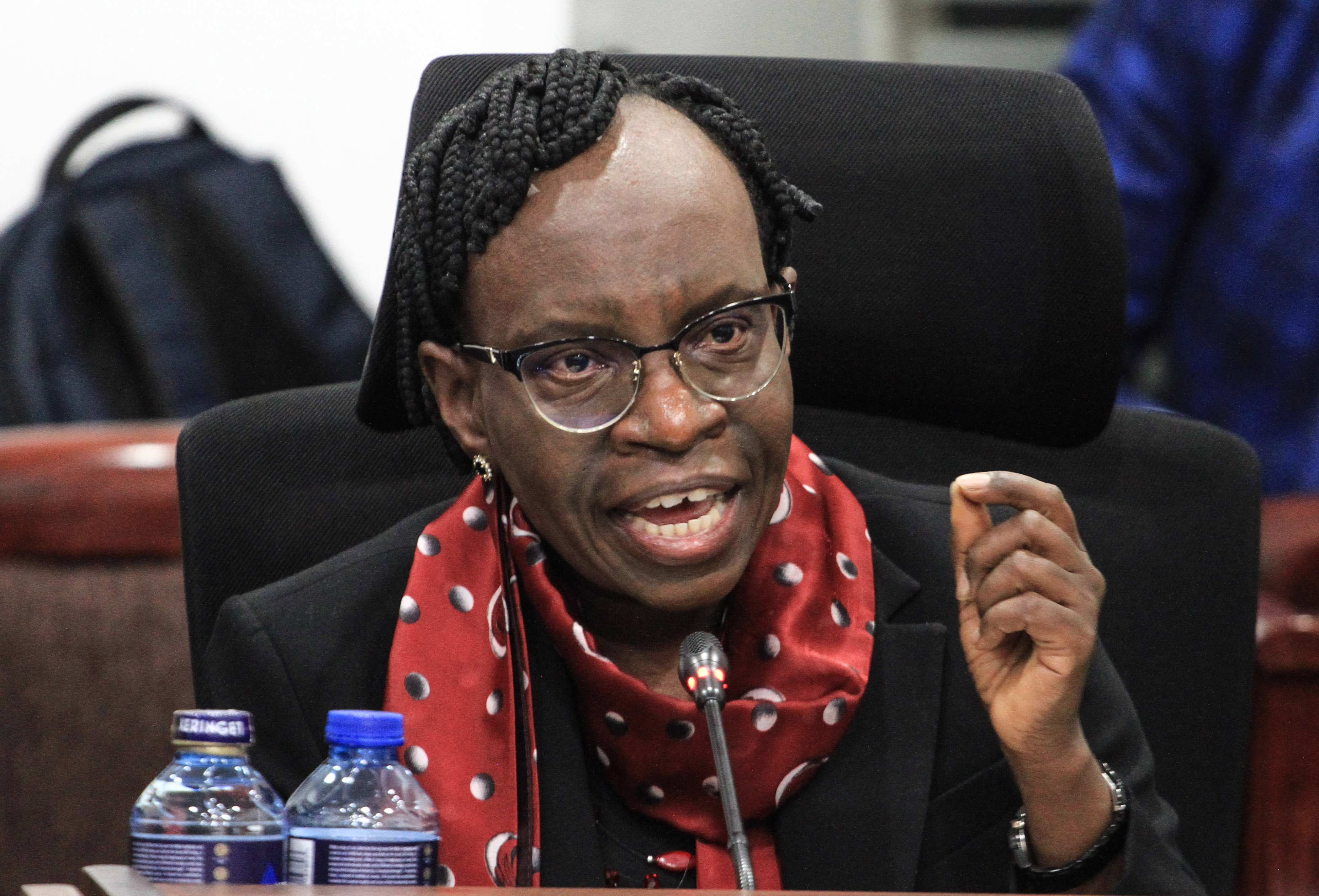
A new audit report by Auditor General Nancy Gathungu has raised queries over the handling and accounting of Sh3.17 billion reflected as a milk mop-up reserve in the books of the New Kenya Cooperative Creameries (New KCC).
The report for the financial year ending June 30, 2025, shows the state-owned milk processor received raw milk grants totalling Sh3.9 billion over two years.
Of this, Sh1.5 billion was disbursed in the financial year 2023-24 and Sh2.4 billion in 2024-25 to support milk purchases from farmers during periods of oversupply.
However, the Auditor General says records provided during the audit indicate the money may already have been fully spent despite the company still reflecting Sh3.17 billion as unutilised reserves.
“The statement reflects raw milk grant utilisation of Sh730,753,000, leaving the balance of Sh3,169,247,000 as an unutilised grant as at June 30, 2025,” Gathungu says in the report.
“However, payment records provided for audit show that all the funds received by the company had been fully paid to farmers for milk delivered to various company plants, which implies that the entire reserves needed to have been utilised.”
Gathungu consequently questioned the existence and accuracy of the reserve fund.
“In the circumstances, the accuracy and validity of the milk mop-up reserve/fund of Sh3,169,247,000 could not be confirmed,” she said.
The Auditor General further noted that New KCC’s financial position did not support the existence of the reserve.
According to the audit, the company reported cash and cash equivalents amounting to Sh228.5 million by the close of the financial year.
Even so, it also had bank overdrafts of Sh476.6 million, leaving it with a negative cash position of about Sh248 million.
The report separately questioned how the company arrived at the Sh730.7 million listed as utilised from the milk grant.
“Supporting documents on how the utilisation amount was arrived at were not satisfactorily explained,” Gathungu said.
The audit also raised concerns over an unsupported payment of Sh300 million back to the exchequer linked to emergency funds advanced under Article 223 of the Constitution during the 2023-24 El Niño period.
It had received Sh600 million in May 2024 to cushion farmers and support milk mop-up activities following the El Niño effects.
However, Parliament later regularised only Sh300 million through a supplementary budget, resulting in the recovery of the excess amount from New KCC’s 2024-25 budget.
Despite this, management reportedly recognised the entire Sh600 million in the milk mop-up reserve.
“The Constitution is silent on action to be taken on funds disbursed under Article 223 of the Constitution and regularisation not done by Parliament,” Gathungu said.
She added that justification for the refund was not provided for audit review, meaning the regularity and propriety of the Sh300 million payment back to the Exchequer could not be confirmed.
The report further paints the picture of a financially strained company despite receiving billions in state support.
New KCC posted a pre-tax loss of Sh974.6 million during the year under review, while its current liabilities exceeded current assets by Sh859.8 million, indicating negative working capital.
The company also incurred finance costs amounting to Sh369.4 million, including interest expenses on loans and overdrafts exceeding Sh368 million.
“These events or conditions indicate that a material uncertainty exists that casts significant doubt on the company’s ability to continue as a going concern,” Gathungu warned.
The Auditor General also faulted New KCC for overspending beyond its actual revenues during the financial year under review.
The company had budgeted to receive Sh8.95 billion but realised only Sh7.61 billion, resulting in a revenue shortfall of Sh1.33 billion.
Despite the lower revenues, the milk processor spent Sh9.07 billion, exceeding actual receipts by Sh1.45 billion or 19 per cent.
“The under-realisation and over-utilisation affected the planned activities and may have impacted negatively on service delivery to the public,” the report states.
The audit further found that trade and other payables stood at Sh3.97 billion, with Sh3.24 billion having remained unpaid for more than 120 days.
“Failure to settle the debts as and when they fall due may attract interest and operations if suppliers stop supplies due to non-payment,” Gathungu cautioned.
Three construction projects at the Kericho sales depot, valued at Sh37.7 million and initiated in 2021, were also found to be incomplete four years later, despite having been scheduled for completion within one year.
The audit further found that 570 out of New KCC’s 1,486 employees had overcommitted their salaries beyond the legal two-thirds threshold, contrary to public service regulations.