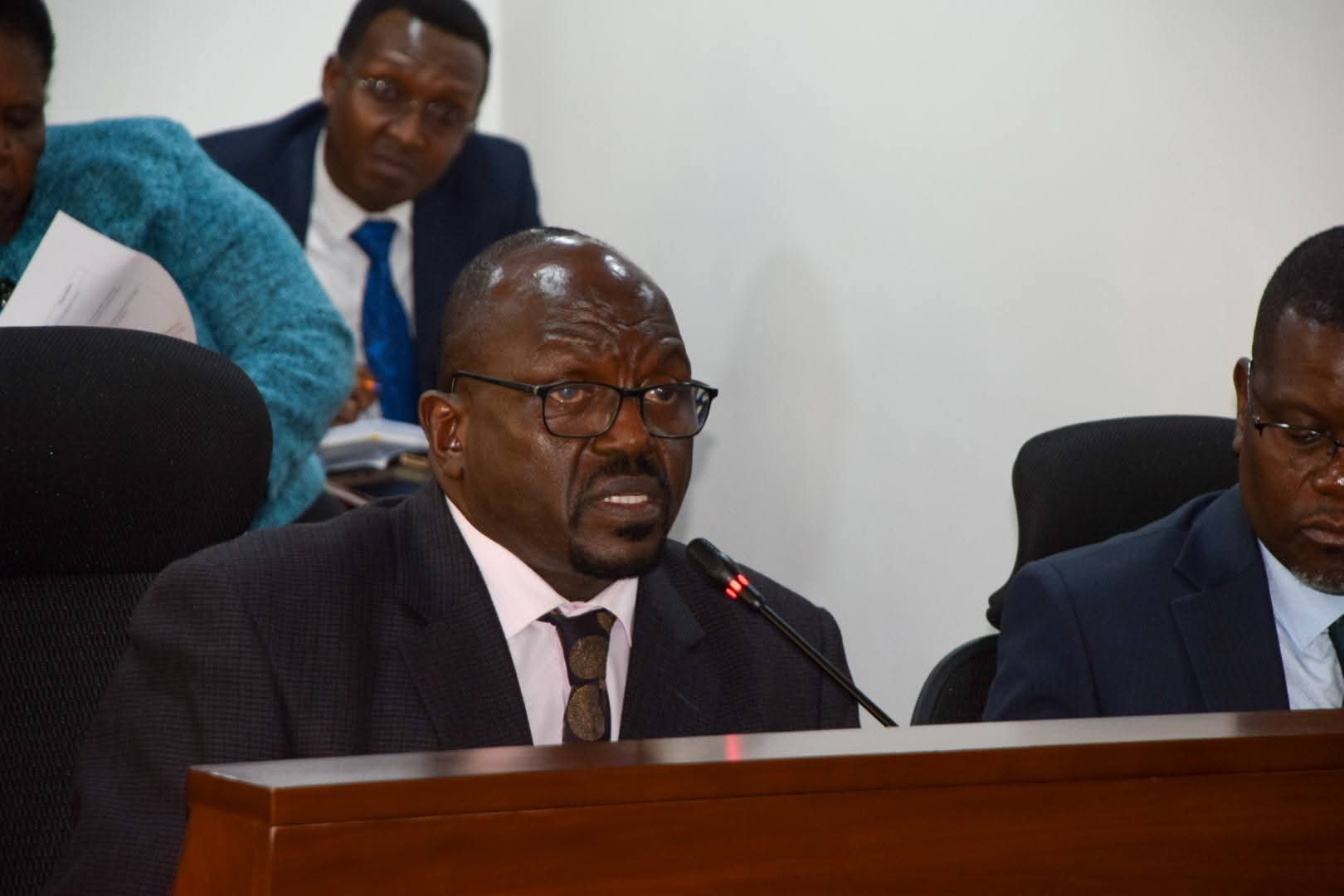
 NPSC CEO Peter Lelei when he appeared before PAC yesterday/Bunge
The Public Accounts Committee has sounded the alarm over acute understaffing at the National Police Service Commission (NPSC), warning that the commission may struggle to effectively carry out its mandate.
Committee members led by Chairperson Tindi Mwale (Butere) raised concerns during a session to review the Auditor-General’s report on the commission for the 2023/2024 financial year.
The Auditor-General flagged chronic understaffing at the commission, revealing that only 271 staff members were in office out of an approved establishment of 1,333 employees. This left a shortfall of 1,062 staff across various cadres.
Members of the committee questioned NPSC Chief Executive Officer Peter Leley on measures taken to address the staffing crisis.
“As a commission with a very important mandate, what steps have you taken to ensure the staffing gap is filled?” Mwale asked.
The NPSC is mandated to recruit, appoint, promote and exercise disciplinary control over officers within the National Police Service.
Leley told the committee that the commission had written to the National Treasury seeking additional funding to facilitate recruitment.
He said the commission received approval in the last financial year to recruit 149 additional staff members as the first phase of addressing the shortage.
The committee resolved to meet the Treasury Principal Secretary to seek an explanation over delays in the release of funds required for the recruitment exercise.
“The commission plays a critical role and must be supported to perform its duties effectively and optimally,” said Mwale.
Meanwhile, the government has proposed a Sh3,000 monthly stipend for village elders across the country in a move aimed at formally recognising their role in supporting the National Administration.
Appearing before the National Assembly Departmental Committee on Administration and Internal Security during scrutiny of the 2026/2027 budget estimates on Wednesday, Dr Raymond Omollo said the programme would benefit about 110,000 village elders nationwide.
Dr Omollo told the committee that the Ministry of Interior had already developed a policy framework and criteria for the identification of village elders, following years of consultations and public participation.
“The conversation about village elders began in 2016, and the House actually gave directions to the ministry. It has taken almost 10 years to get us here,” said Dr Omollo.
He credited the committee for supporting the allocation, saying without its intervention the funds would not have been included in the budget estimates.
Under the proposal, each village elder would receive a Sh3,000 monthly stipend beginning in the next financial year, subject to Parliament approving the policy.
“Our expectation is that we will be giving a stipend of Sh3,000 to each village elder, and the amount that has been provisioned for will be almost enough to take us through the whole year,” he said.
The PS added that the government would ensure only elders not already benefiting from other state support programmes, such as the social safety net scheme for the elderly or community health promoter initiatives, would qualify for the stipend.
Members of the committee, however, pushed for an increase in the proposed payment.
Teso North MP Oku Kaunya sought clarification on the legal and administrative structure under which village elders would operate, saying the framework should clearly define their reporting hierarchy within the National Administration system.
“I hope they are anchored within the National Administration structure. If that is the case, then I would support the idea that they need to have an enhanced amount of Sh5,000, which would be reasonable,” said Kaunya