

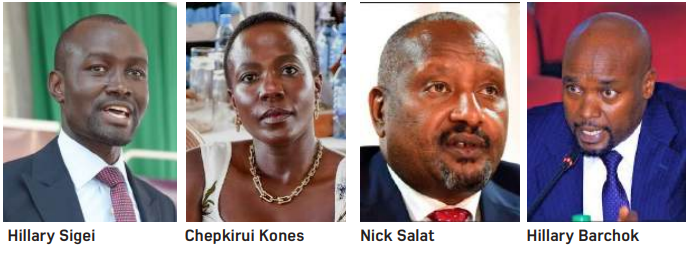
The contest for the Bomet Senate seat is emerging as a fiercely watched 2027 political battle involving seasoned politicians, rising figures and political dynasties.
What first appeared to be a routine succession race has now developed into a complex four-way contest involving incumbent Senator Hillary Sigei, Governor Hillary Barchok, veteran political operator Nick Salatand newcomer Chepkirui Kones.
At the heart of the race lies a broader political question that appears to be shaping voter sentiment: whether Bomet should stick with continuity and established leadership, shift towards political legacy and influence, reward performance in office, or embrace a generational transition in leadership.
The entry of Kones has particularly reshaped early calculations. As the daughter of former influential minister Kipkalya Kones (deceased) and wife of Belgut MP Nelson Koech, her candidature has revived the political weight of family legacy in Rift Valley politics.
Her move to transfer her voter registration to Bomet signalled a serious bid for the seat, immediately forcing rivals to recalibrate their strategies.
She has insisted her decision is personal and driven by a desire to offer leadership, not political endorsement. “I was not endorsed by anyone. I believe I can offer better leadership to the people of Bomet,” she said.
Her supporters see her as a fresh and unifying figure who could appeal strongly to youth and women voters, while critics argue that her campaign leans heavily on name recognition and emotional appeal rather than an established leadership record.
Political analyst Kipkemoi Barsumei said her entry has already unsettled the political field, saying her name alone has shifted attention and disrupted assumed voting patterns.
For Sigei, the race is increasingly shaping into a referendum on his Senate record, particularly his aggressive oversight role and frequent clashes with the county executive.
While his allies credit him for defending public resources and pushing accountability, critics accuse him of prioritising political confrontation over development cooperation.
Sigei has downplayed early campaigns, maintaining that it is still too early to declare political positions.
“When the time comes, I will present my agenda. The people of Bomet know what I have done,” he said during a recent public function.
Governor Barchok, meanwhile, enters the race with the advantage of incumbency networks built during his time in office following the death of former Governor Joyce Laboso. His allies point to expanded infrastructure, improved health services and agricultural support programmes as evidence of performance.
However, his tenure has not been without controversy, with critics pointing to governance decisions such as the dismissal of hundreds of county employees, which they say alienated sections of the workforce and their families.
His relationship with Senator Sigei has also become increasingly adversarial, with both leaders trading accusations over corruption and governance.
Barchok has dismissed allegations against his administration, accusing the senator of using them for political gain.
Former Kanu secretary-general Salat adds another layer to the race, bringing experience and strong mobilisation skills.
He has positioned himself as a defender of internal democracy, warning against what he describes as political manipulation within party structures.
“The people of Bomet will decide their leader. Nobody has a monopoly of leadership,” he said, arguing that nominations must be open and fair.
However, analysts say Salat faces the challenge of appealing to younger voters who may view him as part of an older political generation.
Beyond individual personalities, the race is increasingly being shaped by alliances, party loyalties and clan-based arithmetic.
Early mobilisation efforts are already underway across constituencies, with candidates aggressively courting youth groups, women networks, religious leaders and local influencers.
Support for national political formations, including perceived proximity to President William Ruto, is also expected to play a significant role in shaping voter behaviour.
Analysts say the contest is gradually turning into a broader test of identity politics versus performance politics.
It pits dynasty influence against reformist appeal, incumbency against outsider momentum and national influence against local priorities.
As the campaigns intensify, voters in Bomet are likely to face increasingly difficult choices: whether to reward experience, embrace political legacy, prioritise development records, or opt for generational change.
What is clear is that the Senate race is no longer just about who becomes senator—it is becoming a defining contest over the political identity and direction of Bomet county heading into 2027.
Instant analysis
The Bomet Senate race is evolving into a multi-layered political contest that blends personality politics, dynastic influence and shifting generational expectations. The entry of Chepkirui Kones has reactivated the power of political lineage, while also challenging established figures to rethink their voter appeal. Incumbent Senator Sigei’s record-driven approach contrasts sharply with Governor Barchok’s incumbency strength and Salat’s mobilisation politics, creating a fragmented field with no clear frontrunner. Beneath the competition lies a deeper struggle over control of political networks in Rift Valley and alignment with national power structures. Ultimately, voter sentiment will hinge on trust, identity and perceived delivery ahead of 2027.







