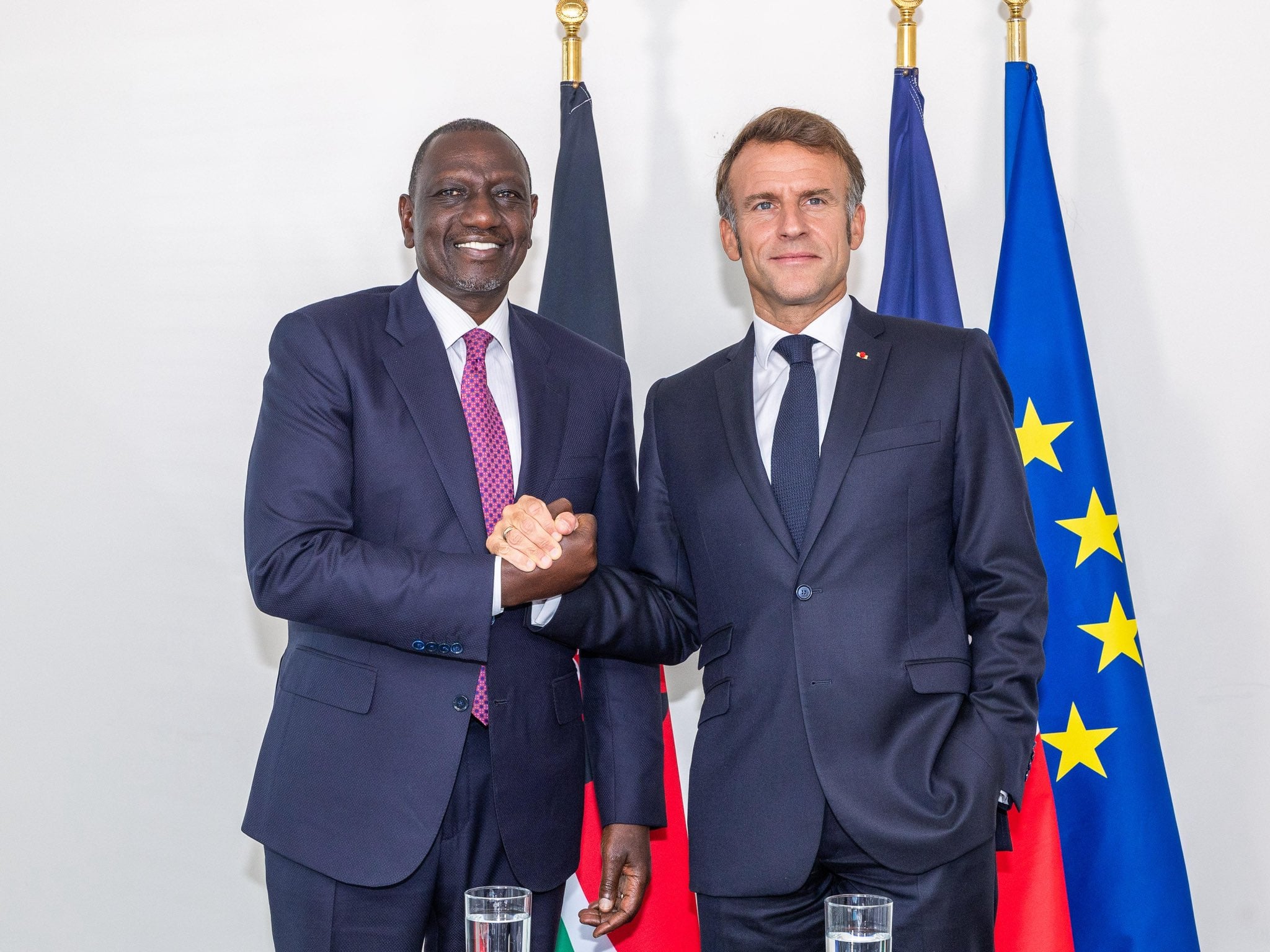
 President William Ruto with his French counterpart Emmanuel Macron in past event in Paris/PCS
Civil society organisations are pressing African and French leaders to use the Africa–France Summit in Nairobi to move beyond rhetoric and secure concrete commitments on economic transformation, climate resilience and financial sovereignty.
Pan-African political strategist at Greenpeace Africa Fred Njehu said Africa is currently at the centre of global geopolitical attention due to ongoing economic and political transitions, creating urgency for structural reforms.
“This creates the urgency to address the structural challenges that undermine the continent’s prosperity, especially reforms of the global financial architecture as a starting point,” Njehu said.
He added that the summit presents an opportunity for African leaders to negotiate partnerships driven by Africa’s own development priorities rather than external interests.
Civil society groups at the summit are calling for a shift from symbolic cooperation to practical outcomes that address long-standing barriers to development.
These include fairer development financing, debt restructuring, support for green industrialisation, local value addition, technology transfer, renewable energy investment, digital infrastructure, and reform of global financial systems that disadvantage African economies.
They are also pushing for stronger climate justice measures, including taxes on fossil fuel corporations and reforms to ensure polluter revenues are channelled toward climate adaptation, biodiversity protection, community resilience, and loss-and-damage financing.
Senior Climate Advisor at Powershift Africa Amos Wemanya warned that Africa cannot continue exporting raw materials while importing unemployment and debt.
“What this summit should deliver is not just broader access to African markets, but stronger commitments on development finance, green industrialisation and reforms that allow African countries to build productive economies for their own people,” he said.
Concerns were also raised over increasing global competition for Africa’s natural resources, energy potential, agricultural land and marine wealth, with fears that communities may continue bearing environmental and social costs if safeguards are not strengthened.
Pan-Africa Advocacy and Policy Lead at Christian Aid Africa Kiiza said past deals often reflect extractive colonial legacies where profits are exported while environmental burdens remain local.
“This summit must reflect a true spirit of partnership, not paternalism, and build a future where Africa’s resources strengthen local livelihoods and support a just transition that leaves no one behind,” Kiiza said.
The Africa–France Summit held in Nairobi on Monday and Tuesday came at a time of heightened global competition for influence in Africa.
Major powers including China, Russia, the United States, South Korea, Turkey and France have all intensified engagement with the continent through high-level summits, reflecting Africa’s rising strategic importance in global diplomacy.
Civil society groups say the Nairobi meeting should be used to elevate African priorities ahead of the G7 Summit in Evian, France, particularly on climate finance, debt restructuring, tax justice and global financial reform.
The Africa–France Summit, first held in 1973, was initially designed to strengthen France’s ties with its former African colonies but has since evolved into a broader platform involving governments, private sector actors, civil society, youth and innovators.
Discussions span trade, investment, climate change, peace and security, digital transformation, public health and industrialisation.