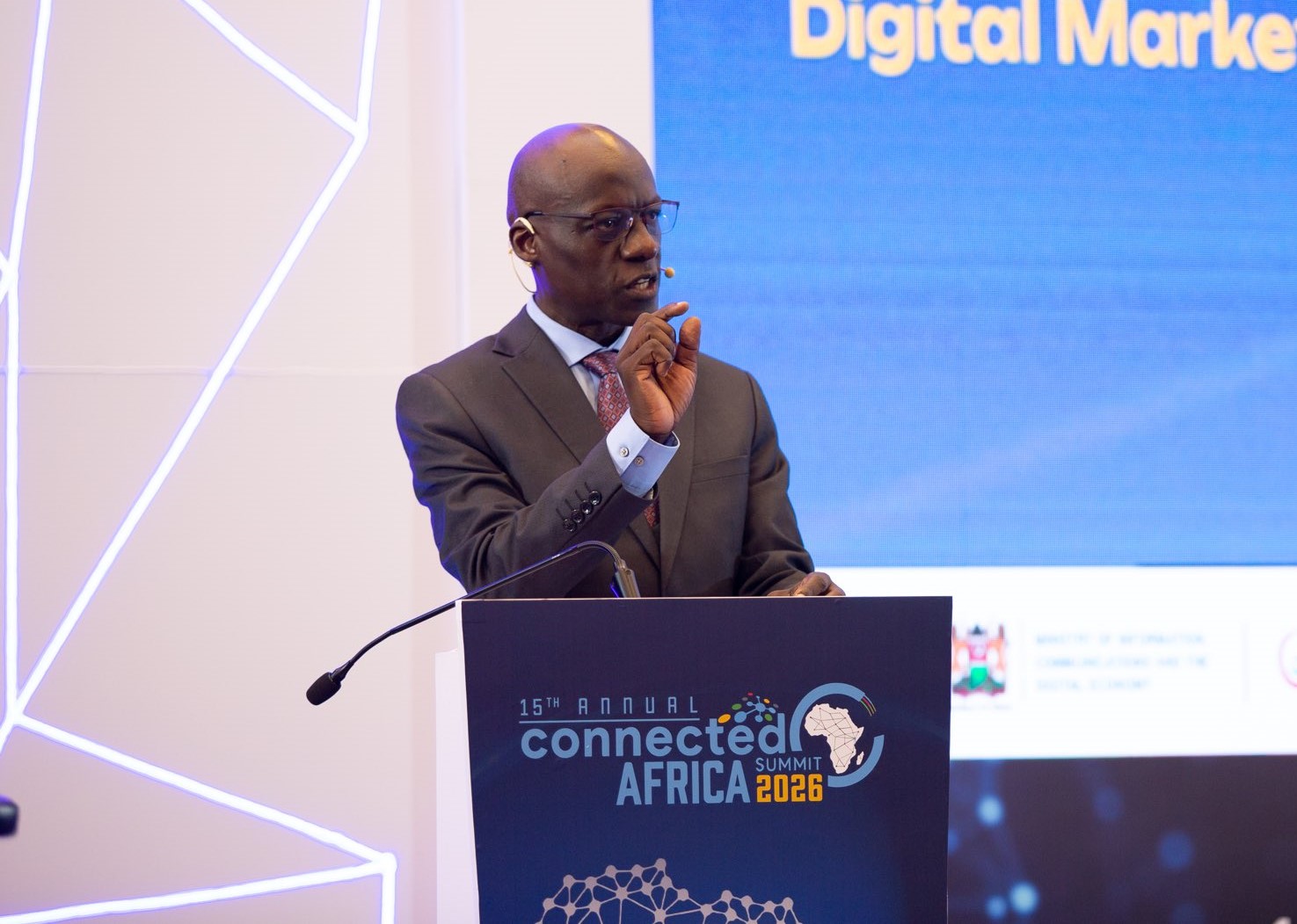
 Special Tech Envoy Ambassador Philip Thigo speaking at a past event / HANDOUT
Kenya has dismissed reports that the planned $1 billion Microsoft-G42 data centre project has stalled.
Special Tech Envoy Ambassador Philip Thigo has clarified that the government remains fully committed to the initiative despite concerns over electricity capacity.
In a statement issued on X, Thigo said President William Ruto’s recent remarks had been misinterpreted, emphasising that the President was highlighting the need to expand Kenya’s power generation to support emerging digital infrastructure rather than signalling a suspension of the project.
“His point has not been that the project was suspended, but Kenya must confront the scale of energy required to support next-generation digital infrastructure,” Thigo said.
The clarification follows media reports claiming that Kenya’s plans to host the Microsoft-G42 data centre had stalled after President Ruto reportedly said the country lacked sufficient power capacity to support the investment.
The project, announced during President Ruto’s state visit to Washington in May 2024, is expected to strengthen cloud computing and artificial intelligence services across East Africa through Microsoft’s Azure platform.
Kenya currently has an installed electricity generation capacity of about 3,000 megawatts, far below the anticipated demand required to support large-scale AI-powered data centres.
However, Thigo said the government was already working to address the challenge through an ambitious energy expansion programme targeting at least 10,000 megawatts of generation capacity.
“President Ruto’s message was clear: While the energy demands of next-generation technologies are significant, Kenya is committed to scaling up our power capacity to at least 10,000 megawatts by 2030. This will ensure projects like the Microsoft-G42 data centre can thrive,” Thigo said.
“His point has not been that the project was suspended, but Kenya must confront the scale of energy required to support next-generation digital infrastructure.”
Thigo maintained that Kenya’s ambitions to position itself as a regional hub for artificial intelligence, digital infrastructure and emerging technologies remained intact, citing the country’s renewable energy resources, geothermal potential and growing digital economy as key advantages.
He added that infrastructure development would be a major pillar at the upcoming France Africa Summit, where regional data centre investments across the continent, including in Kenya, are expected to be announced.
“As we push forward with digital transformation, addressing power infrastructure is paramount,” Thigo said.
“Kenya is positioned to lead in emerging technologies while building a sustainable energy future.”
The President has repeatedly underscored the urgency of expanding Kenya’s energy base, framing it as a prerequisite for industrialisation and sustained economic growth.
During an address to the Kenyan diaspora in Qatar on November 5, 2025, he warned that the country risked routine load-shedding during peak hours to power the data centre.
“We need a minimum of 10,000 megawatts, and we need it like yesterday,” he said.