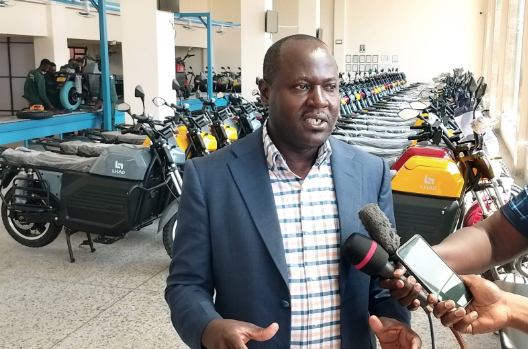
 Teketeke managing director Richard Chesebeh at the firm's assembly point in Nairobi /HANDOUT
Kenya is expected to champion for e-mobility at the upcoming Africa Summit, with local firms in the sector pushing for innovation and funding partnership with Franch and European Union.
The summit, scheduled for May 11–12 in Nairobi, is jointly hosted by Presidents William Ruto and Emmanuel Macron of France. It marks the first time since 1973 that an Africa-France Summit is being held in an English-speaking African country.
At least 30 African heads of states are expected in Nairobi for the forum that has also attracted more than 1,500 business leaders and global investors.
On Friday, a Kenyan electric mobility company, Teketeke said the forum presents a perfect opportunity to scale up the uptake of e-mobility as investors, innovators and policy makers meet.
Kenya's e-mobility sector faces a massive, multi-billion-dollar financing gap, with roughly $8.9 billion in asset financing needed to achieve 80 per cent electric two-wheeler (E2W) penetration, while only about $50 million in funding has been realised.
High initial capital costs for vehicles and infrastructure hinder growth, despite innovative Pay-As-You-Go (PAYG) models helping consumers
Addressing media, Teketeke director, Richard Chesebeh said his firm is seeking at least Sh1 billion in investment to expand charging infrastructure and accelerate adoption of electric transport solutions across the country.
According to Chesebeh, the firm is positioning itself as a homegrown solution to Kenya’s growing demand for clean and affordable transport.
The company, which assembles electric bikes and three-wheel tuk-tuks at its plant along Mombasa Road opposite Signature Mall, is focusing on solar-powered mobility products aimed at reducing reliance on fossil fuels and cutting carbon emissions.
Chesebeh said Kenya has nearly two million boda boda riders, yet fewer than 30,000 currently use electric motorcycles, a gap he attributed to inadequate charging infrastructure and limited financing options.
“We realised the market was missing a practical last-mile solution. That is why we decided to localise production and provide complete solutions including charging cables, solar charging systems and locally assembled bikes,” he said.
The company’s electric bikes can reportedly travel between 150 and 250 km on a single charge, with charging taking less than three hours using standard Kenyan household electricity connections.
It is also targeting rural communities, arguing that electric mobility could offer a cheaper and more accessible transport option in areas with limited access to petrol stations.
According to Chesebeh, the company is developing locally manufactured charging cabinets in partnership with Kenyan firms while piloting electric mobility projects in counties including Bungoma, Trans Nzoia, Nandi and Narok.
He said the company hopes to use the Africa Forward Summit to attract partnerships and funding from French investors to support expansion of charging stations, battery swapping technology and financing for riders and small businesses.
“We want to demonstrate that Kenya has the technical capability to build sustainable e-mobility solutions locally,” Chesebeh said.
The company says it currently employs about 450 Kenyans directly and indirectly through assembly, supply chain operations, distribution and marketing.
Chesebeh also called for policy reforms to support conversion of fossil fuel motorcycles into electric-powered bikes, arguing that current regulations still create hurdles for local innovators.
He urged the government to allow licensed converters to take responsibility for electric modifications instead of leaving the burden solely on original manufacturers.
The official says demand for electric mobility solutions in Kenya remains high, but access to affordable financing continues to slow wider adoption.
"We find this summit as an opportunity to showcase our ability and to at least work with the partners especially the French who are coming to provide solution especially funding for our home-grown solutions in terms of charging stations, financial inputs to the various sectors that would want funding," Chesebeh said.
He said the new investment would also place the firm on path to expand its markets to regional countries as well as internal markets e-bike sales continue to rise.
Teketeke is also riding on the design of its e-bikes which utilise solar energy for charging as well as the ability to charge the bikes at home to capture the market.
"We make sure that we provide a bike, a charging cable and this charging cable is put in a manner that they can use the common 220kv-240kv Kenyan line. We also provide solar solution and you can charge from your home," he stated.