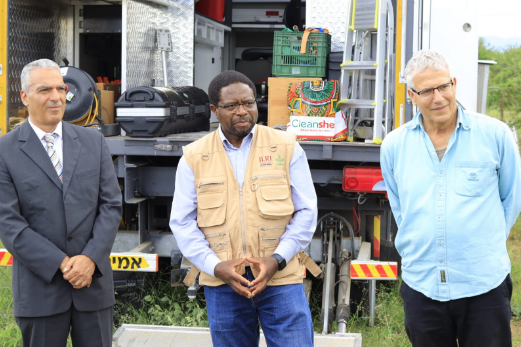
In the dry plains of Kapiti in Machakos county, a truck-like scientific facility parked quietly at the International Livestock Research Institute (ILRI) is attracting global attention.
Inside it, scientists are measuring carbon exchange, vegetation changes, solar radiation and water movement in what experts say could transform how Africa understands and responds to climate change.
The mobile climate laboratory, deployed in Kenya by Israel’s Weizmann Institute of Science, is the first facility of its kind in Africa and possibly the world.
For scientists and policymakers, however, the significance of the project stretches far beyond technology.
It represents a growing effort to solve one of Africa’s biggest but least discussed climate problems, the continent’s severe shortage of reliable environmental data.
Israel’s Ambassador to Kenya Gideon Behar says the lack of accurate climate information continues to weaken Africa’s ability to prepare for environmental shocks and develop effective policies.
“We must remember that there is a huge gap in climate data and climate knowledge in Africa, and the work of this laboratory helps us close this gap,” Behar said during a visit to the facility.
“It enables us to be better prepared for climate change and to make better policy decisions based on real and accurate science.”
For years, scientists have warned that Africa remains one of the least monitored regions globally despite facing some of the harshest effects of climate change.
From devastating droughts in the Horn of Africa to destructive floods in East and Central Africa, environmental disasters are becoming more frequent and unpredictable.
Yet many countries still lack sufficient weather stations, monitoring systems and research infrastructure needed to track climate patterns accurately.
As a result, many global climate models depend heavily on satellite observations with very little ground-based verification from African ecosystems.
Researchers say this creates significant gaps in understanding how climate change is affecting local environments, agriculture and livelihoods.
That is where the mobile laboratory comes in.
The cutting-edge facility is equipped with more than 30 scientific instruments capable of collecting detailed environmental measurements directly from the field.
Unlike permanent climate stations fixed in one location, the mobile lab can move across different ecological zones, from rangelands and forests to mountain regions and agricultural landscapes.
Scientists say the mobility of the lab will allow researchers to compare environmental conditions across Africa’s diverse ecosystems and improve the accuracy of climate models currently used around the world.
“This initiative will provide the data needed to validate and improve those models,” said Eyal Rotenberg, one of the lead scientists involved in the project.
“Models are not well calibrated because there has been very little measurement.”
Rotenberg explained that many satellite observations require direct field measurements to confirm their accuracy.
Without that process, known as ground validation, climate predictions can become less reliable, particularly in regions where environmental conditions vary significantly.
The laboratory has already been operating in Kenya for the past two months and is expected to move to the Mt Kenya region before expanding to other African countries including Tanzania and South Africa.
Researchers hope the project will eventually contribute to building one of the continent’s largest climate datasets.
The initiative is also being viewed as part of growing scientific cooperation between Israel and African institutions on climate resilience and sustainable development.
Behar described the laboratory as both a scientific and diplomatic milestone.
“This is the first-ever climate mobile lab not only in Africa but possibly in the world,” he said.
“The measurements and scientific work being conducted here will serve the global fight against climate change.”
The ambassador stressed that science must move beyond academic research and directly influence public policy and environmental planning.
“It’s not enough to supply scientific data,” he said.
“We also need practical solutions, ideas and policy recommendations embedded in research.”
His remarks reflect broader concerns among environmental experts who say many African countries still struggle to translate scientific findings into effective climate action.
While climate reports and environmental studies continue to increase globally, implementation gaps remain a major challenge.
At ILRI, researchers believe the laboratory could significantly improve understanding of how climate variability affects food systems, livestock and biodiversity.
ILRI director general Appolinaire Djikeng said data-driven decision-making has become increasingly important as climate pressures intensify.
“We are in a society where we need data to make decisions,” Djikeng said.
“The pressure from the climate crisis requires precision.”
“This facility allows us to generate the evidence needed to guide sustainable food production and environmental management.”
The Kapiti research site has long been used for studies on livestock health, genetics and nutrition.
Now scientists say the addition of climate-focused monitoring tools will help deepen understanding of how environmental changes are affecting rangelands and agricultural productivity.
For Kenya and much of Africa, the stakes are particularly high.
Agriculture remains the backbone of many economies across the continent, employing millions and supporting food systems heavily dependent on rainfall.
But shifting weather patterns are increasingly threatening crop production and livestock farming.
Erratic rains, prolonged droughts and extreme temperatures have disrupted livelihoods and increased food insecurity in several countries.
Climate experts argue that better data could help governments and farmers prepare more effectively.
This includes improving drought forecasting, water management and climate-smart farming practices.
Scientists involved in the project believe Africa’s climate vulnerability makes investment in research infrastructure increasingly urgent.
Despite contributing the least to global carbon emissions, African countries are among the hardest hit by climate-related disasters.
At the same time, funding for environmental monitoring and scientific infrastructure remains limited in many regions.
Analysts say this imbalance has left Africa heavily dependent on foreign-generated climate data that may not fully reflect local realities.
The mobile laboratory is therefore being viewed as an attempt to bridge that gap through locally collected evidence.
Researchers say the project could also help strengthen collaboration between African and international scientific institutions.
Still, experts caution that the long-term success of the initiative will depend on sustained investment and local capacity building.
Some analysts warn that Africa must avoid overreliance on external scientific projects and instead increase domestic support for research institutions and climate innovation.
There are also calls for governments to invest more heavily in weather monitoring systems, environmental education and climate adaptation programmes.
As climate threats continue to intensify globally, scientists say accurate and accessible data will become one of the most valuable tools in protecting communities and ecosystems.
For now, the mobile climate lab parked in Kapiti represents more than a scientific experiment.
To researchers, it signals a growing recognition that Africa’s climate future cannot be managed effectively without stronger research systems, reliable evidence, and closer international collaboration.
And as the continent continues facing rising temperatures, shrinking water sources, and growing environmental uncertainty, experts say the race to close Africa’s climate data gap may no longer be optional but necessary.