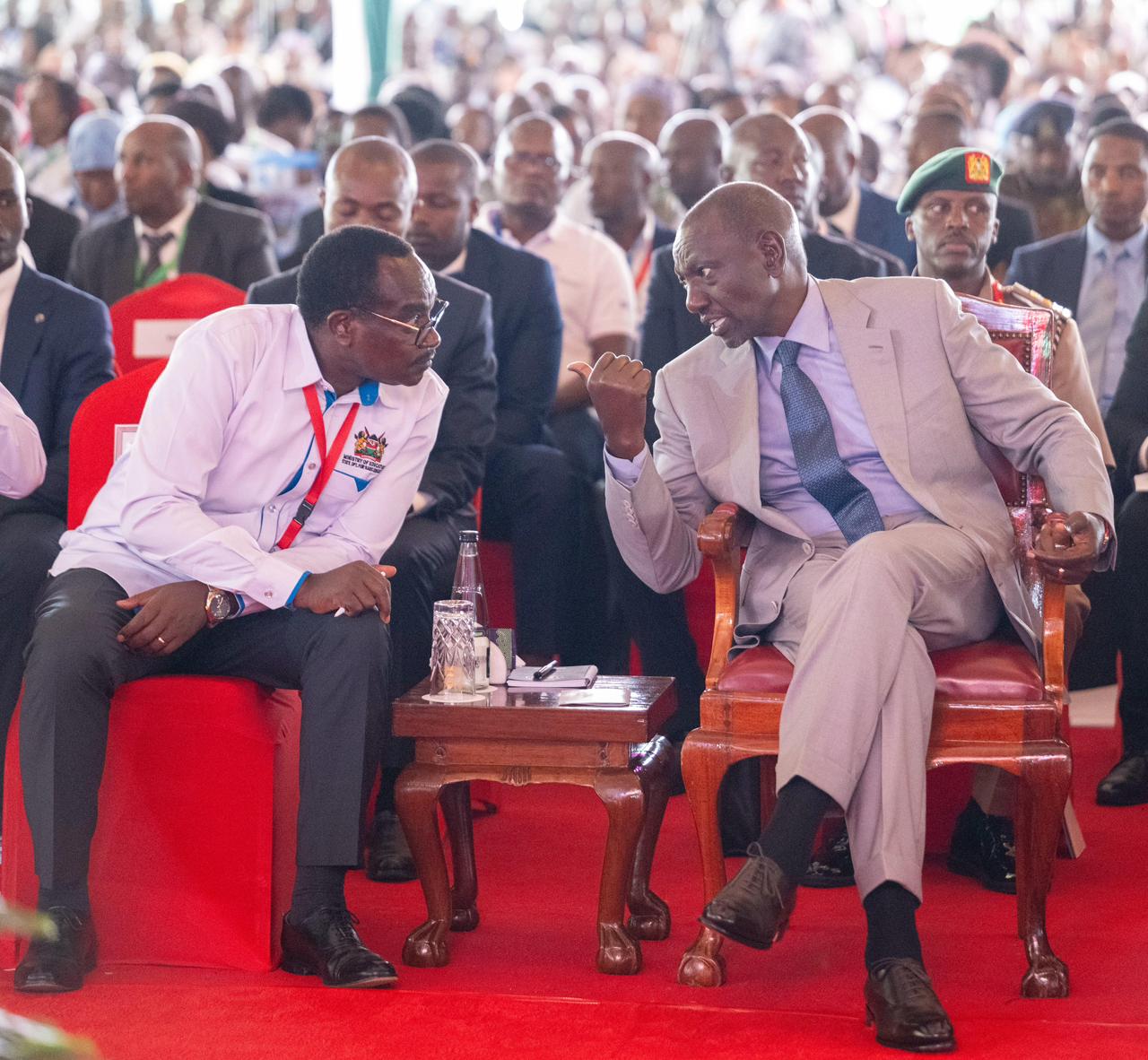
 Education Cabinet Secretary Julius Ogamba confers with President William Ruto during the second national education conference in Lake Naivasha resort in Nakuru on May 7, 2026/PCS
President William Ruto has directed the Ministry of Education to begin a nationwide digitisation of all learner and school records in a move aimed at streamlining planning, improving accountability and sealing loopholes in the education sector.
According to the President, the exercise would be rolled out within the next two months in partnership with technology experts and government agencies.
Ruto said the government plans to digitally capture details of every learner, school, teacher and bursary beneficiary across the country to improve decision-making and ensure resources are distributed fairly.
“Now moving to the next step, I have instructed the Ministry of Education that in the next two months we are going to work with the Konza Technopolis to make sure that we digitise all the education details of every learner, every school, teachers, bursaries and everything else,” he said.
He was speaking Thursday during the opening of the Second National Education Conference at Lake Naivasha Resort in Nakuru.
The Head of State noted that the government intends to use technology and digital data to establish the exact number of students and teachers in every institution, identify staffing gaps and improve planning in the sector.
“We can easily check on whether we have the right number of students, whether we have the right number of teachers, where we have gaps and what we need to do,” he added.
Ruto linked the planned reforms in education to the success of the government’s digital transformation in agriculture, saying technology had helped dismantle cartels and improve efficiency in the distribution of subsidised fertiliser.
The president recalled that for more than a decade, attempts to register farmers had yielded only about 300,000 records.
However, a whole-of-government digitisation exercise had now pushed the number of registered farmers to 7.2 million.
“Today we know how many sugarcane farmers, how many coffee farmers, how many tea farmers, how many growers of wheat and maize we have,” he said.
Ruto explained that the digital platform now allows the government to allocate fertiliser according to the acreage owned by each farmer, reducing fraud and abuse in the subsidy programme.
“A farmer with five acres cannot come and claim fertiliser for 20 acres because the system automatically knows and allocates fertiliser on account of the acreage,” he said.
He said the same model would now be replicated in the education sector to ensure transparency and efficient allocation of resources.
The conference has brought together education stakeholders, policymakers, school administrators and development partners to discuss reforms and the future of Kenya’s education system.
The president said embracing technology was no longer optional, arguing that digital systems remain critical in improving service delivery and eliminating inefficiencies in public institutions.