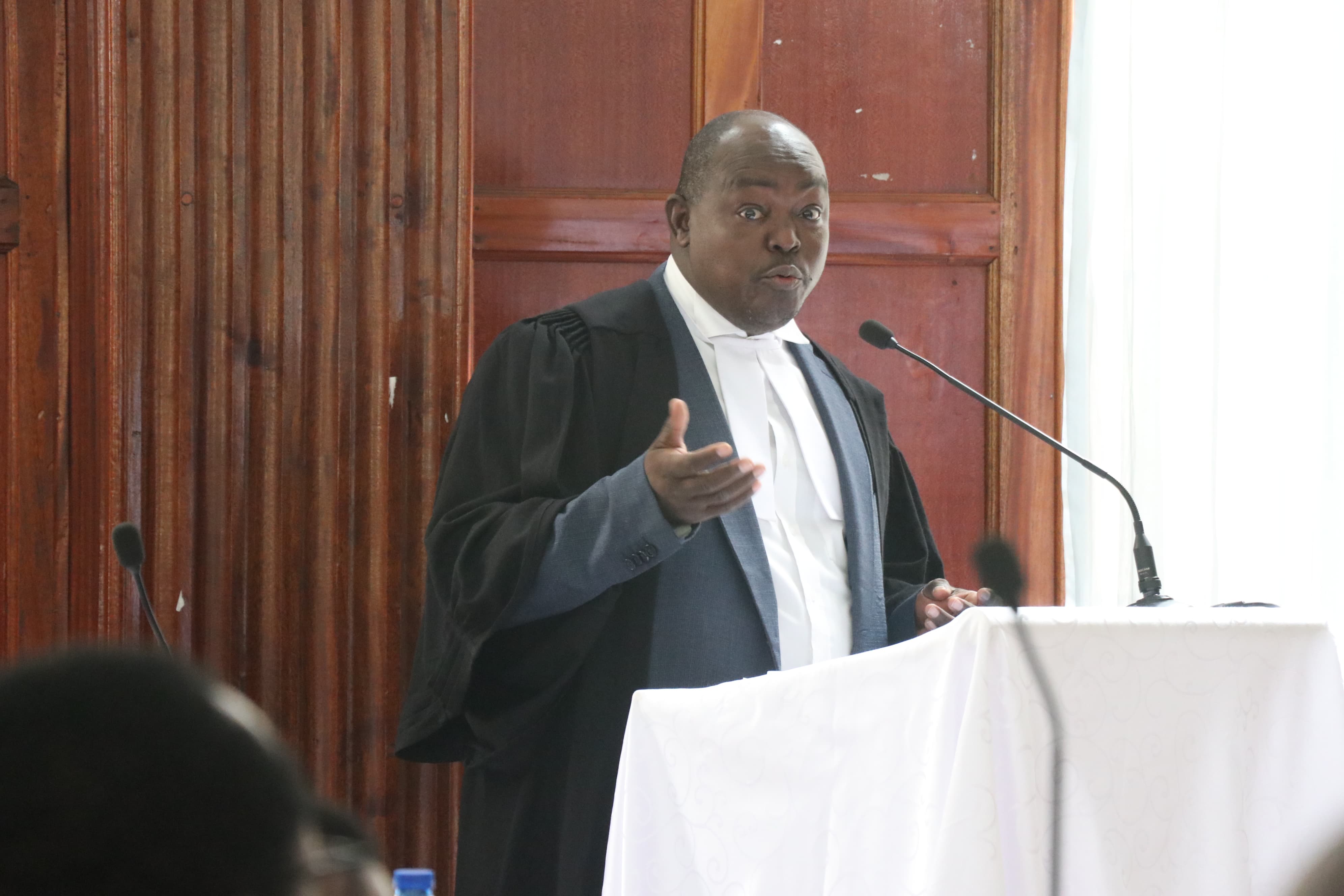
 Lawyer Kibe Mungai during the hearing of former Deputy President Rigathi Gachagua’s petition at Milimani Law Courts, Nairobi on May 7, 2026 /LEAH MUKANGAI
The impeachment of former Deputy President Rigathi Gachagua was powered by pre-determined malice rather than a genuine threat to the public, a lawyer has told the court.
Constitutional lawyer Kibe Mungai, during the final hearing into the ouster of the former DP, told a three-judge High Court bench that the impeachment fell short of the threshold required in any democracy.
He drew a pointed comparison with the 1999 trial of United States President Bill Clinton over the Monica Lewinsky affair, saying in the end, Americans were more interested in whether there was public harm, choosing not to ‘hang’ the leader over ‘personal moral deficiencies’.
He invoked Alexander Hamilton, who in the 1790s evaded impeachment over a private financial dispute because his alleged conduct did not menace American society.
Mungai submitted that the motion never met the standard that impeachment was designed to serve. “It was never meant to make it easy to settle any political scores or any specific fight that happened. That would be an abuse of the impeachment process.”
“To ensure that this procedure would not turn into an injustice, it would not turn into a trial of Jesus Christ, the American Constitution stipulates that the trial shall be presided over by the Chief Justice,” Mungai submitted before Justices Eric Ogolla, Anthony Mrima and Fredah Mugambi.
Parliament, he argued, had transformed itself into “prosecutor, judge, and executioner,” rendering the Senate and National Assembly a “political court” that abandoned constitutional thresholds in favour of settling scores.
He further asserted that the speed at which the process was conducted precluded any possibility of a fair trial, turning the legislative houses into “prosecutor, judge, and executioner.”
A central complaint was Parliament’s deliberate bypassing of the select committee route.
Under the Constitution and the Standing Orders, once charges are preferred against a deputy president, the Senate may establish a special committee of eleven members to investigate the allegations within ten days, taking evidence under oath.
Gachagua’s legal team argued that the Senate unlawfully refused to constitute such a committee, choosing instead to plunge into a plenary vote that denied the accused any meaningful investigatory stage.
During the hearing, counsel, including Wambui and Ndegwa Njiru, submitted that the Senate failed to put in place a select committee comprising 11 members to hear the matter.
Instead of deploying the select committee route, the House chose plenary hearings, which was a procedural failure that violated the former Deputy President’s right to a fair trial.
Counsel for the petitioners argued that the Senate’s decision to bypass the select committee process in favour of a plenary session was part of a “hurried and flawed” mechanism designed to achieve a pre-determined outcome.
The court also heard that Parliament failed to obey a constitutional command under Article 150, which required lawmakers to modify presidential removal procedures for a deputy president.
“Parliament did not actually modify or obey the command of the constitution on what it was supposed to do,” Mungai submitted. “The Senate and the National Assembly turned themselves into a conveyor belt of political whims, completely disregarding the constitutional safeguards meant to protect the holder of the office of the Deputy President,” Mungai told the court.
Advocate Shadrack Wambui, contributing to the petitioner’s case, articulated the “irreparable harm” caused by the ouster, not just to Gachagua but to the millions of Kenyans who voted for the presidency.
Wambui argued that the removal process set a dangerous precedent where a popular mandate could be overturned by legislative “mob justice.” Detailing the reliefs sought, Wambui stated, “We are asking this court to quash the proceedings of both houses in their entirety. Our prayers are not merely for the person of Rigathi Gachagua, but for the restoration of constitutional order that was violated when Parliament chose to bypass the law.”
Legal counsel representing the petitioners argued that the National Assembly failed to meet both the qualitative and quantitative thresholds for public participation. They pointed out that an exercise intended to capture the views of a nation of 52 million people yielded a “negligible 200,000 responses,” translating to a mere 0.385% of the population.
This mathematical deficit, they argued, was a direct result of a process that lacked prior sensitisation, civic education, and sufficient time for citizens to digest the allegations.
Submissions also highlighted the alleged violation of a standing court order, which established a binding legal standard for the participation process.
By proceeding despite these legal safeguards, Parliament had reduced the courts to a state of “impotence” and undermined the supremacy of the constitution.
The accessibility of venues was a particularly contentious issue. The court was told that venues for the residents of Nairobi were shifted from the Kenyatta International Convention Centre (KICC) to the Bomas of Kenya with less than 24 hours’ notice.
“If two days were bad, one day is terrible,” counsel submitted, adding that on the very day scheduled for the exercise, venues in thirty constituencies were shifted.
This “zero-day notice” was described as “horrible” and an intentional hurdle placed to prevent genuine public scrutiny. Furthermore, the legal team highlighted the lack of supporting material and the absence of the Hansard records from the proceedings to verify the integrity of the process.
They argued that the public was expected to respond to a “template for public persuasion” without the benefit of material evidence or the opportunity to seek clarification on the allegations.
This, they contended, rendered the exercise one that failed to satisfy the “reasonable notice” required for a matter of such monumental constitutional significance.
They further argued that the subsequent nomination and approval of Professor Kithure Kindiki as Deputy President is void and should be set aside, describing it as a premeditated scheme to subvert constitutional democracy and re-establish the imperial presidency.
The petitioners seek declarations that the impeachment was invalid, that Kindiki’s approval is void and that Gachagua be afforded compensation for the unfair removal from office.