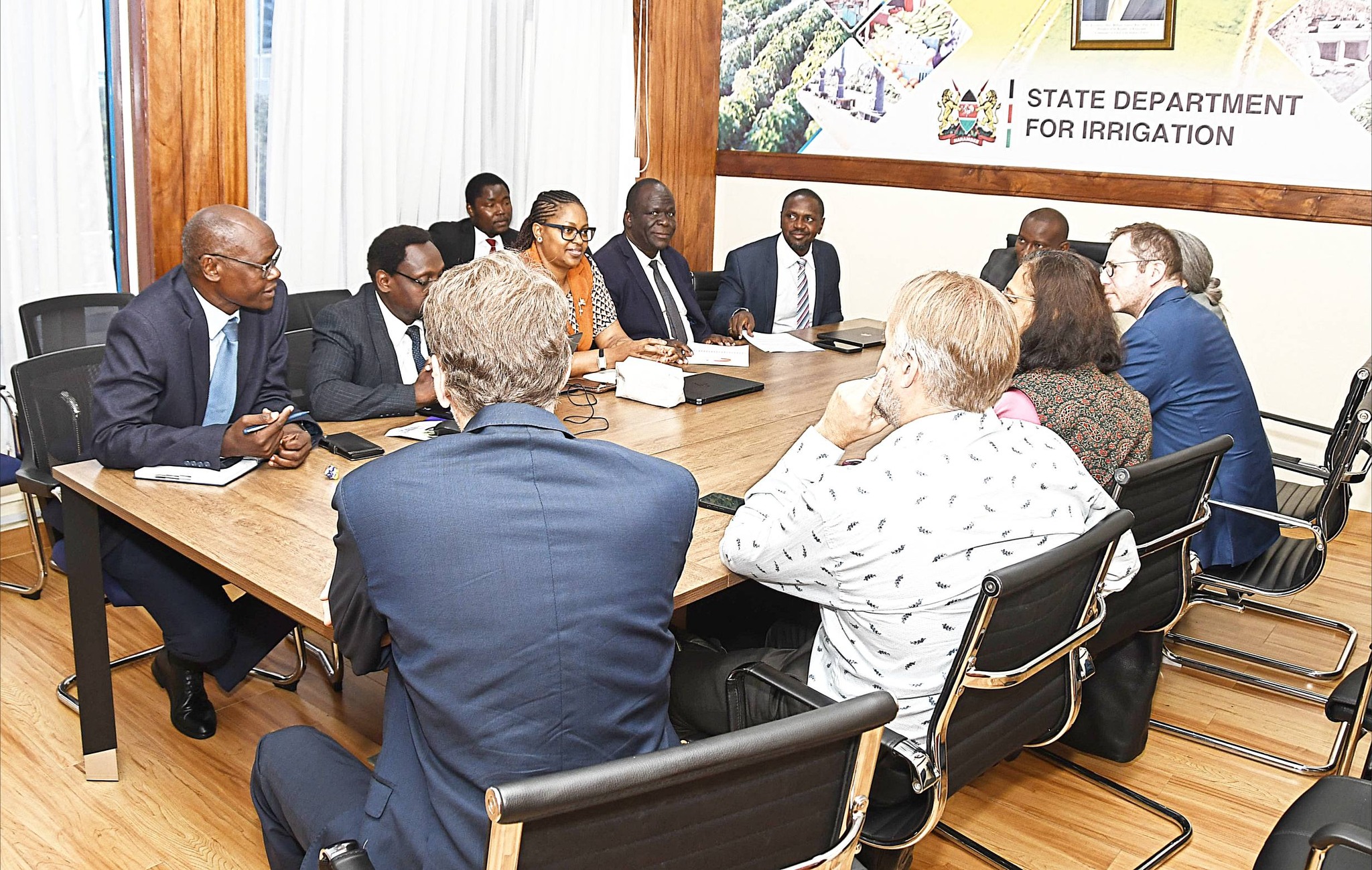
Irrigation Principal Secretary Ephantus Kimotho Kimani has held discussions with a World Bank delegation to review ongoing collaboration aimed at strengthening irrigation development, food security and climate resilience in the country.
The meeting, held at Maji House in Nairobi, brought together senior officials from the State Department for Irrigation and the World Bank team led by Anna Wellenstein, the Regional Practice Director for the Water Department. It focused on the progress of joint programmes currently being implemented under the irrigation sector.
At the centre of the discussions was the Kenya Sustainable Irrigation for Resilient Economy (K-RISE) programme, which brings together key interventions designed to boost agricultural productivity and improve resilience among farming communities.
The programme comprises four main components, including the Farmer-Led Irrigation Development (FLID) Programme, High Performance Public and Community Irrigation Schemes, Water Security and Climate Resilient Landscapes, and Sector Coordination.
According to the discussions, the initiative is expected to support increased household incomes, improved food production systems and stronger resilience to climate-related challenges through expanded and more efficient irrigation investments.
Speaking during the meeting, PS Kimotho said irrigation remains a central pillar in the government’s agenda on food security, poverty reduction, job creation and broader socio-economic transformation.
“The FLID programme is directly linked to poverty alleviation, employment creation and improving the livelihoods of farmers across the country. We anticipate a high uptake of the programme because it addresses the real needs of farmers while promoting climate-smart agriculture and sustainable food production,” said the PS.
He further stressed the need for stronger coordination among all stakeholders involved in irrigation development, noting that effective collaboration between the National Government, County Governments, development partners and the private sector is essential for successful implementation.
“We must avoid working in silos. Coordination among sectors and partners will ensure that programmes are aligned to support farmers in realising increased production, value addition and market access,” he added.
PS Kimotho also underscored the role of County Irrigation Development Units and agricultural extension officers in supporting farmers at the grassroots level. He said the government is considering ways to strengthen and equip these units to improve service delivery and ensure farmers receive adequate technical support.
On her part, Wellenstein commended the ongoing partnership between the World Bank and the State Department for Irrigation, reaffirming the institution’s commitment to supporting Kenya’s irrigation expansion agenda.
She highlighted the importance of investments under Component Three on Water Security, noting that improved irrigation infrastructure and data-driven systems are key to enhancing efficiency, accountability and sustainability in irrigation schemes.
“We are encouraged by the Government’s clear vision and ambition in the irrigation sector. The alignment between Kenya’s food security agenda and the World Bank’s priorities on economic and social development presents a strong foundation for impactful investments,” said Wellenstein.
She also pointed to the programme’s results-based financing model and the planned establishment of farmer databases, saying these will help track the performance of irrigation schemes and ensure that investments directly benefit farmers.
The meeting further emphasised the need for an integrated approach involving government institutions, counties, development partners and private sector actors in order to achieve shared goals in food security and improved livelihoods through irrigation.