Residents of Nairobi County could soon see the cost of managing the city’s growing mountains of waste reflected in their monthly water bills.
This is under a new proposal by the county government aimed at fixing a long-strained garbage collection system.
City Hall is considering introducing a conservancy fee through water bills as part of efforts to secure a steady and predictable source of funding for solid waste management.
The proposal, now under public consultation, is designed to strengthen the collection, transportation and disposal of waste in a city where rapid urban growth has outpaced existing systems.
For many residents, the plan signals a potential increase in the cost of living. Yet for officials, it represents a necessary shift towards a more sustainable model of keeping the city clean.
Green Nairobi executive Maureen Njeri said the approach seeks to take advantage of existing billing infrastructure to improve efficiency while ensuring waste services are consistently funded.
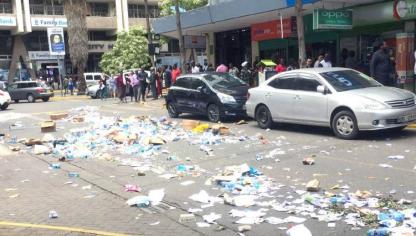
She painted a stark picture of the current situation, noting that Nairobi generates about 3,600 tonnes of waste each day, but only between 45 and 55 per cent is collected.
The remainder is often dumped illegally, eventually finding its way into rivers, roads and informal settlements.
The consequences are felt daily by residents: clogged drainage systems that worsen flooding during rains; the spread of disease linked to poor sanitation; rising urban temperatures; and declining property values in affected neighbourhoods.
“While financing is critical, addressing the issue will also require coordinated action between government agencies and residents,” Njeri said, emphasising that money alone will not resolve the crisis without behavioural change and shared responsibility.
The county is grappling with a Sh5 billion budget deficit in waste management, a gap officials say makes the current funding model untenable.
By introducing a dedicated conservancy fee, the county hopes to create a ring-fenced revenue stream that is both predictable and scalable, reducing reliance on the exchequer.
Under the proposal, Nairobi City Water and Sewerage Company would play an administrative role, collecting the fee alongside water charges and remitting it to the county government.
Managing director Martin Nang’ole said the move had been deemed feasible in collaboration with the Water Services Regulatory Board, noting that the water utility’s role would be limited to collection.
“This is about using an existing system that already reaches most households,” he said, adding that it offers a practical way to improve efficiency in revenue collection without creating a parallel billing structure.
Arnold Karanja, chairman of the Nairobi Water Company’s board, described the ongoing engagements as part of public participation, aimed at explaining the rationale behind the proposal while giving residents a chance to voice their views.
County officials argue similar approaches have worked elsewhere, where levies are integrated into essential services to support public goods such as waste management.
Water and Sanitation chief officer Oscar Omoke said the plan is to leverage the extensive reach of the water utility’s infrastructure to support a cleaner city.
Meanwhile, Environment chief officer Hibrahim Otieno said the county has already contracted a private firm to provide end-to-end waste management services.
This raises expectations among residents who have long endured irregular collection and illegal dumping.
Officials say the shift is also part of a broader move from a linear to a circular economy, where waste is not only disposed of but also reused and recycled to generate value and create jobs.
If implemented, the county promises more reliable daily waste collection, cleaner neighbourhoods, unblocked drainage systems and a reduction in pollution and foul odours that have become a familiar part of life in many parts of the city.
For now, residents are being asked to weigh in on a proposal that could reshape how Nairobi pays for cleanliness—and determine whether the price of a cleaner city will be one they are willing to pay.