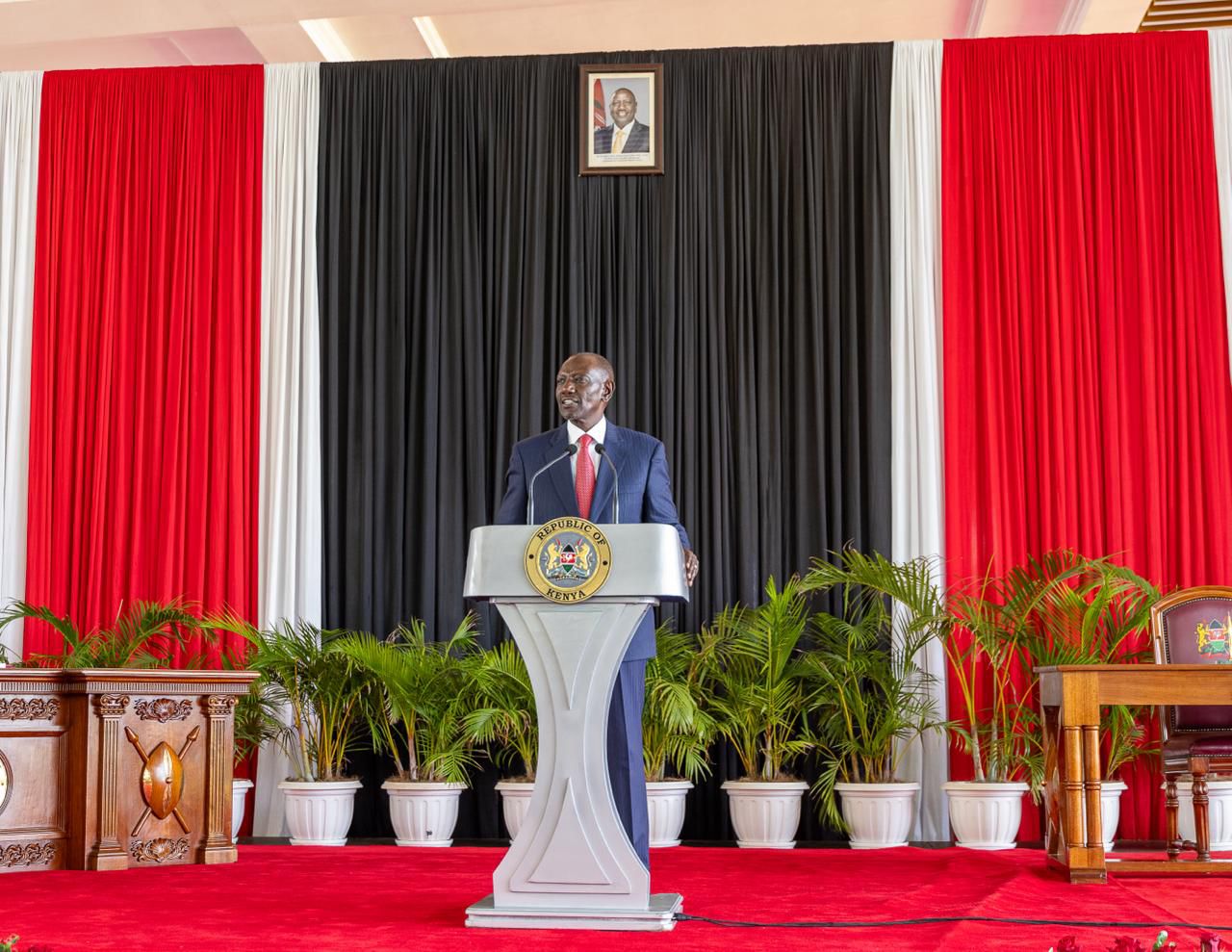
Details have emerged of the administration's deliberate moves to align spending with the President's legacy plan while fulfilling promises made to key voting blocs.
The details buried deep in the National Treasury estimates show a budget designed not just to run the economy, but to secure political survival.
At the top of the political spending is Sh18 billion for the fertiliser subsidy programme, standing out as a direct appeal to the millions of farmers.
While not new, its expansion from last year’s Sh10 billion, coming just as the election cycle heats up, underscores its political statement.
The allocation is, besides Sh2 billion for the seed subsidy programme, Sh2.5 billion for the sugar sector reforms, and billions more for food security interventions.
Treasury has also allocated Sh2 billion for coffee debt waiver, and Sh1.5 billion for the coffee revolving fund.
In his recent Mt Kenya tour, Ruto said he had more up his sleeves to help farmers in the coffee, tea, and milk sectors.
President Ruto’s team has also, in yet another first, allocated Sh3.96 billion for state stipends to village elders.
The elders would now be entitled to Sh3,000 per month starting July 1.
The allocation will go a long way towards fulfilling the administration's long-standing pledge to formalise the elders' role within the local administrative structure.
Critics are likely to view the move as a quiet construction of a political mobilisation machinery, as elders wield significant influence, especially in rural communities.
Ruto’s team in the 2022 election campaigns complained of alleged attempts to use chiefs to mobilise for the then administration in favour of Raila Odinga.
Perhaps more telling is the allocations towards the second phase of the Standard Gauge Railway that is meant to extend the line from Naivasha to Malaba.
The SGR to Malaba remains one of President Ruto’s most significant and most politically delicate infrastructure plans.
It was launched last in March.
Treasury’s Sh20.8 billion to the line signals the government’s intention for the railway, which pundits view as a bargain for the Western vote.
The plan is to build a line from Naivasha to Kisumu – through Narok, Bomet, Nyamira and Kericho counties and onward to the border with Uganda under a Public Private Partnership arrangement.
The government is required to settle land compensation, and also move utilities like water pipelines, oil pipelines, electricity installations, and telecoms infrastructure to clear the route.
The route cuts through Rift Valley and Western Kenya, which is Ruto’s political heartland, and a region where he needs a strong turnout.
Besides the SGR, President Ruto’s team has also set aside significant resources towards railway development, with legacy projects lined up. They include Sh2.7 billion for the acquisition of SGR locomotive wheelsets, Sh2.3 billion for land acquisition, and Sh436 million for the Nairobi Railway City.
The latter envisions transforming the area around the Nairobi Central Railway Station into a modern hub with parks, offices and transport links.
Other infrastructure allocations include Sh580 million for the Nairobi Bus Rapid Transport project, Sh500 million for the dredging of Kisumu port, and Sh412 million for various airstrips.
Roads, which are also central to Ruto’s election agenda, will be funded at Sh230 billion, with Sh48 billion for the construction of roads, Sh64 billion for rehabilitation, and Sh118 billion for maintenance.
President Ruto is banking on road projects, notably the Rironi-Mau Summit expressway, to leave a lasting legacy. He has also pledged the dualling of key connectors, especially in Nairobi and Mombasa.
In what could pass as an attempt to appease the Coast region, Treasury has allocated Sh5 billion for the settlement of the landless, specifically for the region.
Other resettlement efforts for the landless in other regions have been factored into a separate budget of Sh1.5 billion. Another Sh1.7 billion has been set aside for the acquisition of Kedong Ranch, a key political issue among the Maasai.
Treasury has further allocated billions for youth and women, who are also a key target population in Ruto’s reelection calculus.
Estimates show that Sh4.7 billion would go to the Nyota programme, and Sh410 million to the Women Enterprise Fund.
The government is banking on the Nyota programme, bolstered by the World Bank, to empower the restive youthful population.
The Treasury is further expected to set aside funding to compensate victims of police brutality.
Some Sh61.8 billion has been allocated to the National Government Constituency Development Fund (NG-CDF), an increment from this year’s Sh58 billion.
CDF fuels local politics, and Ruto has been joining MPs for project launches, including classrooms, boreholes, and road repairs.
Pundits and MPs have hailed it as visible, tangible, and directly attributable to the current administration.
Jobs also feature prominently in the allocations, with about Sh5 billion set aside for the conversion of 20,000 teachers to permanent and pensionable terms from January 1, 2027.
Another Sh8.1 billion has been set aside for intern teachers, mostly posted to support Junior Secondary Schools.
The Kenya Kwanza administration further plans to spend Sh30 billion in scholarships for university students, Sh9.2 billion for TVET students, and Sh56 billion to the Higher Education Loans Board (Helb).
To avert the backlash the administration suffered last year on the national examinations waiver, the Treasury has allocated Sh9.9 billion for school exams and invigilation.
It forms part of the education’s Sh668 billion budget – the largest compared to other sectors, besides debt repayment.
Sh54.6 billion has been set aside for free day secondary school, Sh30 billion for junior secondary schools' capitation, and Sh7 billion for primary schools.
A further Sh3 billion has been set aside for school feeding programmes, Sh3 billion for improving schools' infrastructure, and Sh12 billion for classrooms and laboratories under the KPEEL and QESIP projects.
Equalisation Fund, a special kitty for the marginalised regions, has been allocated Sh9.6 billion, targeting 34 counties, especially in the North.
UHC workers, based in counties, are also set to receive Sh8.9 billion in conditional grants for health workers.
This is besides Sh3.2 billion for community health promoters, and Sh396 million to insure them under SHA.
The government further appears keen to implement the electronic identification system in the face of Sh2.3 billion being set aside for the same.
Taken together, the allocations paint a picture of a government strategically allocating resources, with each line item carefully calibrated to address a specific constituency.
INSTANT ANALYSIS
And as the country edges closer to the 2027 election cycle, the budget offers a revealing glimpse into how the Ruto administration plans to hold its ground. This would be achieved by spending where it matters most politically, even as the fiscal room continues to tighten.