When you boarded your last flight, two pilots sat in the cockpit. Neither was trusted, by training or regulation, to fly alone. They ran each other's checklists. The cowboy pilot was grounded 40 years ago, after enough avoidable crashes that the industry accepted a principle most of us would now find obvious. No single human mind, in conditions of complexity, is reliable enough to be unchecked.
Engineering accepted this earlier. Every load calculation passes through peer review. Every drawing is signed by more than one hand.
The military reached the same conclusion in blood. After the intelligence failures that preceded the 1973 Yom Kippur War, the Israeli Defence Forces instituted the doctrine of the tenth man. If nine analysts in a room agreed on an interpretation, the tenth was required, by structure, to argue the opposite. The system had finally accepted that consensus, in conditions of complexity, is the most dangerous state of mind a group can occupy.
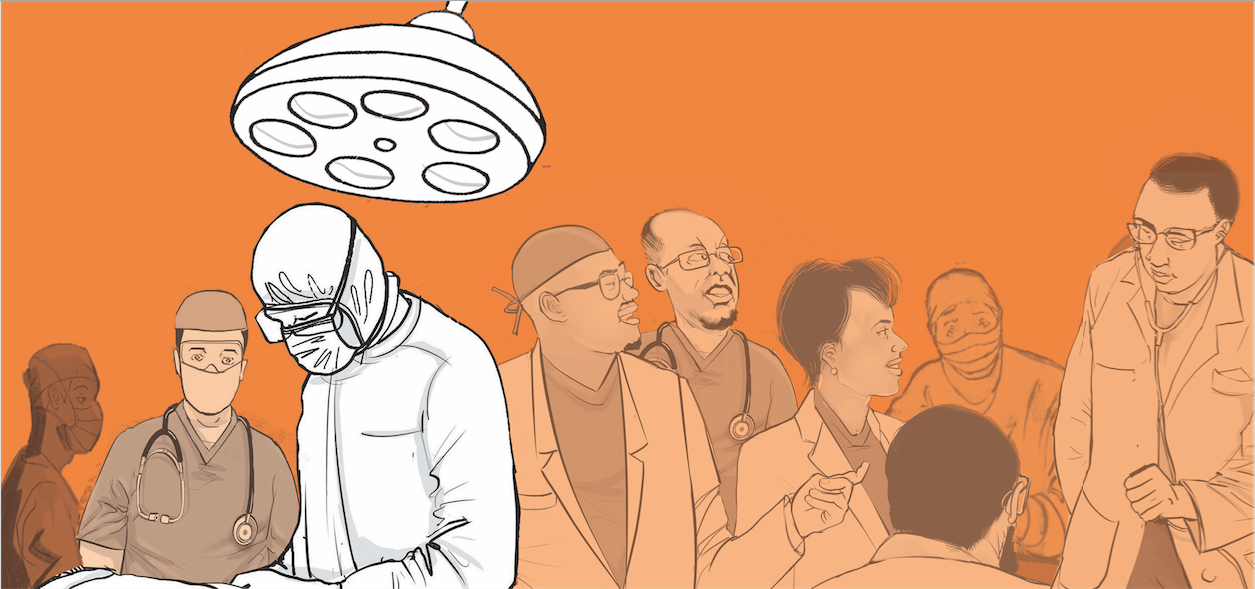
Surgery is the holdout. We still permit unchecked individual judgment. A single surgeon may decide, in the privacy of her own office, to operate on a cancer she has rarely encountered. No second mind reviews the imaging. No tumour board confirms the plan. No registry records her outcomes. There is no tenth person in the room, because there is no room.
I learned surgery on a ward round at the University of Dar es Salaam. The teaching was collegial in a way I have come to recognise as rare. Decisions about patients were collective by default. Even a student's opinion could shift a plan. I once raised an observation at the bedside that quietly changed the operative approach. What the Israeli Defence Forces would later codify into doctrine, my teachers in Dar practised by instinct.
Years later, at the University of Nairobi master's programme, there was a fear in the room. Brilliant clinicians hesitated. They dressed disagreements in apology. To be wrong out loud was a professional risk. The discussion had grown careful in a way it had not been in Dar.
Private practice has taken what was left. We do not consult colleagues because no system pays us to. We do not invite criticism because no system exists in which criticism arrives without cost.
What remains is the colleague who reads our films over coffee unprompted. Early in my consultancy, I was about to take a patient to theatre for a procedure I had decided was correct. A colleague stopped me in the corridor. He asked whether I had considered that this might not be the primary.
It was not. The mass on her thigh was a metastasis. The primary was elsewhere, undiagnosed, and would have killed her regardless. What saved me was the residue of an older practice. It was the corridor doing, by chance, what the ward round used to do by design.
We have replaced design with luck. We have replaced collective judgment with private decision. We have replaced the ward round with the corridor, and the corridor with silence.
The most dangerous moment in cancer care is not the surgical error. It is the meeting that did not happen. The image that was not reviewed by a second pair of eyes. We obsess over surgical complications because they are visible and litigable. The absent meeting hides because absence does not appear in any indicator we collect. Yet it kills more patients than the surgical error ever has.
The cost is not abstract. It is the patient with an above-knee amputation she did not need. It is the woman whose breast was removed before anyone considered whether neoadjuvant chemotherapy would have shrunk the tumour into a lumpectomy. Neither met a bad surgeon. Each met a system that did not require the case to pass through a room where minds disagreed before blades moved.
I know how this sounds to colleagues who have spent their careers operating in good faith. It sounds like accusation. It is the opposite. The heroic frame is a burden the system has placed on you, not a privilege it has granted you. It asks you to carry decisions that no mind should carry alone. The lone surgeon is not the beneficiary of this system. The lone surgeon is its casualty.
The reform is not novel. It is restoration. Reimburse the multidisciplinary meeting as a billable activity. Mandate referral pathways for rare cancers. Build outcome registries with the courage to publish them. None of this is radical. All of it is overdue.
But the deepest reform is cultural. It is the willingness to be the tenth person in the room. The one who raises a hand when nine others have already nodded, because the field has finally remembered that unchallenged consensus is where catastrophe is born.
Cancer care is a conversation. The patients we lose are the ones whose conversation never happened. The patients we save are the ones whose cases passed through enough minds to catch what one mind could not.
The ward round is the most important room. The corridor is what is left of it. We have emptied both. It is time to fill them again.
Comments 0
Sign in to join the conversation
Sign In Create AccountNo comments yet. Be the first to share your thoughts!