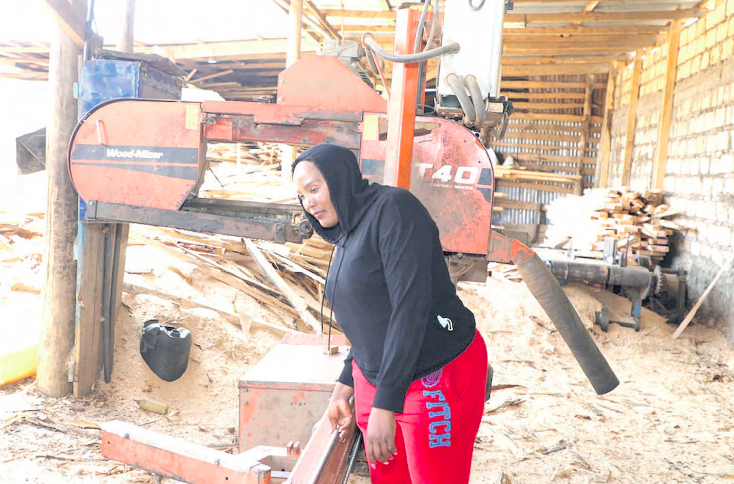
Sawmiller Margaret Mburu checks one of her machines /GILBERT KOECH
A new survey has shown that the contribution of natural resources to gross domestic product has significantly improved.
The Economic Survey 2026 shows that the overall share of the environment and natural resources sector in GDP rose to 4.3 per cent in 2025, compared to 3.9 per cent in 2024.
The survey, released on Wednesday by the Kenya National Bureau of Statistics, showed that logging contributed Sh199 billion in 2021, Sh242.9 billion in 2022, Sh277.5 billion in 2023, Sh339.3 billion in 2024 and Sh396.7 billion in 2025.
The survey presents the performance of the economy over the last five years and provides an economic outlook for 2026.
It also showed that fishing and aquaculture contributed Sh80.7 billion in 2021, Sh84.3 billion in 2022, Sh89.4 billion in 2023, Sh109.8 billion in 2024 and Sh146.1 billion in 2025.
Mining and quarrying contributed Sh92 billion in 2021, Sh120.1 billion in 2022, Sh110.2 billion in 2023, Sh112.6 billion in 2024 and Sh141.7 billion in 2025.
Water supply contributed Sh63.3 billion in 2021, Sh64.7 billion in 2022, Sh67.8 billion in 2023, Sh71.5 billion in 2024 and Sh74.8 billion in 2025.
Overall, environment and natural resources contributed Sh435.1 billion in 2021, Sh512.1 billion in 2022, Sh544.8 billion in 2023, Sh633.2 billion in 2024 and Sh759.3 billion in 2025.
The survey showed that the population of endangered wildlife species in 2025 included 42,072 elephants, 2,512 lions and 1,059 black rhinos.
It also showed that there were 119,816 tonnes of freshwater fish in 2024 and 125,374.6 tonnes in 2025.
Marine fish stood at 48,608 tonnes in 2024, while the tonnage in 2025 was 63,776.
The survey shows that the total forest area was 5,226,200 hectares (12,914,201 acres) against a total country area of 59,196,900 hectares (146,278,499 acres).
Forest cover in the country increased from 5.9 per cent in 2018 to 8.83 per cent in 2021, while the national tree cover stands at 12.13 per cent, above the constitutional target of 10 per cent.
Results generated from the National Forest Resources Assessment 2021 show that the country has 5,226,191.79 hectares of national forest cover, which represents 8.83 per cent of the total area.
In addition, the results reveal that the country has a tree cover per capita index of 1,507.48 m² per person.
The report shows the distribution of forests and tree cover across the 47 counties.
According to the assessment, 37 out of 47 counties (79 per cent) have a tree cover percentage greater than the constitutional target of 10 per cent.
The central region, and parts of the western and coastal regions, are the most forested.
The proportion of total land area under forests and tree cover varies significantly by ecological regions and counties.
Nyeri has a tree cover of 45.17 per cent, Lamu 44.06 per cent, and Vihiga 35.92 per cent.
Counties with the lowest tree cover include Kisumu (8.85), Busia (8.39), Uasin Gishu (8.04), Taita Taveta (6.87), Isiolo (6.7), Machakos (6.03), Siaya (5.27), Wajir (4.45), Mandera (3.61) and Marsabit (2.06).
The report shows that wooded grasslands account for the highest land cover in Kenya, with approximately 70 per cent of the total land area.