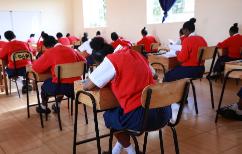
 Girls seated for an exam at school./FILE
 Enrollment in pre-primary schools has increased to 3.1 million in 2025, with more girls joining classrooms across the country.
Pre-primary school enrolment in Kenya rose sharply in 2025, driven by increased access to early learning and a steady rise in the number of girls joining school, according to the Economic Survey 2026 released by the Kenya National Bureau of Statistics.
Total enrolment grew by 7.1 per cent, from 2.91 million pupils in 2024 to 3.12 million in 2025. Girls accounted for 49.6 per cent of learners.
Education analysts attribute the rising number of girls in pre-primary schools to sustained government and community efforts to promote early childhood education, growing awareness among parents and targeted interventions aimed at keeping girls in school from an early age.
“The near-equal enrolment of girls and boys at pre-primary level reflects the success of policies that encourage early childhood education and address barriers to girls’ access,” said an education policy analyst familiar with the survey findings.
The expansion of learning infrastructure has also played a key role. The number of pre-primary schools increased to 48,190 in 2025, up from 47,760 in 2024, improving access, especially in underserved areas.
The survey also showed that total expenditure is projected to rise from Sh615.8 billion in the 2024-25 financial year to Sh702.1 billion in 2025-26, with recurrent spending taking up the bulk at 95.8 per cent.
Across the basic education cycle, combined enrolment in primary and junior schools rose by 11.2 per cent to 11.9 million learners in 2025.
“The Competency-Based Education system saw its first full cohort in junior school reach 3.7 million learners across Grades 7, 8 and 9,” the survey showed.
Meanwhile, the gradual phase-out of the 8:4:4 system saw secondary school enrolment stand at 3.34 million students, covering Forms 2, 3 and 4.
The number of basic learning institutions increased to 130,659 in 2025, up from 129,463 the previous year. This includes growth in primary schools to 39,339, junior schools to 32,079, and secondary schools to 11,051.
The Economic Survey also indicated that teacher capacity is expanding, with the number of trained teachers rising by 5.5 per cent to 81,843.
Notably, female teachers account for 87.4 per cent of the workforce at this level, providing important role models that may further encourage girls’ enrolment and retention.
“Female teachers often play a critical role in supporting young girls, especially in early years, by creating safe and inclusive learning environments,” the report added.
Experts note that early gains in pre-primary enrolment, particularly among girls, are critical for long-term education outcomes.
“Getting more girls into school early improves retention, learning outcomes and eventually transition to higher levels of education,” it shows.
“It is one of the most effective ways to narrow gender gaps across the education system.”
Beyond basic education, the survey pointed out increased investment in skills and higher education. The number of Technical and Vocational Education and Training institutions rose by 13.4 per cent to 3,126, while universities increased from 72 to 74.
Student financing also expanded, with loans disbursed by the Higher Education Loans Board rising by 32.1 per cent to Sh62 billion in 2025-26.
However, bursary allocations dropped significantly, largely due to the shift towards the New Funding Model.