The last contingent of 150 police officers arrived in Kenya on Tuesday from Haiti, marking the end of the two-year mission in the Caribbean country.
The Kenya-led Multinational Security Support mission, however, concludes under mixed outcomes.
While Nairobi, through President William Ruto and the Foreign and Interior ministries, has persistently praised the successes of the mission, United Nations reports point to a worsening humanitarian and security crisis in the Caribbean nation.
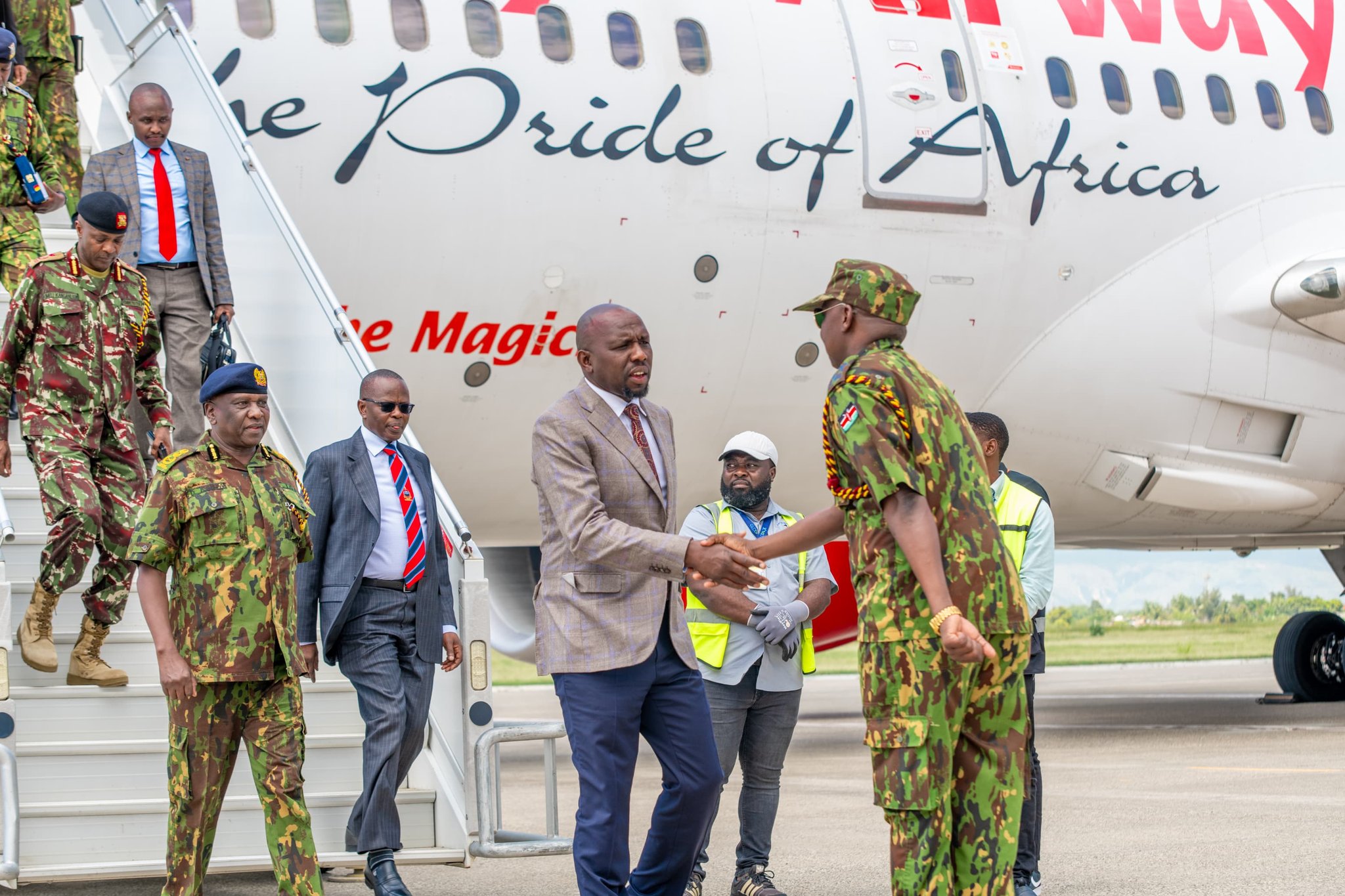
Interior CS Kipchumba Murkomen and Inspector General of Police Douglas Kanja travelled to Haiti this week to oversee the final phase of the drawdown, meeting the remaining Kenyan contingent and commending them for what the government described as a successful mission.
The MSS mission, deployed under the authority of the United Nations Security Council, is now transitioning to a new Gang Suppression Force.
Murkomen conveyed a message of goodwill from President Ruto, praising the officers for their “unwavering commitment and sacrifice” in restoring law and order.
Kanja emphasised the professionalism and discipline displayed throughout the deployment.
Officials briefed the visiting delegation on what they termed key successes of the mission, including the “pacification and stabilisation” of targeted areas and the establishment of a foundation for longer-term security interventions.
The government has consistently framed the mission as a demonstration of Kenya’s growing role in global peace and security, positioning the country as a credible partner in international stabilisation efforts.
However, findings from the Office of the United Nations High Commissioner for Human Rights present a more sobering assessment of the situation in Haiti.
According to the UN report, 5,519 people were killed and 2,608 injured between March 2025 and January 2026, underscoring the scale of violence during the period of Kenya’s deployment.
The data indicates that while gangs were responsible for a large share of killings, security operations and vigilante actions also contributed significantly to the toll, according to the report.
The report details how gangs have expanded their reach beyond the capital, Port-au-Prince, into surrounding regions, consolidating control over key transport and economic corridors that sustain their operations.
Civilians have faced widespread abuses, including killings, kidnappings, extortion and sexual violence. The report documents cases of gang rape, forced exploitation and brutal killings, with some victims executed publicly or burned.
In an April 7 letter to António Guterres, Prime Cabinet Secretary and Foreign Affairs CS Musalia Mudavadi defended the mission’s record, rejecting claims of misconduct and criticising what he termed inaccuracies in UN reporting.
Mudavadi said allegations of sexual exploitation and abuse reported in 2025 were investigated and found to be unsubstantiated, with no formal complaints filed. He stressed that Kenyan officers operated within strict human rights frameworks and maintained high standards of accountability.
UN High Commissioner for Human Rights Volker Türk warned the situation remains fragile, urging authorities to balance security operations with strict adherence to human rights standards.
“It is essential for authorities to provide security while fully upholding human rights,” Türk said.
The report also raises concerns about the conduct of some security operations, including instances of excessive use of force and alleged summary executions of suspected gang members.
It further highlights the involvement of private military contractors in operations using drones and helicopter gunfire, with limited accountability mechanisms in place.
In addition, self-defence groups have carried out mob justice killings, sometimes with alleged support from elements within the police, complicating efforts to restore order and the rule of law.
Despite these challenges, Kenyan officials maintain the MSS mission achieved its core objectives, including stabilising key zones and paving the way for a structured international response through the new Gang Suppression Force.
The mission also came at a cost.
At least three police officers lost their lives during the deployment, including in an ambush and a road accident, while another officer remains missing. Several others were injured. The fallen have been honoured for their service.
In a farewell message, the Gang Suppression Mission — the successor — said the Kenyan forces served in Haiti “with courage and unwavering dedication — often under the most challenging conditions imaginable”.
“When Haiti needed support most, Kenya answered the call. This commitment to peace and service beyond borders leaves a lasting legacy,” GSF said.
From the outset, the deployment faced scepticism and legal scrutiny, with critics questioning both its mandate and the potential risks to Kenyan personnel.
The opposition had also called for the return of the officers, arguing the mission was not a priority for Kenya.
Inspector General Kanja urged returning officers to apply lessons learned in Haiti to improve policing at home, framing the mission as both a security and capacity-building exercise.