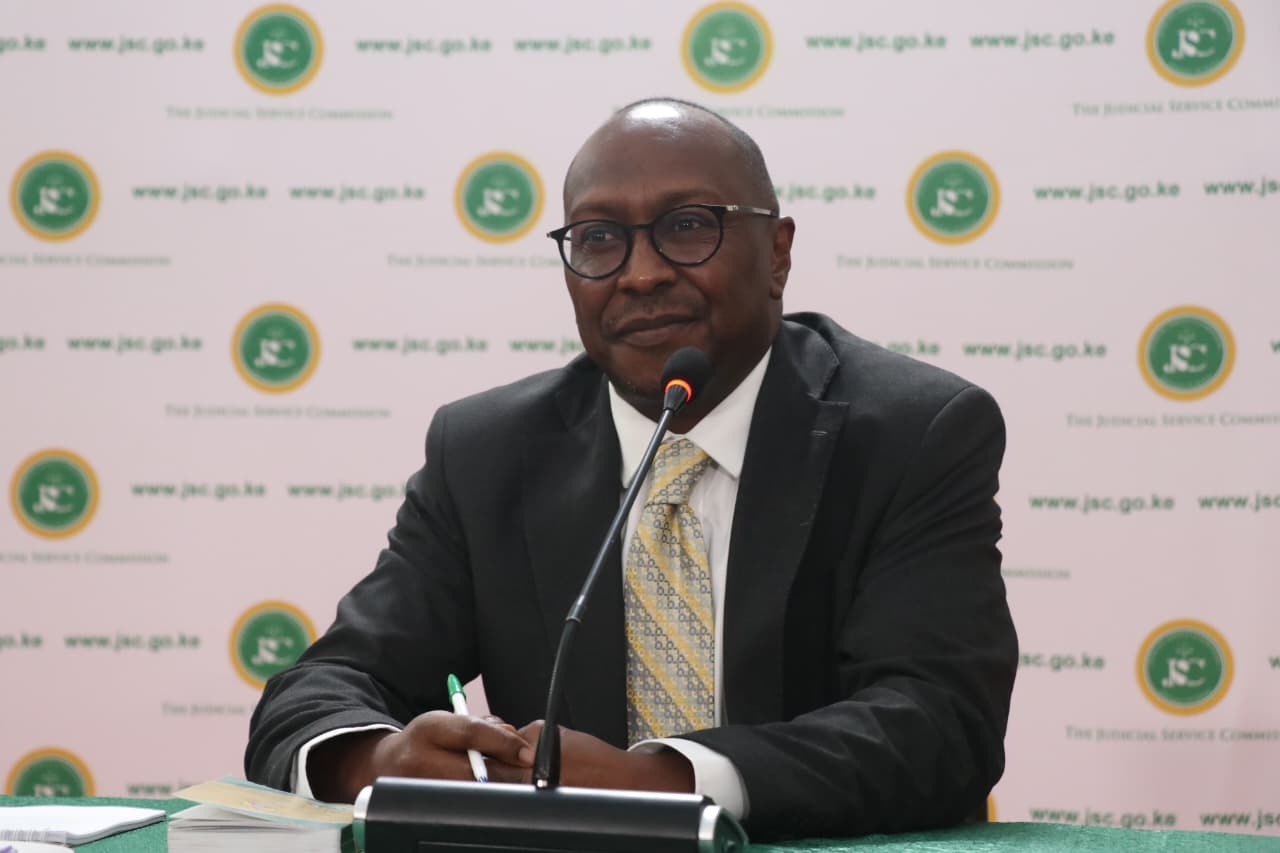
 Justice Francis Tuiyott, when he appeared for an interview before the Judicial
Service Commission at Milimani Law Court in Nairobi yesterday /LEAH MUKANGAI
Justice Francis Tuiyott, when he appeared for an interview before the Judicial
Service Commission at Milimani Law Court in Nairobi yesterday /LEAH MUKANGAI
A chronic pattern of flawed investigations has been identified as the primary factor undermining the criminal justice system.
Court of Appeal judge Francis Tuiyott said high-profile cases often collapse because of systemic weaknesses that begin long before a file reaches the desk of a magistrate or judge.
Justice Tuiyott noted that judges often see the same mistakes being repeated.
"The court cannot fill the gaps left by the investigator. If the investigation is defective, the case must fall, because the burden of proof is always on the prosecution," Tuiyot said.
He was speaking during an interview with the Judicial Service Commission on Wednesday. Tuiyot is among five candidates interviewed by the JSC to fill the position of judge of the Supreme Court.
"We often see cases where the chain of custody is broken, or where forensic evidence is not properly collected. These are not just mistakes; they are a pattern that suggests we need deeper institutional reform in our investigative agencies."
Responding to questions about public frustration over acquittals, he remarked, "It is better for a guilty person to go free than for a court to convict based on a defective and hollow investigation. Our duty is to the law and the constitution, not to public clamour."
He warned that defective investigations undermine public confidence.
"When the public sees a clear crime but the investigation is so poor that the court has no choice but to acquit, it is the justice system that loses credibility."
Asked about managing presidential election petitions without compromising the quality of justice, Tuiyott emphasised its necessity for national stability.
The Court of Appeal judge, who previously served in the High Court and as chairman of the Sugar Arbitration Tribunal, told the commission that his career has prepared him to handle the most sensitive constitutional disputes.
"The pressure of time must never be an excuse for a shallow judgment. The public must see that even in those 14 days, the court applied its mind to the most critical grievances brought by the petitioners."
He advocated for the full adoption of e-filing and electronic evidence playback during the hearings.
Another candidate, Justice Mohamed Warsame, a Court of Appeal judge since 2012 and a JSC member for a decade, urged the panel to consider his long record of public service.
Asked about the relationship between the Judiciary and the Executive, he asserted that a Supreme Court judge must be prepared to be "unpopular in the corridors of power."
He said the Supreme Court does not just need brilliant lawyers; it needs "judges who are not afraid of their own shadows".
Warsame said judges should never shy away from difficult political or social questions.
"The Supreme Court is the ultimate shock absorber of the nation's tensions. If the court seeks convenient exits through technicalities when faced with a contentious matter, it abdicates its constitutional role," he said.
"I have observed a pattern where the court occasionally retreats into 'safe' jurisprudence. But the law is not meant to be safe; it is meant to be right. We must be prepared to give 'bitter medicine' if that is what the constitution prescribes."
On the supremacy of the constitution, Justice Warsame emphasised that while Sharia law has a place within the Kadhis' courts, the constitution remains the ultimate lens through which all rights are viewed.
“There is no conflict where there is justice."
Addressing potential conflicts between religious beliefs and modern human rights, he noted that the law must evolve and a judge’s duty is to harmonise these values.
“A fair hearing means that the vulnerable, especially women and children in Sharia-related cases, are not left at the mercy of archaic interpretations."