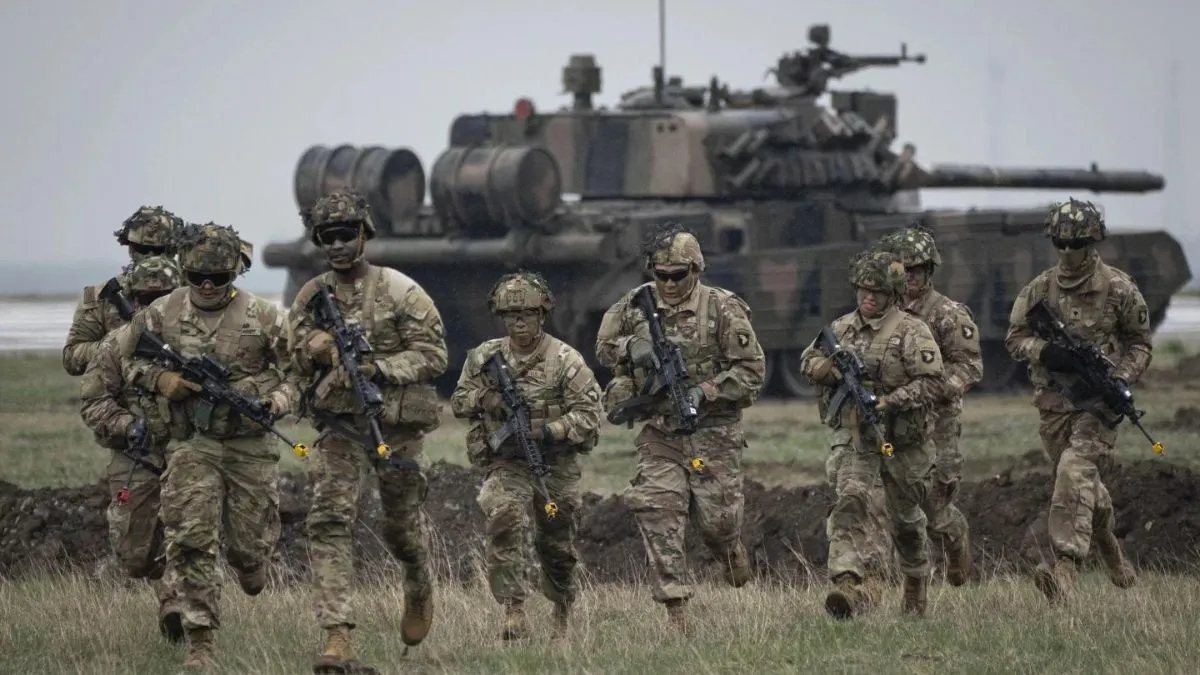
The world’s militaries spent $2.88 trillion (about Sh374 trillion) in 2025, an increase of 2.9 per cent from 2024, according to Sweden’s Stockholm International Peace Research Institute’s (SIPRI) latest report.
At 2.9 per cent, the annual spending increase was significantly smaller than the 9.7 per cent increase recorded in 2024, the report states.
However, this slowdown is largely accounted for by a drop in US military spending. Outside the USA, total spending grew by 9.2 per cent in 2025.
According to the research group, military expenditure refers to all government spending on current military forces and activities, including salaries and benefits, operational expenses, arms and equipment purchases, military construction, research and development, and central administration, command and support.
The top three military spenders—the USA, China and Russia—spent a combined total of $1480 billion (Sh192 Trillion), or 51 per cent of the global total, according to new data published by SIPRI on April 27.
In 2025, the five biggest military spenders were the United States ($954bn), China ($336bn), Russia ($190bn), Germany ($114bn) and India ($92bn), accounting for more than half (58 per cent) of world military spending.
The US is by far the biggest spender, as it has been every year since World War II, with the $954bn (about Sh124 trillion) spent by the US more than the next six countries combined.
China, the world’s second largest military spender, increased its military spending by 7.4 per cent to $336 billion (about Sh44 trillion) according to the report.
This was the 31st consecutive year-on-year increase as China continued its military modernisation drive. A renewed campaign against corruption in military procurement does not appear to have constrained spending.
“Global military spending rose again in 2025 as states responded to another year of wars, uncertainty and geopolitical upheaval with large-scale armament drives,’ said Xiao Liang, Researcher with SIPRI’s Military Expenditure and Arms Production Programme.
“Given the range of current crises, as well as many states’ long-term military spending targets, this growth will probably continue through 2026 and beyond.”
At $954 billion, military spending by the United States was 7.5 per cent lower in 2025 than in 2024. The drop was primarily due to the fact that no new financial military assistance for Ukraine was approved during the year. This was in sharp contrast to the previous three years, when a total of $127 billion was approved.
However, the USA increased investments in both nuclear and conventional military capabilities to maintain dominance in the Western Hemisphere and deter China in the Indo-Pacific, which are key goals of the new National Security Strategy.
“The decline in US military expenditure in 2025 is likely to be short-lived,” said Nan Tian, Programme Director of the SIPRI Military Expenditure and Arms Production Programme.
“Spending approved by the US Congress for 2026 has risen to over $1 trillion, a substantial increase from 2025, and could rise further to $1.5 trillion in 2027 if President Trump’s latest budget proposal is accepted.”
The main contributor to the global increase in military spending in 2025 was a 14 per cent rise in Europe to $864 billion.
The report found that total military spending in Africa increased by 8.5 per cent in 2025 to reach $58.2 billion.
Military expenditure in sub-Saharan Africa totalled $23.3 billion in 2025, up by 7.4 per cent compared with 2024 and 21 per cent more than in 2016.
The year-on-year increase was largely driven by higher spending in Nigeria, the second-largest spender in the subregion.
Nigeria’s military expenditure rose by 55 per cent to $2.1 billion (Sh273 billion) in 2025 against the backdrop of the worsening security situation in the country linked to insurgencies and extremist violence.
South Africa, the largest military spender in sub-Saharan Africa, allocated $3.2 billion (Sh416 billion) to the military in 2025, a 1.2 per cent decrease from 2024 and 19 per cent lower than in 2016.
Amid the persistent cuts in spending, the South African Auditor General is investigating historical irregular expenditures of roughly $900 million by the South African Department of Defence.
Military expenditure in the Democratic Republic of the Congo increased by 20 per cent to $1.2 billion in 2025 as the conflict with a Rwandan-backed non-state armed group escalated during the first half of the year. The two sides agreed on a ceasefire in July 2025.
Spending by Russia and Ukraine continued to grow in the fourth year of the war in Ukraine, while ongoing rearmament efforts by European NATO members led to the sharpest annual growth in spending in Central and Western Europe since the end of the Cold War.
Russia’s military spending grew by 5.9 per cent in 2025 to $190 billion, giving it a military burden of 7.5 per cent of GDP. Ukraine, the seventh largest spender in 2025, increased its spending by 20 per cent to $84.1 billion, or 40 per cent of GDP.
Military expenditure in the Middle East reached an estimated $218 billion in 2025, just 0.1 per cent higher than in 2024. Besides Israel, most of the other major spenders in the region for which data is available increased their spending.
The military expenditure of Israel decreased by 4.9 per cent to $48.3 billion, reflecting a reduction in the intensity of the war in Gaza during 2025 after the ceasefire agreement with Hamas in January 2025. Nevertheless, Israel’s spending remained 97 per cent higher than in 2022.
Military spending by Türkiye grew by 7.2 per cent in 2025 to $30.0 billion, partly driven by its ongoing military operations in Iraq, Somalia and Syria.
Between 2024 and 2025, military spending by the United Kingdom decreased by 2.0 per cent to $89.0 billion as France’s military expenditure rose by 1.5 per cent to $68.0 billion in the same period.
India, the fifth biggest military spender in the world in 2025, increased its military spending by 8.9 per cent to $92.1 billion as Pakistan’s military spending increased by 11 per cent to $11.9 billion.
Saudi Arabia’s military spending increased by 1.4 per cent to reach $83.2 billion, making it the eighth biggest military spender in the world.
Another plan focused on taking over part of the Strait of Hormuz so that it can be reopened for commercial shipping, Axios reported, adding that doing so could involve troops on the ground.
Meanwhile, a statement attributed to Iran's Supreme Leader, Mojtaba Khamenei, said that Tehran would secure the Strait of Hormuz and eliminate "the enemy's abuses of the waterway".
Khamanei's statement on Thursday also said a "new chapter" for the region had been taking shape since the start of the US-Israeli war with Iran on 28 February.
The current Brent futures contract for June delivery is due to expire on Thursday. The more active July contract was trading at around $110 a barrel.
Futures contracts are agreements to buy or sell an asset at a set date.
The US said it would blockade Iranian ports for as long as Tehran continues to threaten vessels that try to use the Strait of Hormuz, severely disrupting global energy shipments.
Iran retaliated against US-Israeli airstrikes by threatening to attack ships in the waterway, through which about a fifth of the world's energy usually passes.
Oil prices had surged by 6% on Wednesday following reports that Washington was preparing for an "extended" blockade of Iran.
"It does seem as though escalation in the war is back on the table, be it in the guise of the US continuing its blockade of Iran, but also reports and rumours that in order to get out of this bind, Iran may start to strike again," said Naveen Das, senior oil analyst at Kpler.
He told the BBC's Today programme that an oil price approaching $125 is the point where businesses and politicians "start to get a bit more jittery".
"We might start seeing maybe more headlines of trying to de-escalate again," he added, because the increase in prices "has a knock-on effect not only on oil, but oil-related products, inflation and basically every factor of our day-to-day lives".
Susannah Streeter, chief investment strategist at Wealth Club, said costs could remain high into next year.
"Urea shipments, used for fertiliser, are blocked, and costs have rocketed for farmers around the world, who didn't buy stocks in advance.
"The worry is that all these costs will be passed on through supply chains, pushing up the price of everyday goods, later in the year and into next year."