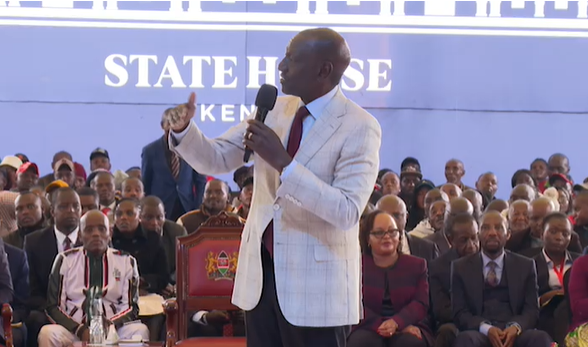
 President William Ruto addressing Kirinyaga county grassroots leaders’ meeting at State House, Nairobi, April 29, 2026.
President William Ruto has renewed his call for Kenya to scale up electricity production to 10,000 megawatts, arguing that the country risks losing high-value investments unless it urgently expands its energy capacity.
Speaking on Wednesday at State House, Nairobi, Ruto cited a failed $1 billion data centre project by Microsoft as a stark example of how limited power supply is constraining economic opportunity.
The President said the deal collapsed despite advanced preparations, after it emerged that Kenya could not meet the facility’s energy demands.
“We signed the contract, and I was told we will give you a billion dollars for the project. We clapped. When I arrived here, I hurried up everyone to speed up the paperwork, but at the end, I was told one data centre requires 1,000 megawatts, and Kenya has 3,000 megawatts,” Ruto said.
He was addressing grassroots leaders from Kirinyaga County during a development meeting at State House, Nairobi.
The proposed facility, announced in May 2024, was a joint initiative between global tech giant Microsoft and Abu Dhabi-based AI firm G42.
It was to be constructed at the Kenya Electricity Generating Company (KenGen) Green Energy Park in Olkaria, Naivasha, and would have ranked among the largest private sector investments in Kenya.
Beyond its scale, the project was positioned as a cornerstone for a new Microsoft Azure cloud region in East Africa, building on the company’s earlier expansion through the Africa Development Centre in Nairobi.
The facility was expected to meet rising demand for digital services while reinforcing Kenya’s status as a regional technology hub.
However, Ruto said the country’s limited generation capacity—currently standing at about 3,000 megawatts—made the project untenable.
“To switch on that one data centre would have meant switching off half of Kenya. That’s when I realised we have a problem. We cannot make progress unless we have enough power. That’s why I’m telling you we need 10,000 megawatts,” he said.
The President has repeatedly underscored the urgency of expanding Kenya’s energy base, framing it as a prerequisite for industrialisation and sustained economic growth.
During an address to the Kenyan diaspora in Qatar on November 5, 2025, he warned that the country risked routine load-shedding during peak hours to power the data centre.
“We need a minimum of 10,000 megawatts, and we need it like yesterday,” he said.
In his speech at State House, Ruto indicated that bridging the 7,000-megawatt deficit will require large-scale infrastructure investment, particularly in hydroelectric dams.
He linked the energy strategy to broader agricultural reforms, noting that irrigation expansion will be critical as Kenya shifts away from reliance on rain-fed farming.
“We are almost coming to the end of rain-fed agriculture. You all know that only 15 per cent of Kenya receives rain, 85 per cent is arid and semi-arid. So we need another 2.5 million acres of arable land and dams,” he said.
The remarks reinforce the government's twin focus on energy security and climate-resilient agriculture, even as questions persist over the feasibility of rapidly scaling power generation to meet growing industrial and technological demand.