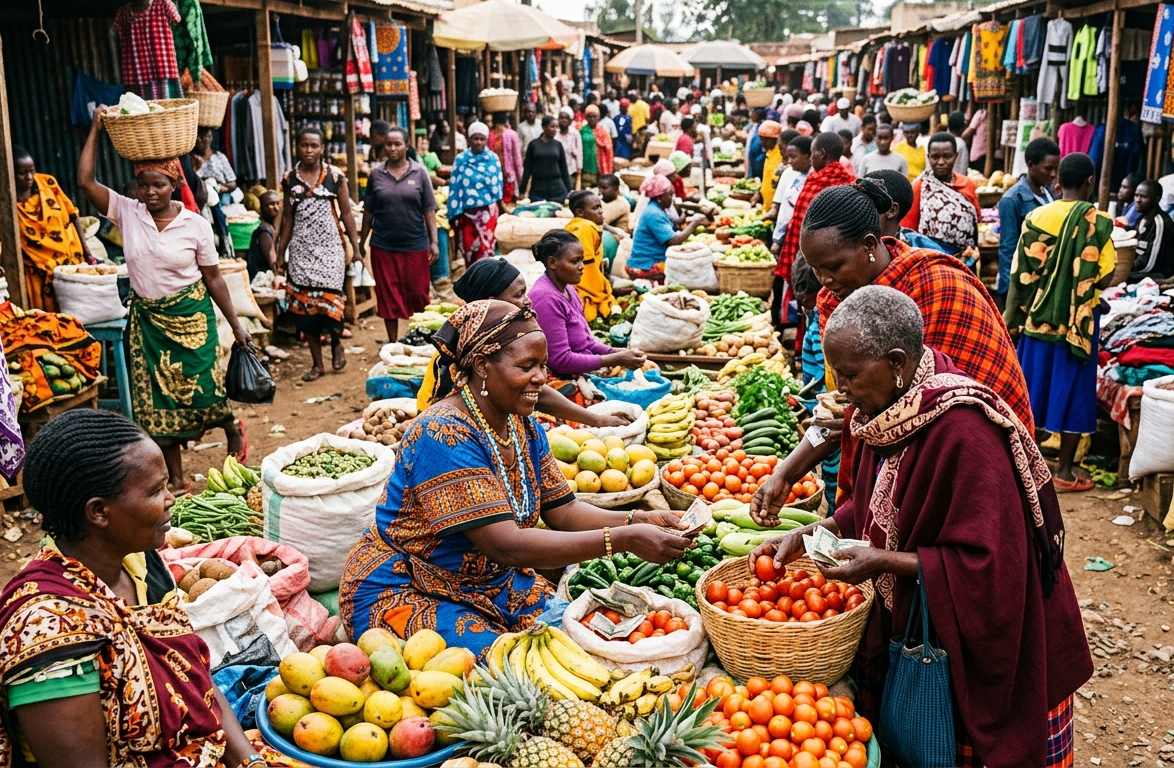
 Women trading in a vibrant market scene/AI GENERATED
Economic empowerment among women remains low in Kenya, according to the latest Economic Survey released in April 2026.
The 2026 Economic Survey indicates that women’s economic empowerment remains moderate, with 36.3 per cent of women aged 18 years and above classified as economically empowered. This translates to approximately 4.9 million women, highlighting substantial gaps that persist despite ongoing policy efforts.
“Clear disparities are observed across place of residence, socio-economic status, and demographic characteristics,” the KNBS report released today states.
The KNBS survey found that marital status also influences empowerment outcomes, where married women exhibit relatively higher empowerment levels (64.0%), particularly those in monogamous unions, while women in polygamous unions and those who are widowed, separated, or divorced tend to have lower empowerment levels.
“A strong positive relationship exists between wealth and empowerment, where 20.0 per cent of women in the lowest wealth quintile were empowered compared to 52.5 per cent of women in the highest quintile.”
Empowerment levels are higher among urban women (41.5%) compared to rural women (33.6%), reflecting differences in access to opportunities, financial services, and infrastructure.
Education emerges as a strong determinant of empowerment, with only 5.8 per cent of women with no formal education empowered, compared to over 50 per cent among those with secondary or post-secondary education.
Similarly, the report adds that empowerment increases with age, peaking among women aged 35–59 years at 44.4 per cent, while younger women aged 18–24 years recorded significantly lower levels at 20.7 per cent.
The report further indicates that a relatively high proportion of women are engaged in economic activities, with about 71.9 per cent reporting employment. At the same time, financial inclusion is also notable, with 79.0 per cent of women owning a bank or mobile money account.
“Overall, the findings underscore that while progress has been made in advancing women’s economic empowerment in Kenya, significant inequalities persist across regions and population groups,” KNBS data shows.
The report provides evidence to support targeted policy actions aimed at improving access to resources, strengthening women’s agency, and enhancing economic opportunities for all women.
The KNBS Women’s Economic Empowerment Index (WEEI) is a composite measure designed to address this gap by providing a multidimensional measure of women’s access to economic opportunities (resources), exercise of decision-making power (agency), and achievement of improved well-being (achievements) using data from the 2022 Kenya Continuous Household Survey (KCHS).
The survey adopted a cross-sectional design covering all 47 counties and targeted women aged 18 years and above. Data was collected through a dedicated Women’s Economic Empowerment module in the survey, implemented across four quarters within one year.
The module captured information on key domains, including employment, financial inclusion, asset ownership, digital engagement, mobility, social participation, gender-based violence, and psychological well-being. Data collection was conducted using Computer-Assisted Personal Interviewing (CAPI) tools.
The sample was drawn from the Kenya Household Master Sample Frame (K-HMSF) based on the 2019 Kenya Population and Housing Census (KPHC). A total of 24,000 households were selected from 1,500 Enumeration Areas using a stratified two-stage sampling design.
From each household, up to two eligible women were randomly selected using the Kish Grid to ensure representativeness. Out of the selected households, 15,189 were eligible for the WEE module, and 14,589 were successfully interviewed. At the individual level, 15,920 women were interviewed out of 19,497 eligible women.
In terms of asset ownership, 71.2 per cent of women reported owning at least one productive asset, with a higher proportion of rural women (75.4%) compared to 63.2 per cent of urban women.
However, saving practices were less common, with only 40.6 per cent of women reporting they had saved money, and a notable gap between urban (50.8%) and rural (35.3%) respondents.
Nationally, three in five women are empowered to make decisions on expenditure at the household level. A higher proportion (62.6%) of women participated in basic household expenditure decisions, 59.0 per cent made decisions about children’s needs and expenses, and 55.9 per cent participated in decisions about major household purchases.
The power to decide on household expenditure increases with the level of education across the three indicators.
On sexual and reproductive autonomy, 57.3 per cent of the women felt justified in refusing to have intercourse, with 61.7 per cent requesting the use of a condom, but only 48.0 per cent felt they could ask their partner to use one.
Across the three indicators of sexual autonomy, a higher proportion of women in urban areas have the power to make decisions compared to rural women.