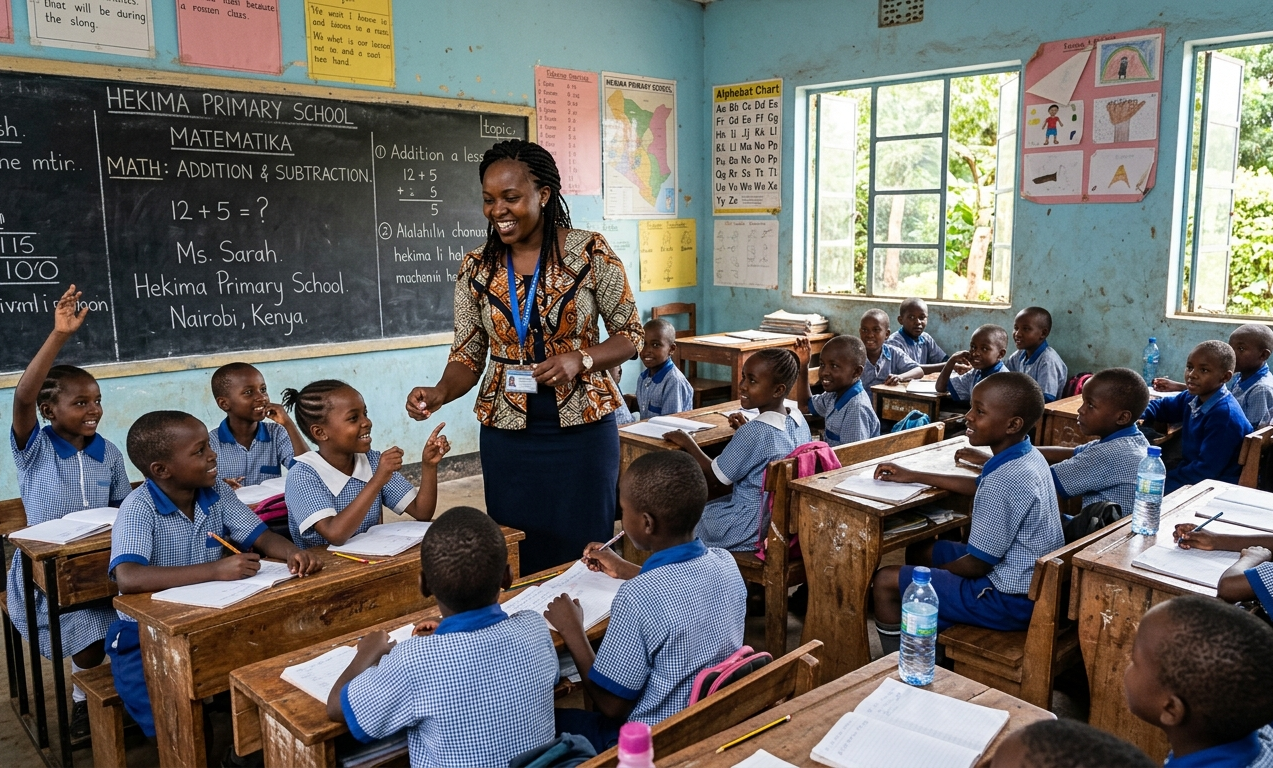
 AI illustration of a classroom setting in a Kenyan school.
The education sector’s contribution to Kenya’s Gross Domestic Product (GDP) has been on a steady decline since 2021, even as government budgetary allocations to the sector continue to rise, new data shows.
GDP refers to the total monetary value of all final goods and services produced within a country’s borders over a specific period.
Findings from the 2026 Economic Survey by the Kenya National Bureau of Statistics (KNBS) indicate that education’s share of GDP fell by 0.5 percentage points between 2021 and 2025, despite a 2.7 percentage point increase in its share of the national budget over the same period.
A summary of the sector's GDP share declined steadily from 4.3 per cent to 3.8 per cent over five years, while budget allocation rose sharply, hitting Sh702.1 billion in 2025–26.
According to the data, the sector contributed 4.3 per cent to GDP in 2021 before dropping to 4.0 per cent in 2022.
The decline persisted, with the contribution falling further to 3.8 per cent in 2023. A slight recovery was recorded in 2024 at 3.9 per cent, before slipping again to 3.8 per cent in 2025.
In contrast, budgetary allocation to the sector steadily increased as a proportion of the total national budget.
The allocation rose from 15.7 per cent in the 2021–22 financial year to 18 per cent in 2022–23.
It climbed further to 19.8 per cent in 2023–24 before easing slightly to 18.4 per cent in 2024–25, a level maintained in the 2025–26 financial year.
In absolute terms, funding to the education sector also showed consistent growth. The government allocated Sh503.9 billion in the 2021–22 financial year, rising to Sh544.4 billion in 2022–23 and then to Sh628.6 billion in 2023–24.
The allocation dipped slightly to Sh615.8 billion in 2024–25 before increasing sharply to Sh702.1 billion in 2025–26.
A breakdown of the data shows that all sub-sectors of education recorded declining or stagnant contributions to GDP over the review period.
Pre-primary and primary education contributed 2.1 per cent in 2021, dropping to 2.0 per cent in 2022, and then stabilising at 1.9 per cent from 2023 through to 2025.
Secondary education contributed 1.2 per cent in 2021 before declining to 1.1 per cent in each of the subsequent years under review.
Higher and other tertiary education followed a similar trajectory, contributing 1.0 per cent in 2021, dropping to 0.9 per cent in the next two years, and settling at 0.8 per cent in 2025.
Over the same period, agriculture, forestry and fishing consistently remained the largest contributor to the economy, with crop production emerging as the biggest revenue earner within the sector.
The agriculture, forestry and fishing sector accounted for 21.5 per cent of GDP in 2021, 21.0 per cent in 2022, 21.5 per cent in 2023, 22.4 per cent in 2024, and 23.2 per cent in 2025.
Within this, crops contributed 15.3 per cent in 2021, 14.9 per cent in 2022, 15.2 per cent in 2023, 15.3 per cent in 2024, and 15.7 per cent in 2025.
KNBS maintained that the Economic Survey report is produced using established and tested methodologies to ensure reliability, objectivity and accuracy, including rigorous quality control measures such as verifying data sources, checking for inconsistencies, and conducting statistical tests.
“The statistics published in the Economic Survey reports are based on a wide variety of sources, including own surveys and censuses, studies carried out by other institutions, and administrative data collected by Ministries, Departments and Agencies, County Governments, and establishments. The sources of data are always duly acknowledged,” the bureau said.