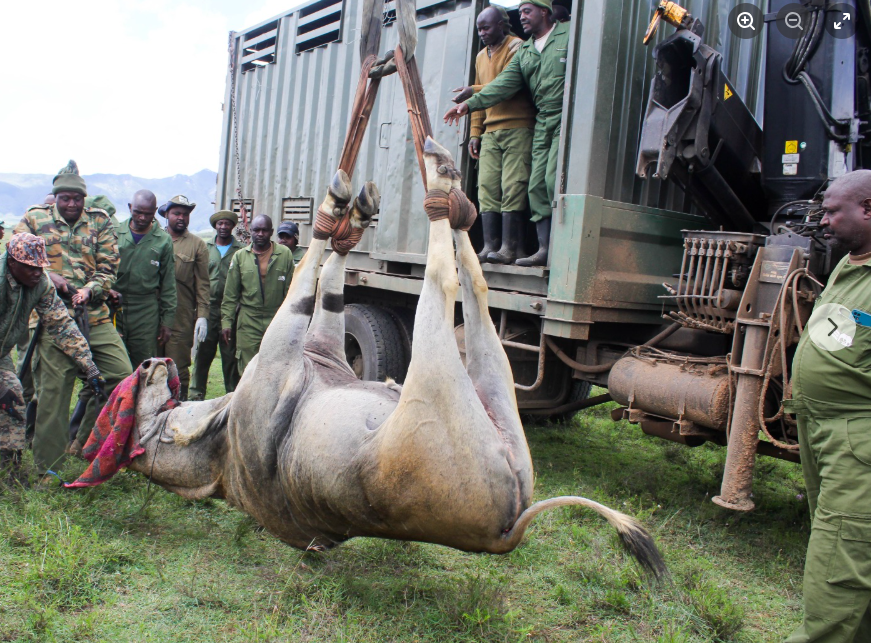
KWS personnel during translocation exercise/KWS
Shrinking wildlife habitats are forcing the Kenya Wildlife Service to intensify translocation efforts, as pressure from human settlement, infrastructure expansion and land fragmentation continues to erode key ecological corridors across the country.
The agency has now embarked on the third phase of relocating herbivores from Kedong Ranch to safer conservation areas, in a bid to secure species survival in increasingly fragmented landscapes.
In a statement on Friday, KWS said the current exercise follows two earlier operations conducted over the past seven months, during which more than 450 animals were successfully moved.
“In a recent operation, the team moved more than 20 Grant’s gazelles and 10 elands from Kedong Ranch to Solai Sanctuary,” the service said.
KWS said Kedong Ranch once played a critical ecological role, acting as a wildlife corridor linking Mount Longonot and Hell’s Gate National Park.
That connectivity, however, has steadily deteriorated.
“Today, that corridor has all but disappeared, lost to fencing, road construction and rapid land sales,” the agency said.
As habitats shrink, wildlife is increasingly confined to isolated pockets where access to food, water and breeding grounds is no longer guaranteed.
KWS says the ongoing phase aims to relocate about 200 herbivores to more stable ecosystems where they can survive and reproduce sustainably.
The intervention reflects a broader national conservation challenge that has been documented for years but only partially addressed.
A government report released in 2017 identified 58 migratory corridors in southern Kenya alone, including critical ecosystems such as the Maasai Mara, Eburu Forest, the Naivasha–Nakuru basin, Athi–Kaputiei, Amboseli and Tsavo.
An additional 52 corridors were mapped in northern and coastal regions.
However, implementation of the findings has remained limited, leaving many of these routes vulnerable or entirely blocked.
Migratory corridors are essential for ecological survival, allowing animals to move in response to seasonal changes, drought, disease and breeding needs.
Conservation experts say such connectivity is vital for maintaining genetic diversity and ecosystem resilience in savannah landscapes.
Yet evidence shows most of Kenya’s wildlife dispersal areas have been significantly disrupted by human activity, ranging from fencing and settlement expansion to agriculture, mining and wetland drainage.
One of the most cited examples is the collapse of wildlife movement in the Athi–Kaputiei ecosystem, where urban expansion and fencing along the Kitengela–Namanga corridor have sharply curtailed access to Nairobi National Park.
These pressures have contributed to a long-term decline in wildlife populations.
Between 1977 and 2013, Kenya recorded an average 67 per cent drop in wildlife numbers, driven largely by land-use change, infrastructure development and poaching.
In response, the government in 2023 suspended the issuance of permits and licences for developments in key conservation areas, including Kajiado, Machakos, Narok, Laikipia, Taita Taveta and Baringo, pending the development of a new conservation policy framework.
According to the directive, the move was intended to address land management challenges that continue to undermine conservation efforts.
Despite such interventions, conservationists warn that habitat loss continues to outpace policy response.
The combination of population growth, infrastructure expansion and changing land ownership patterns has steadily reduced available wildlife space.
KWS maintains that translocation remains a necessary but temporary intervention, rather than a long-term solution.
Without restored ecological connectivity, officials warn, isolated populations may struggle to survive in the long term.
The broader concern is that Kenya’s wildlife economy, long anchored in open rangelands and migratory systems, is being reshaped by fragmentation.
As corridors disappear, conservation increasingly depends on managed relocation rather than natural movement—raising questions about the long-term sustainability of current land-use trends.