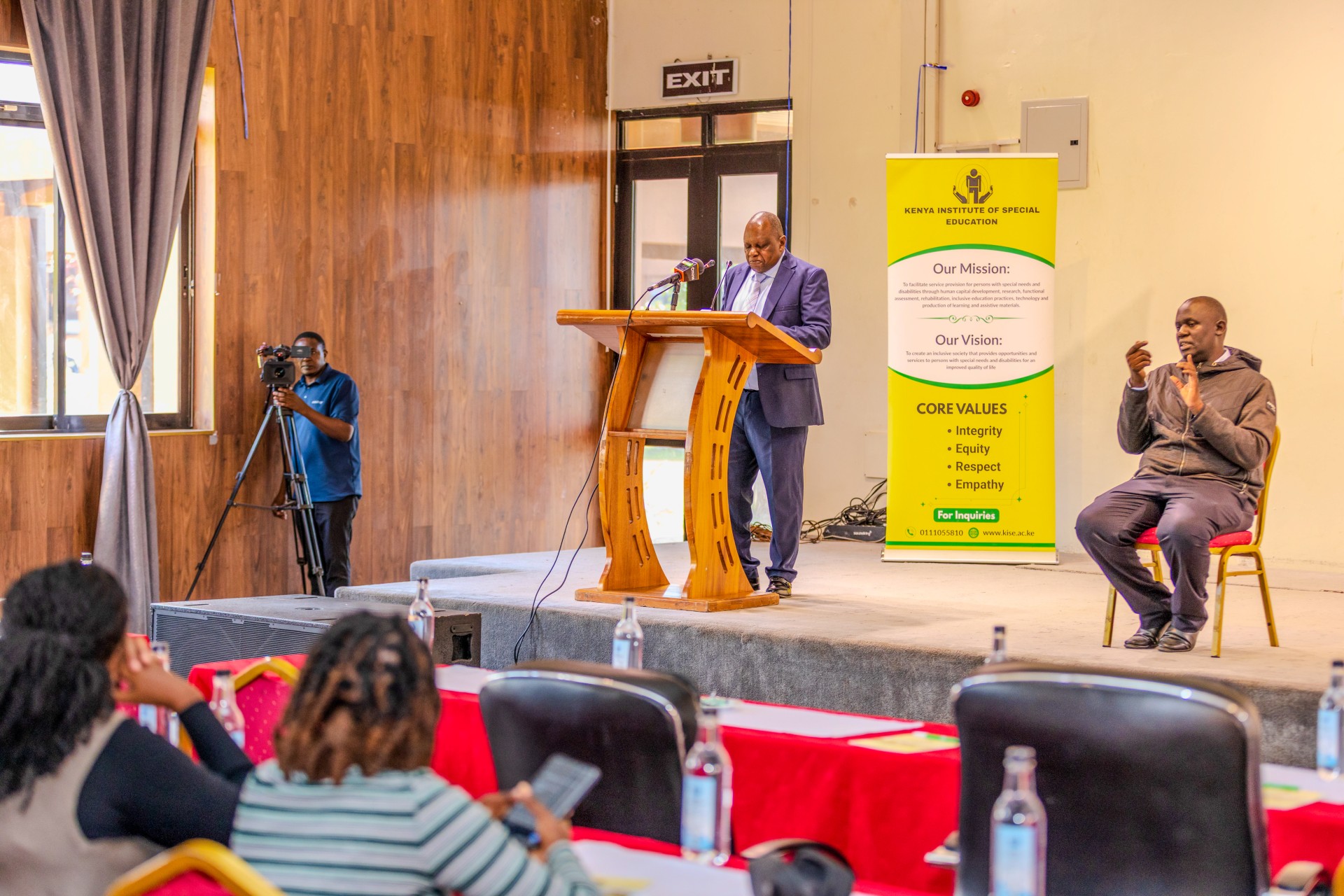
 Kise director Dr Norman Kiogora at the event on Friday, April 24, 2026 /HANDOUT
Artificial intelligence and locally manufactured assistive technology will help end the exclusion of persons with disabilities from economic and social life.
The Kenya Institute for Special Education in Kasarani hosted a forum on Friday revealing ambitious plans to move from imported charity aids to intelligent, homegrown solutions that serve people with special needs.
The initiative, the Kenya AI for Disability Project, is funded by the Mastercard Foundation. It is led by Qhala and Assistive Technologies for Development (AT4D).
It brings together the Ministry of Information, Huawei, Unesco, the Kenya National Innovation Agency and the National Council for Persons with Disabilities.
The official launch is set for April 28.
Kise director Dr Norman Kiogora described the undertaking as a break from the past.
“Today, we open our doors not only to showcase our work but also to demonstrate a growing commitment to inclusive innovation,” he said.
“Our responsibility is to ensure that innovation responds to real needs and creates meaningful inclusion.”
He said a 2024 AI Hackathon with Huawei, AT4D and Unesco had produced working prototypes that will now be scaled up.
“Disability inclusion is not a niche issue; it is a mainstream societal issue. Almost every family knows someone living with a disability, and many people will experience disability at some stage in life. That is why inclusion must be at the heart of innovation,” Adam Lane, Policy and Partnerships Lead, Huawei said.
“The real value of technology, and especially AI, lies in its ability to adapt, learn and respond to individual needs. Rather than one-size-fits-all solutions, AI gives us the opportunity to create highly customised tools that empower persons with disabilities in practical and meaningful ways.”
A nearly completed factory at the institute will manufacture a range of assistive devices.
Deputy director Anthony Mwangi said the facility is more than 99 per cent complete.
It is being equipped with computer numerical control lathes, laser cutters and milling machines.
The machines can shape metal, wood, leather and plastic. For years, Kenya has relied on expensive imports with long waiting times.
“It is expensive to deliver those devices locally. And so we are set to now start production,” Mwangi said.
The factory will build wheelchairs and white canes. It will produce the tiny spare parts that keep braille machines working.
Thousands of braille machines lie idle across the country because of missing components.
“Some are just missing some very small parts that we will be producing here. So we are going not only to save this country a lot of money, but also bring back to life support for the persons that are in this country,” Mwangi said.
Design teams are already going further. They are working on wheelchairs with memory seating and adjustable stature that can help a user rise to a near-standing position.
They are exploring smart canes and wheelchairs fitted with GPS and sensory feedback. The goal is not just to replicate what exists. The goal is to build world-class assistive devices that offer real independence.
“We have moved from talking about being proactive to now talking about being predictive, and that is the promise of AI. Predictive technologies can transform disability support, from intelligent mobility solutions to next-generation tools for the visually impaired. This has the potential to be a true game changer," said Esther Molocyce, Senior ICT Officer – Partnerships, Ministry of Information, Communications and the Digital Economy.
Dr Lynett Ongera, coordinator of research and innovation at Kise, stressed that technology alone is not enough. The rollout must overcome a crippling knowledge gap.
“Learners with special needs and disabilities have got limited access to information about what is available in relation to AI or assistive technology, especially those who are in far-flung areas,” he said.
She described a world where someone who needs a white cane uses a simple stick. Even those who know about white canes have never heard of smart versions.
Many teachers, administrators and families remain unaware of assistive technology and what it can do.
Digital infrastructure is also a barrier. Documents are often shared in formats incompatible with screen readers used by blind persons. Some schools lack electricity and connectivity. Devices are sometimes delivered to institutions that cannot power them.
“We invite them to the government and supply assistive devices. They are just there because there is no electricity to help them to use,” Ongera said.
He urged partners to provide tools that can run on solar and other available energy sources.
Personalisation is a central theme of the new push. Ongera warned against treating persons with disabilities as a uniform group.
“Sometimes we assume that persons with disabilities are homogeneous. We provide what is uniform without necessarily knowing that they have got individual needs,” she said.
She called for adaptive devices that analyse a learner’s strengths and weaknesses and deliver tailored instruction. For instance, a tool for a learner with dyslexia could identify reading gaps, give immediate feedback and suggest corrections.
Speech-to-sign-language synthesisers would allow learners with hearing impairment to socialise without isolation. Navigation apps fitted to wheelchairs and canes would enable independent movement.
The project also plans to use AI in assessment. The institute’s clinical assessment centre will incorporate assistive technology to calculate results and reduce human error. Virtual communities will connect persons with disabilities to AI opportunities, breaking the isolation that so often accompanies mobility or hearing challenges.
With Unesco keeping a focus on AI ethics, the coalition is determined to make inclusion practical.
Ongera said: “When we are talking about inclusion and we are still lagging behind in matters AI and IoT, then the level is not the same. Let’s work together and ensure that as much as possible, we talk about inclusion, not in concept, but in practicality.”
Only one per cent of adults with disabilities hold formal jobs. The law reserves five per cent of public sector positions for them.
The project, which uses locally developed AI to connect persons with disabilities to sustainable livelihoods, aims to address.this gap.
It also aims to supply them with the tools they need to navigate school, work and daily life independently.
Kiogora closed with a call to journalists. “Reporting on disability is not only about highlighting challenges but also about amplifying ability, opportunity and progress,” he said.
“When we design for inclusion, we do not just transform systems, we transform lives.”
As the April 28 launch nears, Kenya’s model of local manufacturing and intelligent assistive technology is positioning itself as a blueprint for the continent.