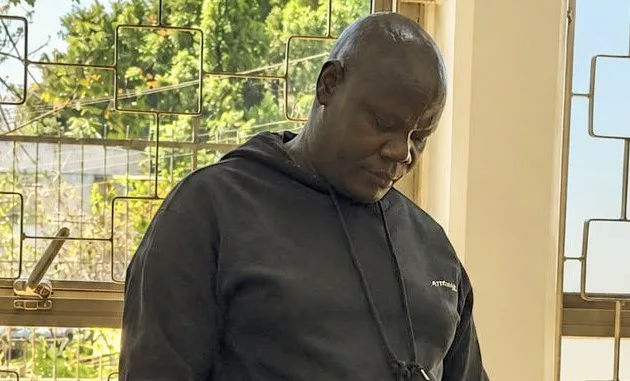
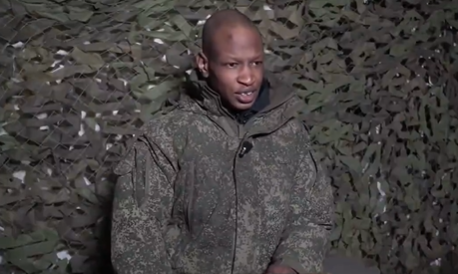
 Joseph Kabugi during a video interview.
A Kenyan captured by Ukrainian forces while fighting for the Russian army in the ongoing war has recounted his ordeal, issuing a call to jobless youth to resist the urge to enlist as fighters in the conflict.
In a video interview widely shared on social media, Joseph Kabugi, 41, said he joined the Russian army as a last resort after years of struggle marked by joblessness.
A computer scientist by profession, he said it had been difficult to find work and, when an opportunity came through a referral, he took it.
"The message went through like news. It's a friend tell a friend, and so that's how the information got to me," he said.
Kabugi said their travel arrangements were handled by an agency, which informed them from the outset that they were going to join the Russian army.
Russia launched a full-scale invasion of Ukraine on February 24, 2022, marking a major escalation of a war that began in February 2014 with the annexation of Crimea.
As of April 2026, the war continues, with heavy fighting in eastern and southern Ukraine. Both sides have suffered significant casualties, including civilians.
Russia has been recruiting foreigners, including Africans, to fight in Ukraine amid reported personnel shortages and rising battlefield losses.
Ukraine estimates that more than 1,700 citizens from 36 African countries are fighting for Russia, often drawn by alleged deception, promises of high wages, or training opportunities, before being deployed to frontline roles.
Kabugi said that although he knew he was joining the Russian army, he was initially told his role would not involve frontline combat but would align with his professional skills.
"There was an agency that offered that process, that you can join the Russian army, you don't need to pay anything. They will cater for everything, even the air ticket to come all the way," he said.
"I'm a computer science engineer, so I more of understand the gadgets (and) the systems because I have installed CCTVs, radio stations and stuff. Those are the things that I used to work with," he said.
He said he was enlisted alongside another Kenyan, and neither of them fully understood what they were signing up for.
"We were just blank," he said.
After signing the contracts, they underwent three weeks of training on how to use firearms.
"For me, I was not really prepared because in the real sense, how do you prepare for three weeks to go and fight in a war?" he posed. "I was afraid."
Kabugi said that after the training, they were transported by boat across a river to the battlefield. Along the way, he said he saw dead Russian soldiers.
He said he realised at that point that he, too, might end up dead.
The area he was deployed to was Kupiansk, a railway hub and city in Ukraine's Kharkiv Oblast, located on the Oskil River, about 40km from the Russian border.
During his early days there, he said he was injured in a drone attack.
"They told me they were going to retrieve me all the way back, so by the time I was getting out of that mission, I knew I was going all the way back, but it didn't happen."
Kabugi said he was kept in a location he cannot recall, including its name or exact position.
"You know in literal sense, you are not talking to the commander because of language barrier," he said, adding that he understood only a few Russian words.
"Around February 14, we got the second drone attack so we ran for our lives to another dorm."
He said that in the second hiding location, survival became their main focus, with daily efforts to find food and water.
Kabugi said one Russian soldier would leave to look for supplies while they waited.
"Mostly, we didn't shoot, we didn't do anything. We just had to look for food because it was time for me to go back."
He said the Russian soldier was captured by Ukrainian forces on his second attempt to go look for food.
He then led them to the hideout, leading to their capture. Kabugi said they were taken into Ukrainian territory, where he remains a prisoner of war.
Based on previous official government position, Kabugi now becomes the third Kenyan prisoner of war in Ukraine.
"I didn't understand because the other soldier told me to follow. They were very kind because they had an option to shoot us or to let us live. They had an option of not giving us food, but they did."
Kabugi has urged Kenyan youth not to be lured into travelling to Russia, whether knowingly to fight in the war or in search of employment.
He said he endured harsh winter conditions and had to be provided with multiple layers of clothing to keep warm.
"My advice: don't join war. Don't join the war of Ukraine and Russia. Be safe, stay in your country."