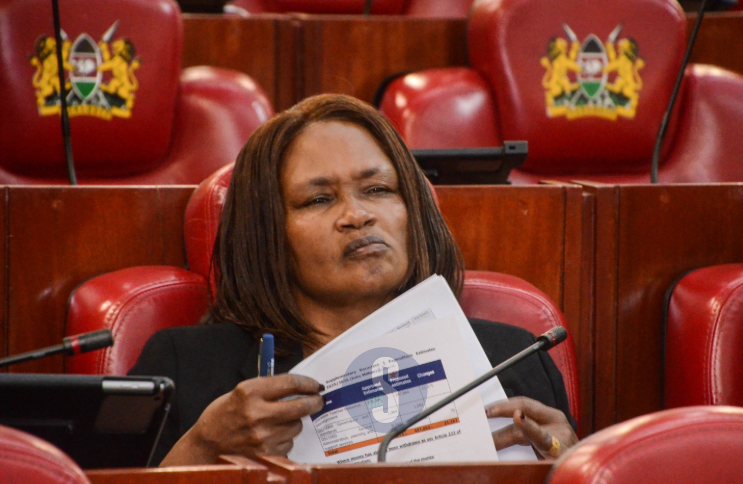
 Teachers Service Commission acting CEO Eveleen Mitei. /FILE
The Teachers Service Commission is increasingly finding itself in a loop of dismissing a wave of fake news and disinformation that could potentially harm its reputation and professional standing.
Between March 31 and April 22, 2026, the commission has been hit by six fabricated circulars deceptively designed with official logos and insignia to appear like genuine policy directives.
It has, on each occasion, promptly flagged the publications—shared widely on social media platforms—as fake.
The latest, published on April 22, falsely claimed that the commission had released a list of approved teaching subject combinations for secondary schools.
Another post claimed that the teacher employer had released revised hardship designations and allowances effective July 1, 2026.
"Reference is made to the two circulating posters regarding Hardship Allowance Reclassifications and Secondary School Subject Combinations. Please note that the information is not only misleading but fake," the commission said.
The fake posts appear targeted, coming days after TSC released new guidelines on approved teaching subject combinations for secondary schools, tightening recruitment rules to align with Competency-Based Education (CBE).
It unveiled 51 approved subject combinations that will determine who qualifies for employment under the new curriculum, warning that those trained outside the list risk being locked out of teaching jobs.
The directive emphasises specific subject pairings for Science, Languages, Mathematics, Technical, and Humanities to determine teacher eligibility.
The new rules are aimed at ensuring teachers are prepared for senior school (Grade 10–12), with combinations such as History/Kiswahili and CRE/Geography considered overloaded or less sought after.
The changes seek to align teacher expertise with demand across STEM, Arts and Sports Science, and Social Sciences pathways.
Back to the fake news: on April 20, TSC flagged fake recruitment adverts purporting to be from the commission. The advert claimed that TSC was looking to hire 20,000 teachers to be deployed to junior schools on permanent and pensionable terms.
The fraudulent notice purported to invite applications from P1- and diploma-in-education-trained teachers registered with TSC.
"There are fake recruitment adverts purporting to be from Teachers Service Commission on recruitment. Please note that authentic job vacancies, recruitment guidelines, adverts and official information are only available on our official website, verified official communication channels and recognised national media outlets," the commission said.
A day prior, it had flagged another fake post that purported to inform teachers that their April salary would be delayed because the commission had recalled the payroll following allegations that a certain teacher association had potentially misappropriated millions of shillings collected from female teachers who are its members.
Beyond the fake teacher recruitment hoaxes, the commission's credibility on financial management has also been targetted.
On April 6, TSC dismissed as false a blog report circulated online that claimed the commission was facing a Sh7.9 billion “financial meltdown”.
The blog report drew from an audit review contained in earlier reporting on findings in Auditor General Nancy Gathungu’s review for the financial year ending June 30, 2025.
Though the figures reported were based on a credible audit report, TSC rejected the characterisation as a “financial meltdown”.
"Please be advised that the information circulating regarding a ‘Sh7.9 billion financial meltdown’ at the Teachers Service Commission is false!"
On March 31, 2026, the commission issued a disclaimer disowning a Facebook page purporting to belong to the acting TSC CEO, Eveleen Mitei.
The commission advised the public to rely only on information posted on its website and official social media channels—TSC Kenya on Facebook and @TSC_KE on X—all bearing a blue verification badge.
Until the recent surge in fake news reports targeting the commission, the last time it came out to fight propaganda was in November 2025.
One post, published on November 21 that year, purported to invite applications from trained teachers to fill vacancies left by those who exited through natural attrition.
Another, posted on November 18 and circulated on social media platforms, falsely claimed that the commission had advertised 20,000 vacancies on permanent and pensionable terms for junior schools—underscoring a recurring pattern of misinformation the commission continues to confront.
The commission finds itself facing one of the rapidly evolving global crises, driven by the democratisation of generative AI, which has fundamentally changed the speed, scale and convincing nature of misinformation.
As of early 2026, an estimated 72 per cent of global internet users encounter misinformation monthly, with AI-generated fake content seeing a 300 per cent increase between 2023 and mid-2025.