 Hon.Salah Maalim Alio, Horn of Afrika, Governance , Peace and Security Management Specialist and CEO of Sambul Consulting./HANDOUT
As President William Ruto visited Mandera on April 18, 2026, his assurance that the county deserves a modern airport—comparable to those serving other major urban centres in Kenya—must be understood not as a symbolic gesture but as a strategic national priority. For Mandera, the question of air connectivity is not merely about convenience; it is about equity, safety, regional integration, and unlocking economic potential in one of Kenya’s most geopolitically significant frontiers.
Mandera town, as the headquarters of Mandera County, sits at a uniquely strategic position along the Kenya–Somalia–Ethiopia border triangle. Its proximity to Bulla Hawa in Somalia and Suftu in Ethiopia makes it a natural gateway for cross-border trade, humanitarian operations, and regional mobility within the Horn of Africa. Yet, paradoxically, this gateway remains physically and economically constrained by one of the most inadequate aviation infrastructures in the country.
Air travel to Mandera is, by all practical standards, untenable. The cost of flights on this route is among the highest domestically, effectively isolating the region from affordable access to the rest of Kenya. More concerning, however, is the state of the existing airstrip—an unmurramed runway located within a military camp, surrounded by both residential and commercial developments. This setup raises serious aviation safety concerns, falling short of basic regulatory standards. The situation is further compounded during the rainy season, when the runway becomes unusable due to mud, leading to frequent flight suspensions. The reliance on aircraft such as the Fokker 50, capable of handling such harsh conditions, underscores the abnormality of the current arrangement rather than its adequacy.
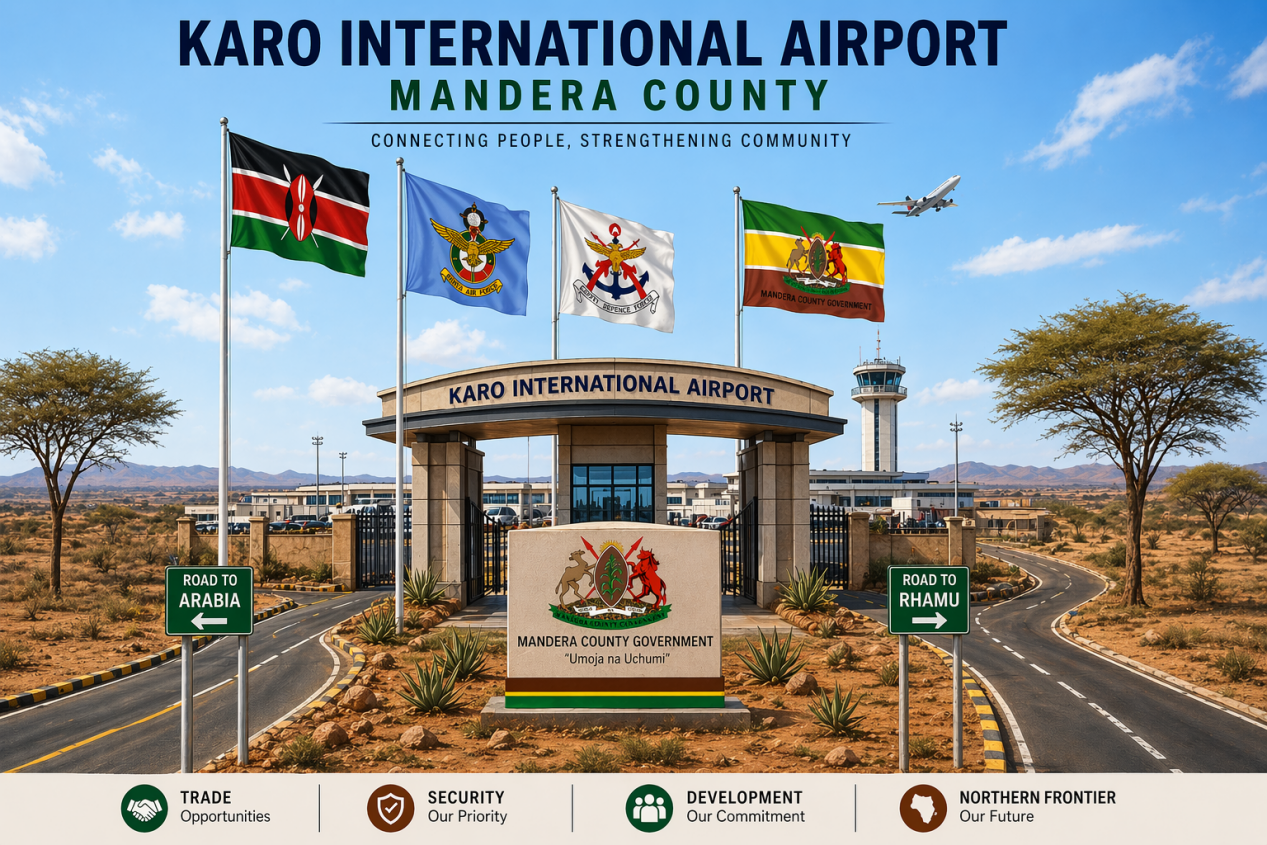 Graphic Image of Karo International International in Mandera County(By
Salah Maalim Alio)
Graphic Image of Karo International International in Mandera County(By
Salah Maalim Alio)
The timing for such an investment could not be more appropriate. Mandera is currently undergoing transformative infrastructure development, including major water and sewerage projects funded by the African Development Bank. These investments signal a shift toward urban resilience and improved quality of life. However, without corresponding upgrades in transport infrastructure—particularly aviation—the full economic and social benefits of these projects will remain unrealised.
Critics of the proposed Karo Airport have often cited community land concerns, particularly from sections of Mandera East. While community engagement is essential in any development process, it is important to clarify the legal and institutional context. Under the Community Land Act of 2016, unregistered community land is held in trust by county governments until formal registration is completed. In Mandera, delays in community land registration—often influenced by local political dynamics—should not be allowed to stall critical public infrastructure projects indefinitely.
The airport project must therefore be approached with both sensitivity and decisiveness. Genuine community concerns should be addressed through structured dialogue and inclusive planning processes. At the same time, leadership—both local and national—must resist the instrumentalisation of land issues as tools for political obstruction. The broader public interest, particularly in a region as strategically vital as Mandera, must take precedence.
Beyond infrastructure, the airport represents a deeper promise: dignity and inclusion. For decades, residents of Mandera have endured systemic marginalisation, reflected in limited access to essential services and national economic opportunities. A modern airport would signal a break from this history, affirming that Mandera is not a peripheral outpost but an integral part of Kenya’s development and urban growth trajectory.
Furthermore, improved air connectivity would facilitate transhumance movements across borders, a critical aspect of pastoralist livelihoods in the region. By enabling faster and safer movement of people, goods, and services, the airport would contribute to stability, economic integration, and resilience in a region often defined by its vulnerabilities.
President Ruto’s assurance must now translate into concrete action. The development of a modern airport in Mandera should be fast-tracked as a flagship project under Kenya’s broader regional integration and infrastructure agenda. It is an investment not only in Mandera, but in the future of the Horn of Africa as a connected, prosperous, and stable region.
Mandera has waited long enough. The runway to its transformation must no longer remain grounded.
The writer is the Horn of Afrika, Governance , Peace and Security Management Specialist and CEO of Sambul Consulting.