On October 24, 2017, former Interior and Coordination of National Government Cabinet Secretary Fred Matiang’i declared the following day, October 25, a public holiday.
The day had been set by the election commission the previous month as the date for a repeat presidential poll following the invalidation of the earlier results by the Supreme Court of Kenya.
In the Gazette notice, Matiang’i claimed he was giving Kenyans sufficient time to participate in the election.
The announcement caught everyone unawares, including the Judiciary, which was at the time processing urgent disputes relating to the same election.
Chief Justice David Maraga defied the holiday and allowed judicial officers to work on the day.
Needless to add, the repeat election ended up being the most bogus electoral exercise in Kenya’s recent history where the then incumbent, President Uhuru Kenyatta, literally competed against himself.
For a repeat election date that had been set weeks before, it was inconceivable that Matiang’i only realised the necessity of a public holiday a few hours to it. The declaration was obviously part of the state-sponsored “kumira kumira” mobilisation for Kenyatta support.
This was not the first time the Kenyatta government was playing poker on the matter of public holidays. The previous year, the same government added a new public holiday to the Kenyan psyche, the Eid al-Adha.
This is a significant festival in the Islamic calendar that commemorates the willingness of Prophet Ibrahim (Abraham) to sacrifice his son in obedience to God’s command.
It is an act cherished also by Christian faithful for centuries, without a date to it. The announcement was therefore a double win for both Christians and Muslims and a political masterstroke for a man facing a re-election.
As expected, the new public holiday was widely embraced and is now part of Kenyans' expectations. Last June 4, Cabinet Secretary for Interior and National Administration Kipchumba Murkomen declared June 6 a public holiday to celebrate the festival.
Like all his predecessors, Murkomen declared the holiday at very short notice to the detriment of employers and the joy of employees. I know of a case where a Kenyan employer in the Information Technology sector paid the price for it.
The employer was hosting a delegation of European IT companies that were exploring the possibility of hiring Kenyan IT professionals to remotely work for them.
The holiday coincided with the day the Europeans were set to visit the Kenyan IT company to see the business operations first hand. The employer painfully recounted the frustrations they went through convincing the Europeans to push the visit to the following week.
They would not believe that the Kenyan could not have foreseen the situation. As a fully born and bred Kenyan, the employer was used to some of the contradictory, little and pathetic habits which we easily condone as a society.
For instance, it is now widely accepted that funerals and pulpits are political theatres, that public projects and their launches are political functions, and that political campaigns begin the morning after the declaration of electoral winners.
We have settled for sudden bursts of policy directives of far-reaching implications. We have seen regulators retroactively invalidate training institutes and courses without a whiff of protest.
Internally, these incongruities seem to have gained legitimacy owing to their sustained toleration by the people. However, when weighed against internationally acceptable standards of doing business, they expose us badly. The Kenyan IT employer lost the deal.
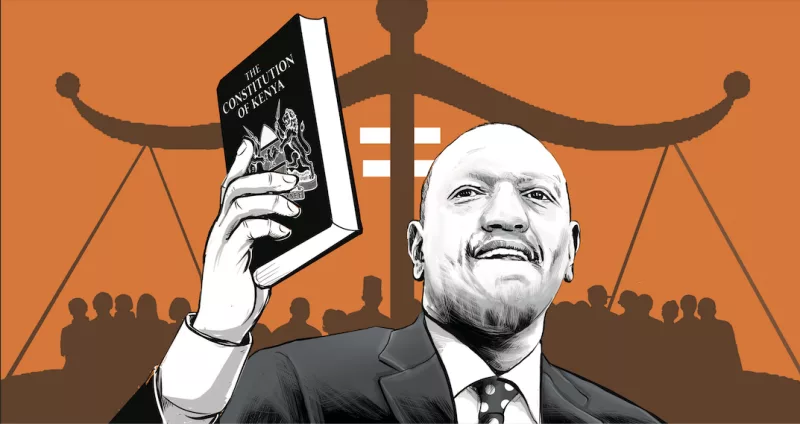
The matter of additional public holidays is particularly sad because Kenyans enacted the public holidays they desired into the Constitution. The same Kenyans have widely embraced the new ones imposed on them by their leaders.
Given that it is not easy to take these holidays back, is it too much to ask for a certain measure of certainty and predictability of their occurrences?
In the present world of technology, including time-honoured practices such as astronomical calculations, is it completely untenable to accurately predict the sighting of the moon?
An Artificial Intelligence (AI) overview for Eid al-Adha 2026 places the holiday on Wednesday, May 27. CS Murkomen should “look for the moon” early enough and avoid last-minute declaration.
Advocate of the High Court and a Senior Project Manager with the Friedrich Naumann Foundation. The views expressed here are his own