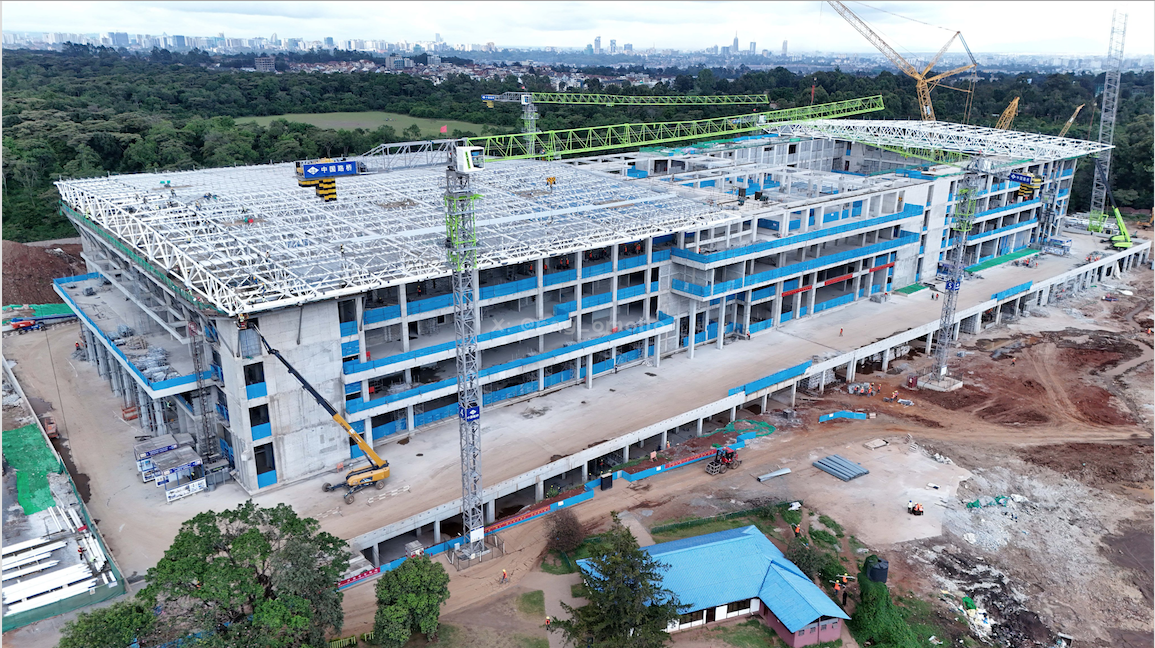
 The Bomas International Convention Complex under construction in Lang'ata /HANDOUT
Why would a developing country like Kenya, faced with competing development priorities, commit tens of billions of shillings to a world-class convention complex? Why now? Why this scale?
But another question to pose is: what kind of economy is President William Ruto trying to build and more so, what enabling infrastructure does that future require?
For decades, Kenya’s growth model has leaned heavily on agriculture, trade and, more recently, infrastructure. While these sectors remain essential, they are not sufficient on their own to propel the country into first world status.
Instead, global benchmarks have demonstrated that beyond production, bold investments in the service sector through innovative, high-value, globally connected and knowledge-driven products will accelerate the desired transformation. This thinking practically aligns with the Bottom-Up Economic Transformation Agenda (BETA). It is in this context that the Bomas International Convention Complex (BICC), in Nairobi, begins to make sense.
Jimmy Okidiang, Bomas of Kenya CEO, testifies that the presidential directive to develop the Bomas International Convention Complex illustrates the government’s preference for a long-term economic strategy rather than a trade-off against existing obligations.
Cognisant of the huge development funding gap, the BICC is positioned as a forward-looking investment aimed at widening the national revenue base, increasing incomes, creating more jobs, making the shilling stronger and attracting more private investors, among other tangible benefits.
Today, global cities compete not just on roads, railways and ports but also on their ability to convene the world. Conferences, summits, exhibitions and diplomatic gatherings are now central to how influence, investment and ideas flow.
Cities such as Kigali, Cape Town and Dubai have understood this well. They have invested deliberately in world-class convention infrastructure and are reaping the benefits: steady inflows of high-spending visitors, global visibility and a seat at important decision-making tables.
In the early 90s, Singapore Prime Minister Lee Kuan Yew invited Hong Kong businessmen to invest in Suntec Convention and Exhibition Centre. This made it one of Singapore’s premier world-class Meetings, Incentives, Conventions and Exhibitions (MICE) destinations in Singapore. It now welcomes more than 5 million visitors annually and targets $50 billion (Sh6.5 trillion) in tourism receipts by 2040, thanks to the MICE sector being a key growth driver. The BICC shares this ambition.
Kenya, despite its strategic location and diplomatic relevance, has lagged in this space. The Kenyatta International Convention Centre (KICC), while rich in history, is limited in capacity and is increasingly unable to meet the demands of modern, tech-savvy and large-scale events.
The BICC is designed to close that gap.
From a citizen’s perspective, the benefits may not be immediately visible, but they are real. For example, the project has already created significant employment, with over 3,000 workers engaged daily.
This phase has stimulated economic activity across construction and supply chains. Once complete, the complex will sustain thousands of jobs in sectors such as hospitality, transport, event management and security. Planned additions, including two five-star hotels, a four-star hotel and a shopping mall, will create an integrated socioeconomic ecosystem.
Conference tourism is one of the highest-yield segments in the travel industry. A single international summit can bring thousands of delegates who spend on hotels, transport, food and local experiences. This creates income opportunities not just for large businesses, but for small and medium enterprises, from taxi operators and caterers to artisans and tour guides.
More importantly, these events are gateways. They bring investors, policymakers and innovators into direct contact with the country. Deals are discussed. Partnerships are formed. Perceptions shift. In many ways, a convention centre is not just a venue; it is a marketplace of ideas and opportunity.
There is also a strategic dimension. In a world where diplomacy increasingly happens through forums, summits and multilateral engagements, the ability to host is the ability to influence. Infrastructure like the BICC becomes a tool of soft power, allowing Kenya to shape conversations, not just participate in them.
Kenya’s successful bid to host the Africa-France Summit at the BICC, even before its completion, highlights this growing international confidence in the country’s capacity to convene major global events.
Concerns about cost, duplication and prioritisation cannot be dismissed. Public investments should always be weighed against competing needs. The success of the BICC will ultimately depend not just on its construction, but on its management, utilisation and integration into the broader bottom-up economy.
This is why the conversation should not be framed as a choice between development priorities, but as a question of balance and execution. Kenya must continue investing in essential services, but it must also invest in the sectors that will drive future growth.
The BICC represents a bet. A bet that Kenya can become a leading hub for global convening in Africa. A bet that the investment returns economic, diplomatic and reputational gains. This will outweigh the costs. And a bet that the country is ready to compete, not just regionally, but globally. Bottom line is that more Kenyans will pocket more money and enjoy shared prosperity (pesa mfukoni).
Delivery and PPP expert, and head of Government Delivery Unit in the Executive Office of the President. [email protected] | @GDUDelivery, www.delivery.go.ke