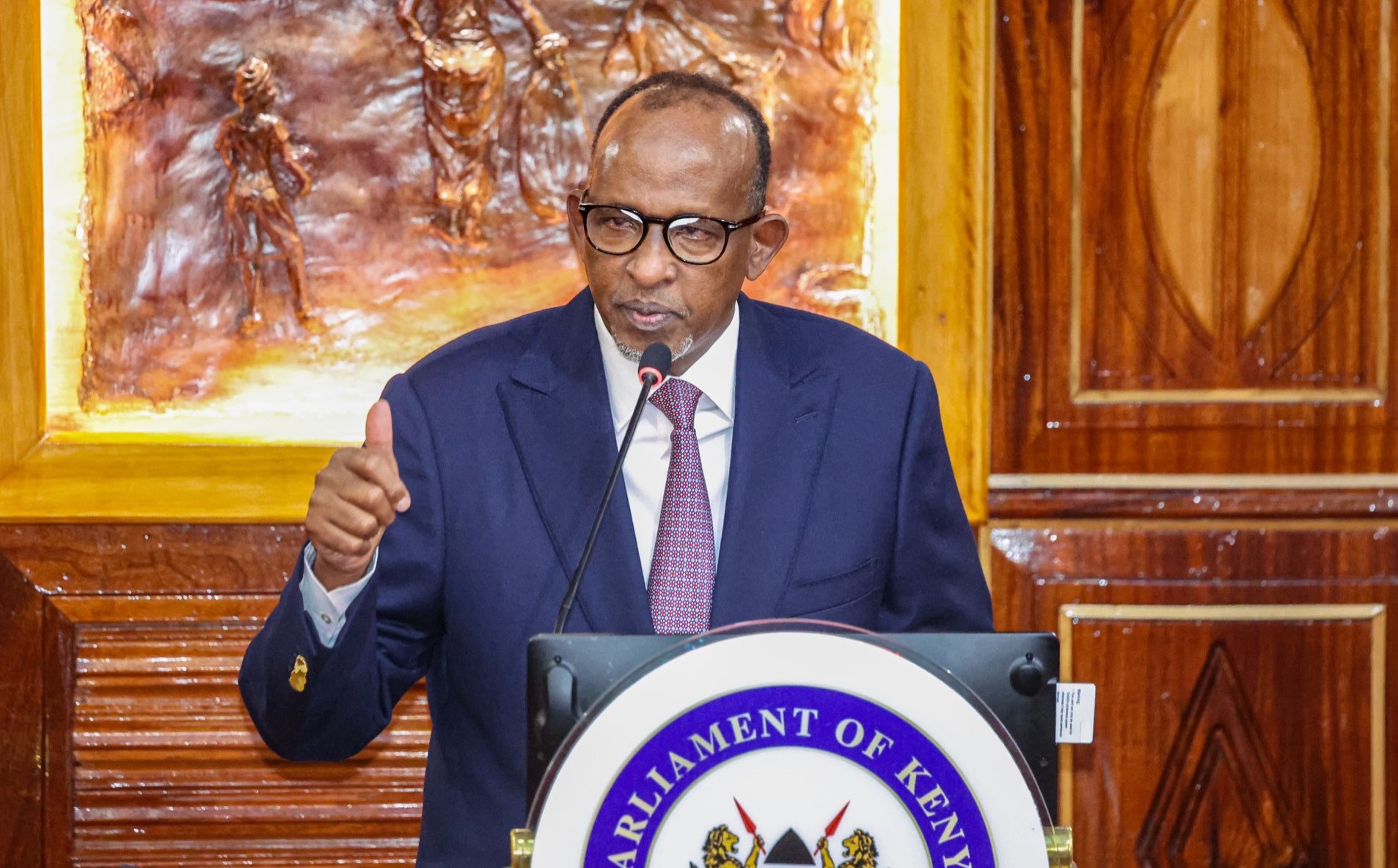
 Health Cabinet Secretary Aden Duale briefing the Senate on progress in ongoing health sector reforms, Wednesday, April 22, 2026./MoH
The Social Health Authority (SHA) will henceforth not reimburse subcounty and county referral hospitals for the drug component if facilities fail to dispense medicines after treating patients under the Social Health Insurance Fund (SHIF).
Health Cabinet Secretary Aden Duale said the Digital Health Superhighway has flagged inconsistencies in the treatment of patients in Level 4 and 5 hospitals across various counties, where patients go through all treatment processes but are never given the prescribed medication at the facilities’ pharmacies.
Answering questions in the Senate on Wednesday, Duale blamed the trend on the sprouting of private pharmacies around county-run health facilities, where most patients end up paying for drugs out of pocket.
“We found in the provincial referral hospital in Kakamega, 52,000 patients have gone through the system. They have seen a doctor, gone to the lab, they have gone to the theatre but they have not been given drugs,” Duale said.
“We’ve seen the same problem in Nairobi. We see the patients moving but when it reaches drugs, they don’t get drugs,” he added, noting that a similar trend was witnessed in Bomet county.
“If you go to some counties, you will find there are many pharmacies around the hospitals.”
The Digital Health Superhighway is an initiative to create a unified national digital ecosystem that connects patients, providers and insurers, accelerating Universal Health Coverage (UHC) through technology.
It digitises health services, enabling secure real-time sharing of data across all levels of care, both public and private.
Duale said going forward, SHA will not honour claims for the drug component for patients who were treated but never given medicine at pharmacies within the respective facilities.
“What we have done in the system is that if you go through the system and you are a SHIF or SHA paid-up member at the primary healthcare level and you don’t get medicine, SHA will not reimburse. It will reimburse everything else, but the bit of medicine it will not reimburse,” he said.
The CS said this will encourage facilities to procure medication from the Kenya Medical Supplies Authority (Kemsa), whose technological capacity and drug stock levels he said have significantly improved.
“Today Kemsa’s order fill rate is 92 per cent. Every 10 products you ask from Kemsa, they will provide you with nine. By the end of this year, it will be a 100 per cent fill rate,” he said.
As part of the upgrade, he said assistive hearing devices have been integrated into the national distribution system to improve access, with 2,000 more devices set for procurement through partnerships.
Duale said the ministry is in talks with governors to ensure all county-run health facilities procure their medicines from Kemsa.
“Because we have capitalised Kemsa and streamlined its governance architecture, we want our counties to draw from Kemsa.”
The CS said the Digital Superhighway initiative has reduced corruption within the health system leading to the closure of more than 1,200 facilities flagged for fraudulent activities, while 22 doctors and 40 clinicians have been barred due to malpractice.
Duale confirmed that the government has allocated Sh4 billion to start settling verified claims under the defunct NHIF, particularly those below Sh10 million.
He said the move is aimed at restoring confidence among healthcare providers and ensuring stability in the transition to the SHA.
The CS reported that SHA is improving efficiency in claims processing, with a 74 per cent settlement rate achieved so far, supported by a strict 90-day timeline for payments across all levels of care.
On public health, he said the ministry is strengthening tobacco control through increased awareness, enforcement and regulatory measures supported by the Solatium Compensatory Contribution.
Duale said the ministry is implementing the Kenya Climate Change and Health Strategy (2024–2029) to better prepare the health system for climate-related risks.
"In cancer care, the government is expanding access to treatment, including plans to install an additional linear accelerator at Kenyatta National Hospital and establish regional cancer centres in Kisii, Nyeri, Meru, and Kisumu to bring services closer to patients," he said.