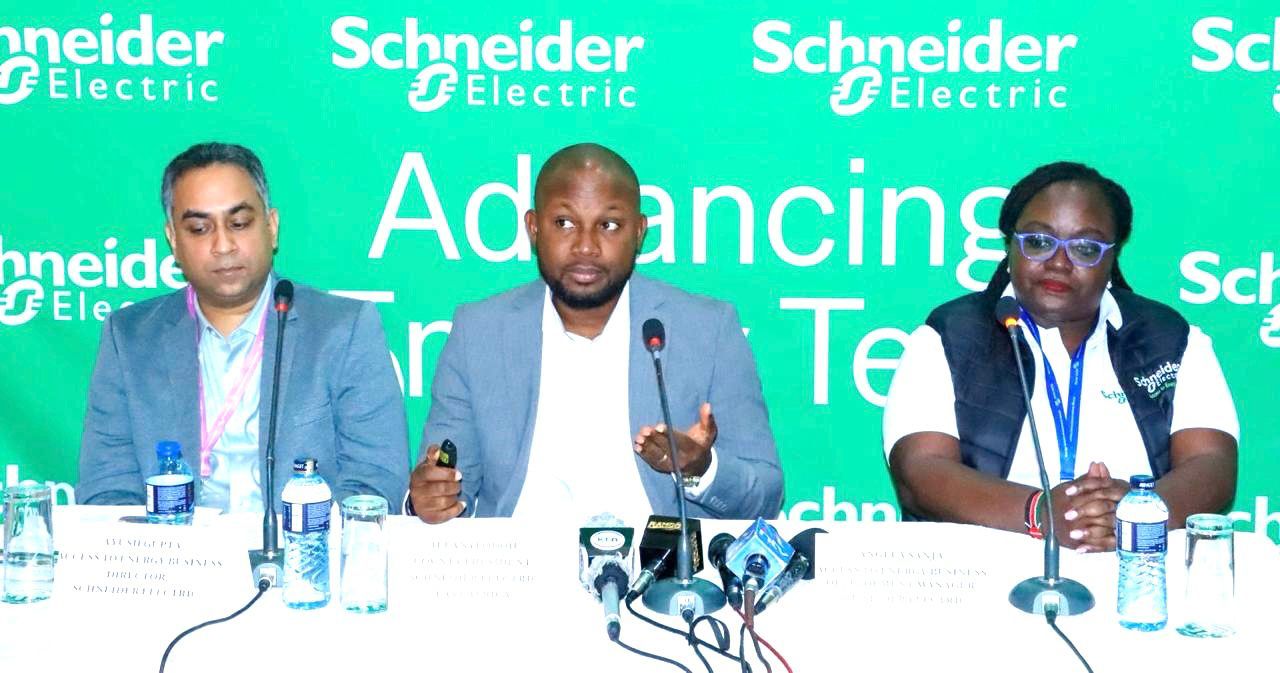
 Global Strategy & Business Anglophone Africa, Access to Energy Ayush Gupta , Country President of Schneider Electric East Africa Ifeanyi Odoh and Angela Sanja Business Development of Access to Energy for East Africa./HANDOUT
Schneider Electric has reaffirmed its commitment to expanding access to clean and affordable electricity across Sub-Saharan Africa, as millions remain locked out of power.
The announcement was made during the Alliance for Rural Electrification Energy Access Investment Forum 2026 in Nairobi, where the company outlined plans to accelerate an inclusive energy transition targeting underserved communities.
The firm said its ambition is to impact 100 million people with access to sustainable energy by 2030, as it pushes for long-term social and economic resilience in the region.
The move comes against the backdrop of a widening global energy gap. According to the International Energy Agency, more than 666 million people worldwide still lack electricity, with Sub-Saharan Africa carrying the heaviest burden. Of the 20 countries with the largest deficits, 18 are in the region.
Schneider Electric is now calling for stronger collaboration among stakeholders to drive what it termed “energy democracy” and address challenges of access, affordability and reliability.
Over the four-day forum, the company showcased a range of innovations, including the Climate Smart Village model, which integrates smart technologies with community-led approaches to expand decentralised clean energy.
“Access to energy must go hand in hand with strengthening human capacity and fostering local entrepreneurship,” said Ayush Gupta.
“Since 2009, we have integrated clean electricity access with vocational training, support for local entrepreneurs, and impact investing—ensuring that communities gain not only reliable energy but also economic opportunities and long-term self-reliance to power progress.”
The company said its efforts have already delivered measurable impact, with more than one million people empowered, 11,000 entrepreneurs supported across 60 countries, and 61.7 million individuals reached with clean electricity solutions.
At the forum, Schneider Electric also highlighted practical technologies aimed at last-mile communities.
These include the Homaya Advanced Solar Solution, which delivers reliable electricity to homes, schools and healthcare facilities, supported by digital monitoring through EcoStruxure Energy Access.
Another innovation is the Altivar Solar ATV320, a solar-powered water pumping system designed to improve access to clean water and support irrigation in off-grid areas.
The company said such integrated solutions can boost agricultural productivity, strengthen food security and improve public health outcomes while building resilience in vulnerable communities.
A key highlight was the Climate Smart Village model, already implemented in India. In villages in Jharkhand, an 85-kilowatt solar system now powers homes, irrigation, public services and businesses.
The project has helped double household incomes over four years and reduced seasonal migration.
Schneider Electric said the model demonstrates how energy access can drive wider social and economic transformation and could be adapted to African contexts.
“Access to clean and reliable electricity can transform communities by unlocking economic opportunity and strengthening resilience,” said Ifeanyi Odoh.
"Realising this potential requires solutions rooted in local realities and supported by strong technical expertise and partnerships.”
The company maintained that decentralised renewable energy, backed by digital tools and local engagement, will be key to closing the energy gap and building a sustainable future for millions across Sub-Saharan Africa.