Accountability in public health is not complicated. It requires only that the people who control a system be unable to escape its failures. Everything else, the funding models, the reform strategies, the parliamentary committees, follows from whether that single condition is met.
Namibia is trying to meet it.
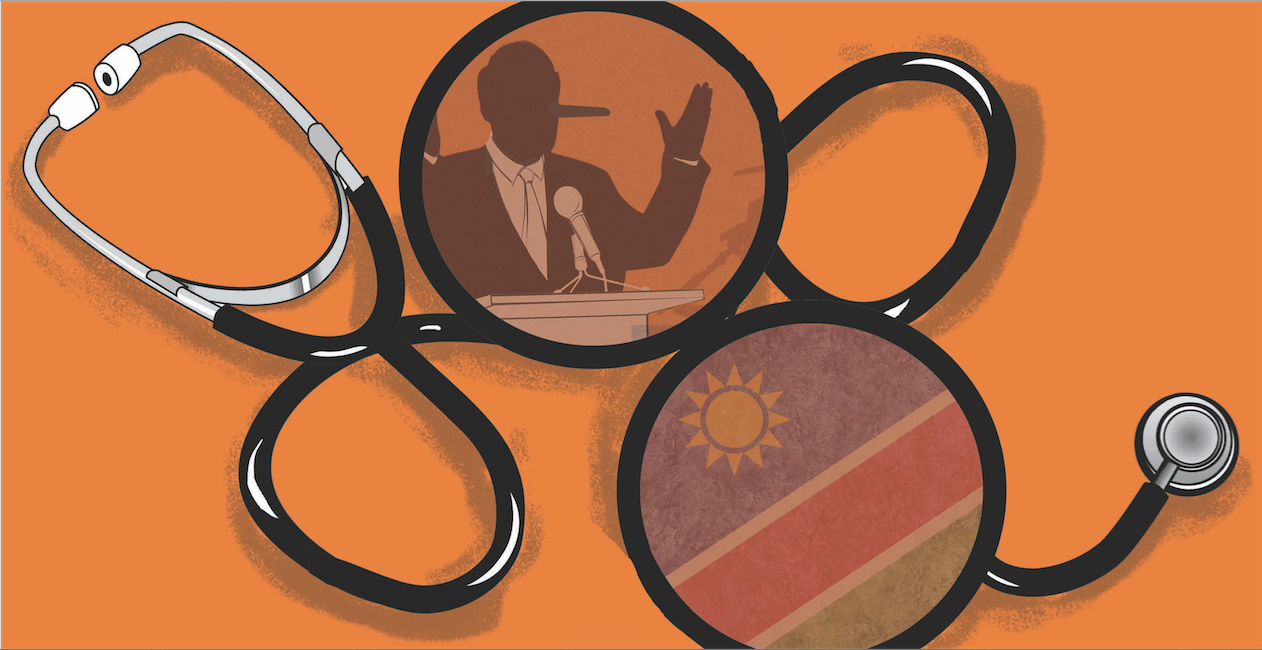
On April 1, Vision April 2026 came into force, a presidential directive requiring senior government officials to receive their healthcare at public hospitals. President Netumbo Nandi-Ndaitwah, Africa’s first elected female head of state, visited Katutura State Hospital and Windhoek Central Hospital to assess progress. She was not there as an inspector. She was there as a future patient.
The financial logic is real. The Public Service Employees Medical Aid Scheme, PSEMAS, channels between $162 million and and $216 million annually into the private sector to cover roughly 100,000 civil servants. Vision April 2026 redirects that flow into public facilities, funding phased upgrades ward by ward, hospital by hospital.
The government has committed about $12.9 million in new medical equipment and recruited more than 2,300 health workers since December last year in preparation.
But financing is not what makes this significant. What makes it significant is what it does to the people in power when the dialysis machine breaks down.
A Cabinet Secretary whose child depends on that machine will not convene a task force. She will make a call that evening. A Principal Secretary waiting in the same queue as a subsistence farmer does not experience that queue as a policy problem.
He experiences it as an injustice he has the authority to end. This is not idealism. This is the oldest truth about systems: they reflect the experiences of those who build them. Change whose experience is at stake and you change what gets built.
We have come close to understanding this in Kenya. When Charity Ngilu served as Health Minister under President Mwai Kibaki, she was admitted to Kenyatta National Hospital during her own tenure. It was an act of integrity that deserved the recognition it received.
But integrity is not structure. A minister who chooses to use a public facility is telling us something about her values. A president who mandates that senior officials have no other choice is telling us something about the system.
Ngilu’s admission did not alter who bore the consequences of KNH’s failures. The moment she recovered and walked out, the accountability she had briefly embodied walked out with her.
We must be honest about why that loop has never closed. Kenya’s political class retains private medical insurance, parallel public funds, supplementary cover, arrangements that insulate them entirely from what ordinary Kenyans face when they are sick. This is not an oversight. Medical aid schemes profit from it. Private hospital groups depend on it.
The political class is comfortable because of it. These are not separate interests that happen to align. They are a structure, built carefully over decades, that converts public health failure into private health gain. Reform that forces politicians into the same system as everyone else does not merely inconvenience them. It threatens the architecture of that arrangement entirely.
That is precisely why it is worth attempting.
There are legitimate questions about Vision April 2026. Namibia’s private practitioners have warned that public hospitals lack the billing systems to process PSEMAS claims. Phase 1 covers only 294 senior officials. The structural weaknesses that have persisted in Namibia’s public system for more than a decade, staff shortages, medicine stock-outs, deteriorating infrastructure, will not yield to a presidential directive alone.
But something has shifted that no directive can undo. The people who must now live inside those weaknesses are the same people who control the budget to fix them. That is not a small thing. It is the thing that has been missing from every health reform Kenya has attempted.
Universal health coverage is not a financing problem Kenya has failed to solve. It is an accountability problem Kenya has refused to confront. The difference matters. Financing problems respond to money. Accountability problems respond only to consequences.
The lesson is plain. If Kenya’s political class were required to access healthcare through SHA, not as a supplement, not alongside a separate fund, but as their only cover, on the same terms as every other Kenyan, the quality of that cover would become urgent in a way that no policy paper has ever made it.
Not because politicians would discover compassion. Because their own comfort would finally depend on the same system whose inadequacy they have spent years tolerating from a safe distance.
That is the reform worth demanding. Not a restructured benefit package. Not another financing framework. The simple, radical insistence that those with the power to fix the system have no refuge from it.
Namibia has found a president willing to give up that refuge. The question we must sit with is not whether we admire her for it. The question is what it says about us that we have not demanded the same.
Note: All Namibian dollar figures converted to USD at an approximate exchange rate of N8.5 to USD 1 (April 2026).