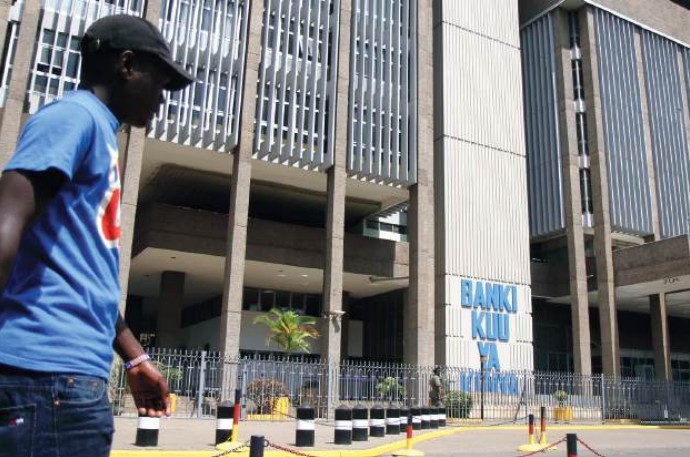
Money market investors gave the government’s short-term securities a wide berth in the week ended Friday, 17, undersubscribing to T-bills in favour of high-yielding, flexible alternatives.
Data from a weekly bulletin by the Central Bank of Kenya shows that the Treasury bill auction of April 16 received bids worth Sh14 billion against an advertised amount of Sh24.0 billion, representing a performance of 58.3 per cent.
This is despite the yields on the 91-day, 364-day and 182-day papers increasing by 2.4 bps, 0.2 bps and 0.02 bps to remain relatively unchanged from the 7.4, 8.3 and 7.8 per cent.
Investors’ preference for the shorter 91-day paper waned, with the paper receiving bids worth Sh2.6 billion against the offered Sh4 billion, translating to a subscription rate of 64.4 per cent, significantly lower than the 199.4 per cent recorded the previous week.
The subscription rate for the 182-day paper decreased to 76.7 per cent from 108.5 per cent recorded the previous week, while that of the 364-day paper decreased to 37.5 per cent from 57.2 per cent recorded the previous week.
The government accepted Sh13.97 billion worth of bids out of Sh14.0 billion bids received, translating to an acceptance rate of 99.8 per cent.
Investment experts are attributing this trend to the lower base lending rate that continues to drive down overall lending rates.
They argue that when the CBK lowers rates, Treasury bill (T-bill) yields typically decline as falling rates drive up their value, benefiting holders.
“Money Market Funds (MMFs) tend to react even more quickly. Since they invest in short-term instruments like repos, T-bills and agency securities. Their yields drop as existing holdings mature and are reinvested at lower rates,’’ Gregory Mugendi, a money markets analyst, told the Star.
Currently, he says, the capital market, especially the stock securities, is the most preferred investment vehicle, boosted by the launch of Safaricom’s Ziidi trading platform.
During the week, the Nairobi Securities Exchange continued with a bullish trend, with the NASI, NSE 25, and NSE 20 share price indices increasing by 0.85 per cent, 0.89 per cent and 1.11 per cent, respectively.
Market capitalisation, total shares traded and equity turnover also increased by 0.85 per cent, 59.36 per cent and 28.45 per cent, respectively.
Bond turnover in the domestic secondary market increased by 48.34 per cent to close the week at Sh52.9 billion compared to Sh37.5 billion the previous week.
The Kenya Shilling remained stable against major international and regional currencies, while the foreign exchange reserves remained adequate at $13.3 billion (Sh1.72 trillion) or 5.6 months of import cover.
This is sustained by rising diaspora remittances.
According to CBK, remittance inflows to Kenya totaled $450.3 million (Sh55.4 billion) in March 2026 from $412.7 million (Sh53.4 billion) in February 2026, an increase of 9.1 per cent.
The 12-month cumulative inflows to March 2026 increased by 2.2 per cent to $5.1 billion (Sh659.4 billion) from $4.97 billion (Sh642.6 billion) in a similar period in 2025.
“Remittance inflows remain a key source of foreign exchange earnings and continue to support the balance of payments,’’ CBK said.