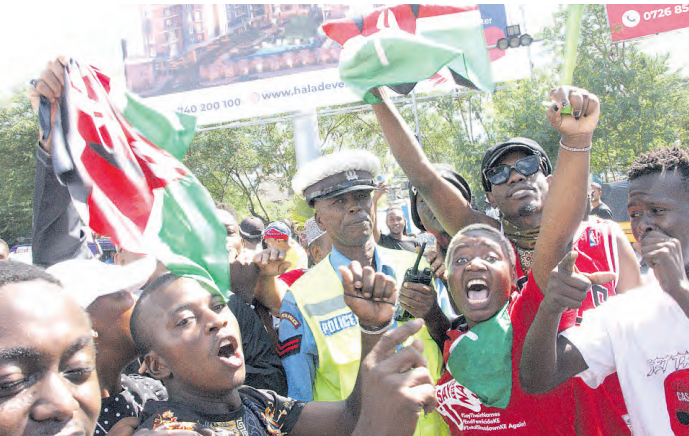
 Geoffrey Mboya, Willie Oeba and Tuko Kadi movement founder Allan Ademba march in Moi Avenue, Nairobi, to rally Gen Z to turn up for voter registration, April 14, 2026 /LEAH MUKANGAI
#TukoKadi, #RegisterNaMbogi are among current messages urging newly eligible voters to register for the upcoming general election next year.
How this message is supposed to reach the majority of voters, regardless of age, urban or rural, social class and education level is a matter requiring serious discussion, and hopefully, an urgent change in messaging.
In Kenyan sheng, “mbogi” simply refers to a group, crew, or squad of people, usually friends or peers who share a common bond, hang out together, or identify with a certain lifestyle or neighbourhood. It is a beautiful term that kind of carries a sense of belonging and identity, especially among youth. For example, saying “mbogi yangu” means “my crew” or “my people.”
This term, however, is mainly known by very few, mainly Gen Z and Alpha youth, from certain social societies among Nairobi’s middle to lower income groups. So #RegisterNaMbogi is a creative initiative by Independent Electoral and Boundaries Commission, calling on youth peers and friends to register.
As Kenya undertakes the ongoing Enhanced Continuous Voter Registration, led by the IEBC, the urgency of building an inclusive voter register cannot be overstated. Launched on March 30 and running for 30 days, the exercise targets at least 2.5 million new voters across the country. While early figures show encouraging turnout, a critical gap exists, not just in participation, but in how voter registration is communicated to the public.
For years, civic messaging in Kenya has largely focused on youth, particularly, currently the Gen Z faction of the youth and first-time voters. This is understandable.
Kenya has a youthful population, and millions are newly eligible to vote. However, this narrow focus overlooks other critical demographics: middle-aged citizens who may have disengaged from politics; youth from social strata who do not understand deep sheng; older voters who need that phone call to act and need assistance with registration, and marginalised groups that are structurally excluded.
Recent efforts by the the electoral commission have emphasised inclusivity, calling on leaders and stakeholders to mobilise communities at the grassroots level and ensure “no eligible voter is left behind.”
This should then inform IEBC’s awareness efforts to ensure proper communication such that no voter regardless is left behind through use of common words known by the wider population across the country.
First, communication should strive to address the voter apathy we have had over the years across all age groups. Many Kenyans, not just the youth, feel disillusioned by unmet political promises, electoral disputes, economic inequalities and governance challenges. Without first rebuilding trust in the electoral agency to deliver the choice of the people, voter registration may not be as high as expected.
Second, messaging must be localised and practical. While registration centres have been decentralised to wards, Huduma centres and institutions, not all citizens understand that they can register anywhere and choose their preferred polling station. Clear, simple and multilingual communication using English, Kiswahili and local tribal languages through radio, community leaders and religious institutions can bridge this gap.
Third, it is necessary to reframe voter registration as a lifelong civic responsibility, not a one-time rite of passage for young people. Democracy is sustained not just by new voters, but by consistent participation across generations, who then carry on the civic responsibility to their descendants.
Forth, using popular musicians to deliver voter registration messages through songs can powerfully mobilise citizens, and inspire diverse audiences to participate in democracy.
Finally, storytelling through the messaging just has to evolve to everyday issues such as cost of living, education, healthcare among other issues. Kenyans need see themselves in the democratic process, and not popular words that will only communicate to a few from a certain social group.
Expanding awareness beyond youth is necessary. Because democracy, at its core, belongs to everyone.