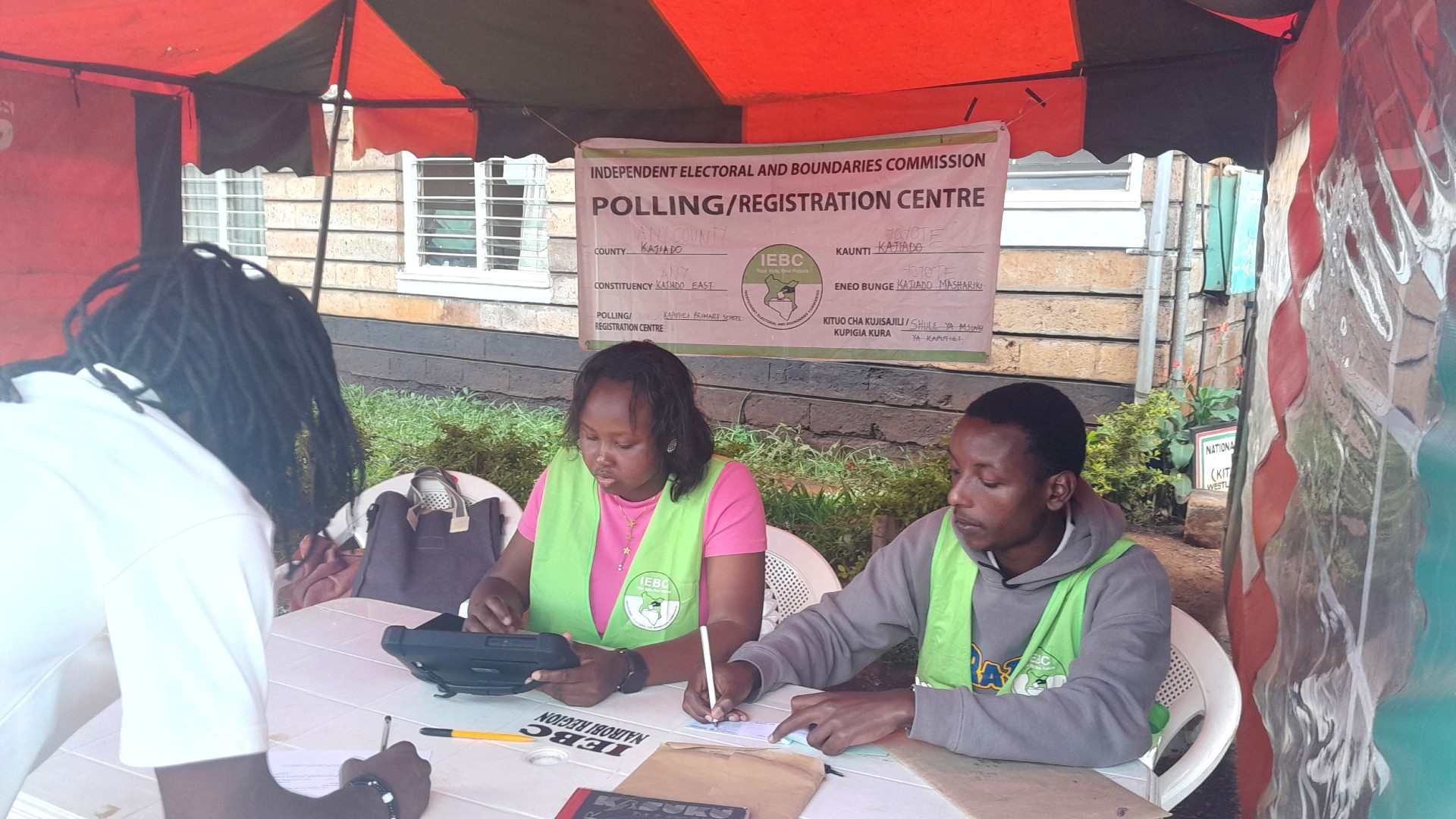
 Joy Githaiga, a voter registration assistant, and Halkano Mio Guyo, a voter registration clerk, attend to a member of the public during the ongoing Enhanced Continuous Voter Registration drive at Westlands constituency office in Nairobi on Wednesday, April 15, 2026
Youth apathy, legislative bottlenecks and a voter gap are undermining the Independent Electoral and Boundaries Commission's voter registration efforts.
More than a year before the 2027 general election, the commission has launched an ambitious multi-layered voter registration and sensitisation strategy, but registration numbers remain worryingly low.
Internally, the electoral agency underwent a specialised workshop in Mombasa to enhance commissioners’ knowledge of electoral legal frameworks, technology and results management.
Externally, the IEBC partnered with the media to combat disinformation and AI-generated deepfakes ahead of the 2027 polls.
To boost participation, the commission has conducted targeted campaigns for women aspirants in Machakos and engaged Gen Z and digital influencers to promote ‘truth-bait’ over ‘clickbait’.
This is in addition to holding virtual dialogues with the Kenyan diaspora and setting up public engagement stands at Agricultural Society of Kenya shows to demonstrate voter registration technology and polling procedures directly to citizens.
Yet, these efforts have not borne the desired fruit.
As of early this year, despite millions of Kenyans having received national identity cards, about 12 million eligible citizens remain unregistered.
The Enhanced Continuous Voter Registration drive, which runs until the end of April, has so far failed to close that gap.
“The youths have really come up to register, but we are still very far from our target, and we still urge them to come out and register,” Mutahi Gakuru, the IEBC registration officer for Westlands constituency, told the Star in an interview on Wednesday.
“There is a lot of apathy, especially among the youth. I don’t know, they don’t want to register for very flimsy reasons.”
Gakuru urged Kenyans, particularly first-time youth voters, to take advantage of the ongoing registration drive.
“The good thing is that any kit you see outside there can register as a youth from any part of this country. You don’t have to travel to your village; you can do it there,” he said. “If they want to have a voice in this nation—in its leadership and everything—there is no other way. It is just to register as a voter.”
The law permits registered voters to transfer their polling stations or change their personal particulars, but Gakuru explained why outreach centres cannot handle such requests.
“When it comes to transfers…and also change of particulars, that can only be done from the office. We change your particulars from the office also because we rely on a very private network that cannot be found in the wards.”
Concerns have also emerged about the 2012 register. Some voters have expressed fears thattheir details may have been deleted. Gakuru has rejected that claim.
“There was a statement that those who registered in 2012 are not in the register. No, those who registered are still in the register, but we still urge them to come and verify. The moment you verify, you know you are in the register, we remind you of your station, and then it’s not a big issue.”
Addressing confusion around online verification, the commission sought to allay fears.
“The kind of verification you are seeing... what they are finding ‘N/A’ is the registration stream. As of now, we cannot tell in which stream you will be.
“That one can only be developed when we really know how many people are registered. So long as your registration station shows…For now, every Kenyan should only be concerned about the registration centre.”
Among new voters, experiences have been mixed. Some found short or no queues, while others endured long waits with no shelter from the weather because the process is lengthy. Yet waiting did not deter them, especially those who mobilised peers and turned the experience into a fun event.
Some suggested going further, such as setting up registration in churches, marketplaces and anywhere citizens frequent, as these spaces would have existing infrastructure such as benches and washrooms.
Notably, new entrants were largely satisfied with the support and instruction from registration clerks, especially where young officers conducted the registration.
Bernard Omondi commended the registration clerks, saying they were "friendly, knowledgeable and helpful".
"Some of us have never voted before and the staff took us through, answering our questions satisfactorily. They were very patient, as it took about half an hour to fill out the form.”
They urged the commission to ramp up voter education efforts to increase uptake.
“I’ve personally not met any electoral commission conducting civic registration,” newly registered Patience Wambua told the Star.
Another new entrant, Victor Wanyoike, questioned why biometric details must be taken twice.
“This might be a stretch, when you register for your national ID, they take all your biometrics—your fingerprints, your palm prints, your signature—and that information is stored somewhere digitally or electronically on some sort of system. Now how come when we’re registering for voting we have to take those biometrics again?” Wanyoike said.
He added that the commission should have a system that enables them to verify biometrics instead of “duplicating” the same.
“It would greatly ease the whole registration process if all you had to do is fill in your name, personal credentials, where you live, where you want to vote—and then they use the biometrics that have already been gathered when getting an identification card instead of having to do all that again.”
He urged the commission to look into the issue and develop the system further to enable voters to register online, making the process faster and enhancing access.
A number of young people asked the IEBC to consider training them as volunteers to help in voter registration, pointing to low voter education as a likely reason registration remains low.
Apart from the ‘Niko Kadi’ movement, which has boosted youth numbers, various groups and organisations have voiced their support for voter registration drives.
In February, the Evangelical Alliance of Kenya pledged to use the pulpit to promote ethical leadership and encourage congregants to register.
Faith leaders are positioned as trusted voices to combat the trauma and mistrust associated with previous election cycles.
In March, university student leaders invited the electoral agency to set up registration hubs during campus ‘Cultural Weeks.’ This model was replicated across institutions of higher learning to capture the Gen Z demographic.
Despite this surge in stakeholder support, the commission warns that the ‘voter gap’ remains significant.
Currently targeting 2.5 million new registrations during this phase, the commission's long-term goal is reaching 28.5 million voters by 2027.