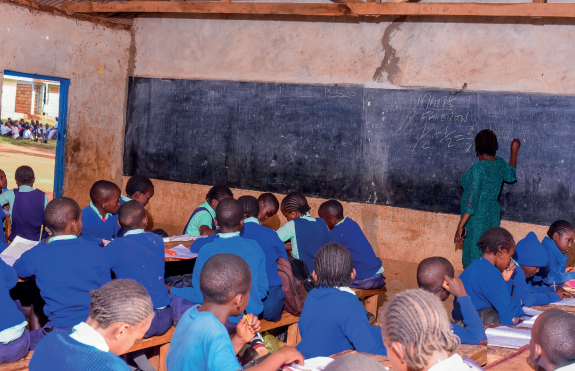
 A teacher in class at a school in Kenya. /FILE
Teachers' pay has long been a volatile and deeply contested issue in Kenya, repeatedly triggering strikes, court battles and sustained discontent among educators.
At the centre of the disputes are the Kenya National Union of Teachers (Knut) and the Kenya Union of Post Primary Education Teachers (Kuppet), often locked in negotiations with the Teachers Service Commission (TSC) and the government over salaries, allowances and career progression.
The signing of the 2025–29 Collective Bargaining Agreement (CBA) introduced salary increments of up to 29.5 per cent, which the teacher employer lauded as progressive.
“The salary review is designed to bridge the wage gap between the highest- and lowest-paid teachers in the public education sector, a move welcomed by the unions as a significant step towards fairness and equity,” noted TSC.
While the teacher employer described the CBA as progressive—particularly for prioritising lower-cadre teachers—disquiet persists across the profession.
Teachers argue that the gains have been eroded by new statutory deductions, including the housing levy, leaving many with unchanged or even reduced take-home pay.
Many educators feel shortchanged and will be pushing their unions to press for better pay once negotiations for the 2028-29 cycle open.
The current CBA, signed in July 2025, provided salary increases over a four-year period.
It's a public document, but its details—especially on job groups and salary structures—remain unclear to many Kenyans.
Misconceptions persist, including the belief among some that all teachers earn similar salaries or that subject specialisation, such as STEM, directly determines pay.
In reality, teacher remuneration is structured around clearly defined job groups under four broad categories: Lowest, Mid-Level, Administrative/Senior and Highest.
These classifications determine basic pay, alongside additional benefits such as house, hardship and commuter allowances.
At the base is Job Group B5, the entry level for primary school teachers. Teachers at this level, designated as Primary Teacher II, earn between Sh28,620 and Sh37,100, making it the lowest-paid category.
The mid-level cadre comprises Job Groups C1, C2 and C3. C1 includes Primary Teacher I and Secondary Teacher III, with salaries ranging from Sh35,000 to Sh47,000.
This job group is the entry point for secondary school teachers. In Job Group C2, which covers Senior Teacher II, Lecturer II, Special Needs Education Teacher II and Secondary Teacher II, monthly earnings range between Sh41,400 and Sh57,200.
Those in Job Group C3, designated as Senior Teacher I and Secondary Teacher I, earn between Sh49,700 and Sh66,200.
Above this is the administrative and senior tier, spanning Job Groups C4, C5, D1, D2, D3 and D4.
In Job Group C4, which includes Deputy Head Teacher II and Secondary Teacher I, salaries range from Sh58,500 to Sh77,100.
Job Group C5 covers Headteachers and Senior Masters, earning between Sh69,700 and Sh96,100.
Promotion to Job Group D1—comprising Deputy Principal II and senior head teachers—raises pay to between Sh80,900 and Sh99,200.
Teachers in Job Group D2, including Deputy Principal I and Senior Master I, earn between Sh95,700 and Sh116,000.
Principals fall under Job Group D3, with salaries ranging from Sh109,000 to Sh133,300.
Senior principals occupy Job Group D4, earning between Sh121,700 and Sh150,700, marking the upper end of the administrative cadre.
At the apex are chief principals in Job Group D5, the highest-paid teachers under the current CBA. Salaries in this category range from Sh135,000 to Sh167,400.
The revised salary structure reflects years of agitation by teachers and prolonged negotiations between unions and the government, even as debate over fair compensation continues.