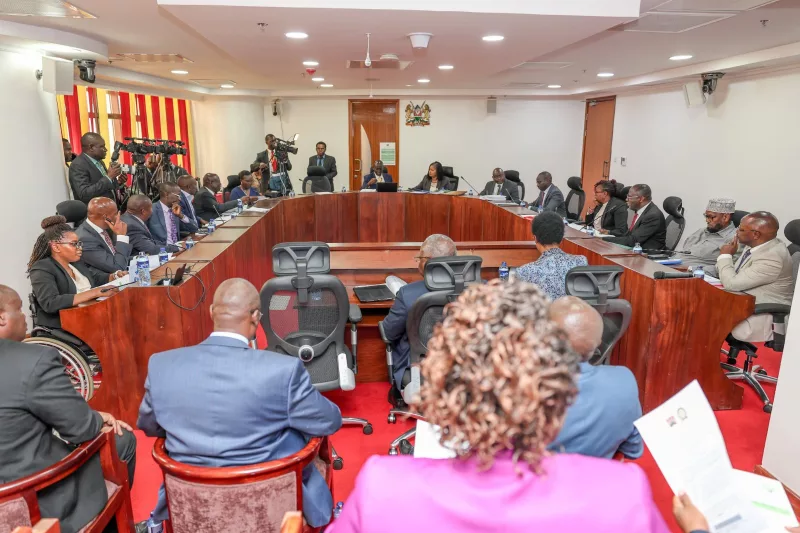
 National Assembly Committee on Education chairperson Julius Melly during sittings on April 14, 2026. /PARLIAMENT
A Parliamentary Committee has raised legal and institutional concerns over proposed amendments aimed at improving the welfare and pay of Early Childhood Development Education (ECDE) teachers, even as it acknowledged the need to address longstanding disparities in the sector.
The National Assembly's Departmental Committee on Education considered the Early Childhood Education (Amendment) Bill on Tuesday, April 14, interrogating provisions that seek to compel county governments to enhance the welfare of ECDE teachers in public institutions.
The Senate Bill No. 54 of 2023 sponsored by Homa Bay Senator Eddy Oketch is anchored on findings contained in a Senate report tabled in the National Assembly on May 2, 2024.
It seeks to amend the Early Childhood Education Act, No. 3 of 2021, in order to provide for the improved remuneration and better welfare of teachers serving in early childhood centers in the counties.
The report highlights systemic gaps in the management of ECDE teachers, noting that recruitment is currently undertaken by county governments through County Public Service Boards.
The boards are mandated to recruit ECDE teachers from a pool of teachers registered by the Teachers Service Commission (TSC) and to ensure that recruitment policies are fully implemented.
Despite this framework, the report observes that county governments have fallen short in supporting ECDE teachers beyond hiring.
It points to the lack of structured professional development opportunities, limited investment in equipping teachers with skills and tools for effective learner engagement, and the absence of compensation for those who undertake further training or upgrade programmes.
To address these gaps, the Bill proposes several amendments. Clause 1 seeks to revise Section 31 of the Act by making teacher welfare a core function of boards of management of early childhood education centres at the county level.
Clause 2 proposes changes to Section 38, introducing additional parameters to guide the determination of remuneration for ECDE teachers.
These include the inflation rate, minimum wage, and cost of living, factors that would be considered alongside existing frameworks by county governments and the Salaries and Remuneration Commission.
"For avoidance of doubt, no county government shall pay early childhood education teachers' salary and allowances less than the remuneration and benefits structure advised by the Salaries and Remuneration Commission," said the Senate's Standing Committee on Education, chaired by Senator Joe Nyutu, in its report dated April 25, 2024.
However, it is these provisions that triggered concern from the National Assembly committee.
While the proposals are intended to strengthen oversight and improve working conditions, the committee raised concerns about the potential for regulatory duplication and ambiguity, particularly in defining the scope of authority among various institutions involved in teacher management and compensation.
The committee observed that introducing parallel considerations in determining pay for ECDE teachers could potentially lead to institutional conflict between the Salaries and Remuneration Commission, the Ministry of Labour, and the Teachers Service Commission.
Such overlaps, the committee warned, risk undermining the clarity and uniformity required in public sector remuneration.
The Bill also introduces teacher welfare as one of the areas under which the Cabinet Secretary may set minimum standards.
Clause 3 proposes amendments to Section 68 of the Early Childhood Education Act, 2021, to empower the Cabinet Secretary to prescribe minimum standards relating to schemes of service for ECDE teachers.
The Bill’s sponsor, Homa Bay Senator Eddy Oketch, defended the proposals, arguing that they are necessary to address persistent inequalities in the treatment and remuneration of ECDE teachers across counties.
The intention, he notes, is to harmonise earnings and reduce disparities among public service workers at the county level, ultimately creating a more equitable system.
Concerns over the pay disparities were supported by findings from the Senate Standing Committee on Education, which in its report tabled on April 25, 2024, cited wide variations in ECDE teachers’ salaries across counties.
The committee noted that although the Salaries and Remuneration Commission had conducted a job evaluation and outlined job groups and corresponding pay structures, the implementation remains inconsistent, with remuneration failing to adequately reflect teachers’ qualifications.
To address these inconsistencies, the Senate committee recommended amendments to Clause 2, proposing the deletion of the new subsection 2A and its replacement with a provision requiring county governments to adhere strictly to salary and allowance levels advised by the Salaries and Remuneration Commission.
Despite the concerns raised, the committee acknowledged that the Bill has the potential to significantly improve the welfare of ECDE teachers.
Nyutu and his team noted that by addressing remuneration gaps and enhancing working conditions of ECDE teachers, the proposed law could boost their morale and, in turn, improve the quality of early childhood education.
The deliberations now set the stage for further parliamentary consideration, where lawmakers will be required to balance the need for better pay and welfare for ECDE teachers against the imperative of maintaining a coherent and conflict-free regulatory framework.